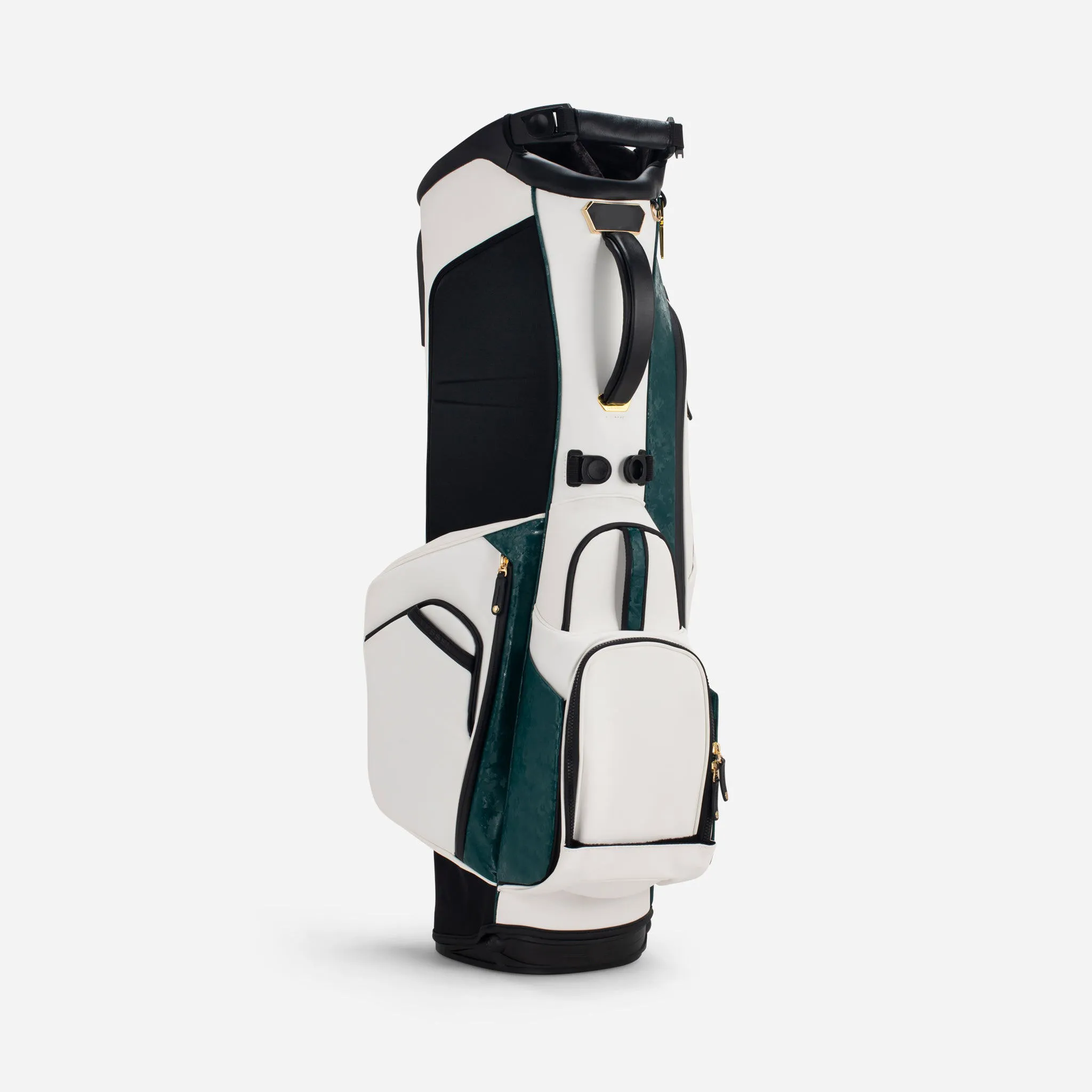
Practice golfers can also browse our range and simulator golf bags — A well-built 6-way top separator gives you full club separation with a divider system that adds only about 60-80 g versus a 14-way full-length top, so a carry-weight golfer keeps a 4.0-4.5 lb bag without trading away grab-and-draw access to 14 clubs. For a B2B buyer, the 6-way is the compromise configuration that balances organization, weight, and cost — our SGS-verified Quanzhou affiliated plant (4,950 sqm, 7 lines, 149 machines, 137 staff) builds these with half-length flexible wedges that stop club-head clatter while keeping the top well under the weight budget of a 14-way tower.
Key Takeaways
- A 6-way top typically saves 120-160 g versus a 14-way full-length tube system while keeping 95% of usable separation for the average 14-club set.
- The two deepest bottom slots are the engineering challenge — they must hold woods without tangling grips in the pocket below.
- Wedge material, rail height, and base-plate alignment drive both separation quality and cost; a 6-way runs roughly 8-12% cheaper in molded top tooling than 14-way.
- Clubs still cross grips when wedges are too low — we hold rail height to 38-42 mm to prevent that at QUANZHOU JUNYUAN BAGS.
Specification Table (Whitepaper View)
Use this table as your internal 6-way separator spec. Confirm each row on a pre-production sample and lock the values before bulk so reorders stay within tolerance.
| Parameter | Typical Spec | Buyer Notes |
|---|---|---|
| Top configuration | 6-way: 4 slots + 2 deep bottom slots | A clear 4-2 split keeps woods separated and grips clear of wedges. |
| Wedge material | EVA or closed-cell foam, 6-10 mm | Flexible wedge radius reduces club-head chatter without adding rail weight. |
| Rail height | 38-42 mm above top rim | Below 35 mm grips start to cross; above it clubs bind when drawing out. |
| Full-length option | Semi-full or half-length (optional) | Full-length tubes add 100-160 g; 6-way is the lightweight alternative. |
| Top weight budget | 180-260 g complete top assembly | Includes collar, rails, wedges, and trim ring. |
| Alignment tolerance | +/-2 mm rail-to-plate registration | Misalignment causes clubs to sit crooked and wear dividers unevenly. |
| Stand integration | Top must clear the hinge block on deploy | Confirm divider bottom does not collide with the leg mechanism at full extension. |
Why 6-way is the classic carry-bag separator
A 6-way top is the industry-standard balance for a walking golfer. It separates clubs into two logical rows — the four shallow slots for irons/wedges and the two deeper bottom slots reserved for woods and the putter — so a player can identify a club by touch and pull it without looking down. The trade-off against a 14-way is weight and depth: where a 14-way full-length tube package can add 120-160 g on the top alone, a 6-way with half-length EVA wedges adds roughly half that, which is why most sub-4.5 lb stand bags default to a 6-way or a 4/5 hybrid rather than a 14-way tower.
From a manufacturing standpoint the 6-way is also the most repeatable configuration to tool. The molded top collar for a 14-way needs more injection points, tighter draft angles, and a more complex base plate, all of which increase tooling cost and reject rate. A 6-way collar is a simpler two-row partition, so tooling cost runs roughly 8-12% lower and the per-unit defect rate for divider misalignment drops because there are fewer moving ridges to register. For a retailer with three or four price points, the 6-way is the confident mid-tier workhorse.
Club separation physics: what actually stops tangling
Separation is not about the number of slots; it is about grip clearance and head capture. Golfers feel "no grabbing" when two conditions hold: the wedge or rail rises high enough to separate shafts at grip height, and the slot bottom tapers so club heads do not wedge into each other at the bottom of the pocket. In our build we hold rails at 38-42 mm above the collar and use an EVA wedge that compresses under head pressure but recovers, so heads settle into independent chambers instead of stacking on top of one another.
The deeper bottom slots deserve the closest attention. In a 6-way, the two long slots share the deepest cavity with the apparel pocket below, so a driver and a 3-wood can collide if the pocket floor is not partitioned. We solve this with a small EVA bump divider inside the lower cavity that keeps the two bottom clubs from crossing grips during a carry. Without that internal bump, two woods rotate toward each other the moment the bag goes on a shoulder, and the buyer on the course feels constant grabbing no matter how good the top looks.
Wedge and rail materials: EVA vs closed-cell foam
The separator that touches your clubs should be soft enough to absorb contact but stiff enough not to fold over time. We use two families: EVA (ethylene-vinyl acetate) in a 6-10 mm thickness for the flexible wedge face, and a denser closed-cell foam for the full-length sections where structural rigidity matters. EVA recovers well after repeated head impacts and stays dimensionally stable through heat and humidity cycles, which is why it outperforms cheaper open-cell foam that crushes permanently under a heavy club set.
For a buyer the decision is a cost-versus-lifetime trade. A full EVA system adds roughly 30-50 g and $0.40-0.70 in component cost per bag versus a thin laminated foam. We recommend EVA on the wedge faces in every configuration because the human wear point is exactly there — a player plants the bag, clubs crash onto the wedge, and a cheap foam flattens in a season. The small cost buys several seasons of "no grab" feel that a retailer can photograph and that reduces post-sale complaints about club damage.
Weight reduction levers in a 6-way top
Because the 6-way is a lightweight answer, every gram matters, and there are four levers we control: wedge thickness, rail height, collar material, and whether dividers are half-length or full-length. Trimming wedge thickness from 10 mm to 7 mm saves about 15-20 g with a small penalty in cushion; shortening the rails from full-length to half-length saves another 40-70 g; a polypropylene collar instead of a heavier ABS collar can save 20-30 g.
The buyer should set a hard weight target before sampling — for example "6-way top must hold the total bag at or under 4.4 lbs" — and then the factory can iterate the levers to land inside that budget. Without a target, a factory optimizes for cost and durability and quietly lets the bag creep up half a pound, which defeats the entire reason a buyer chose a carry bag. We always build to a locked target weight tolerance of +/-0.1 lb (45 g) on the top assembly.
Material play and waterproof considerations
The 6-way interaction with the shell matters too. On a 600D nylon or ribstop shell, the top collar is usually a molded part that anchors directly under the lid, and the divider depth is set so moisture that runs down club shafts drains past the collar rather than pooling at the base of the bag. In a stand bag, the base plate has drainage vents, and the bottom of the divider cavity should align with those vents so water wicked down the club shafts leaves instead of sitting on the dividers.
If your program includes a waterproof or TPU-laminated shell, the 6-way still works but the divider insert must remain breathable — a fully sealed divider traps condensation and mildews the pocket. Our affiliated plant uses a mesh-backed wedge on waterproof builds so the divider protects clubs while still allowing air movement. Confirm the divider material couples with the shell waterproofing: a waterproof shell with a non-draining 6-way divider undercuts the whole weather story.
Aligning with the stand mechanism and base plate
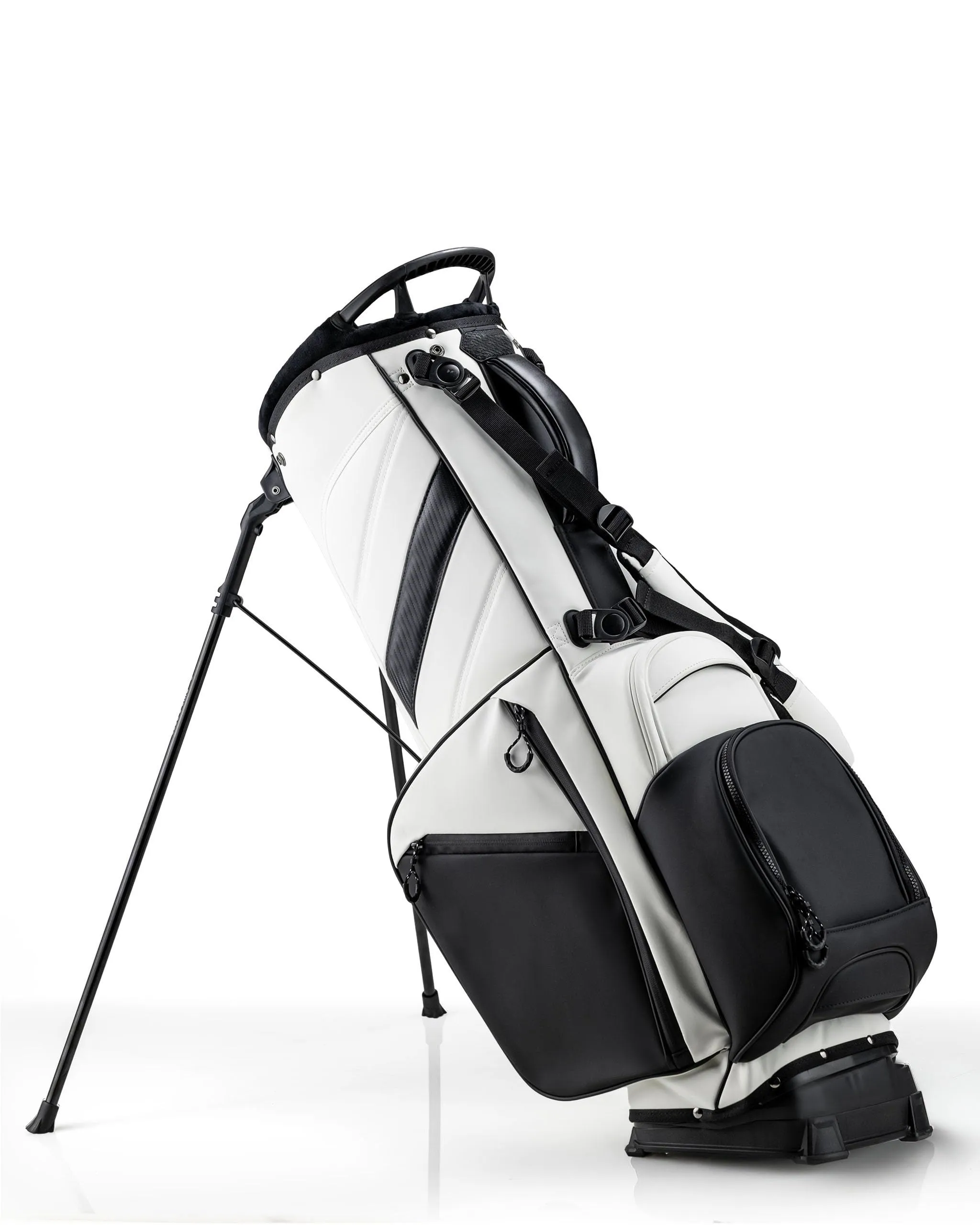
A 6-way top that clears the stand hinge is the difference between a clean deploy and a jam. When legs deploy, the hinge block rotates forward and the top rim must sit clear of that travel, or the divider base presses against the mechanism. We test every configuration with the dividers installed on a full stand chassis, checking that the deepest slots do not contact the hinge at full leg extension and that there is at least 6-8 mm of clearance under the collar.
Coordinate the divider depth with the base plate geometry on the same tech pack. A stand bag base plate is usually a stiffer, deeper floor than a cart bag floor because it carries the leg anchor and the weight distribution of a standing bag. If the 6-way divider is drawn to the wrong floor depth, clubs sit crooked, the bag tips differently on the stand, and the buyer perceives poor quality even though the top itself is fine. Always ship the divider drawing and the base-plate drawing on the same revision so the supplier builds them to one coordinate system.
Test Plan and acceptance criteria
Validate a 6-way top with functional tests, not just a visual check. The pass/fail set below is what we run in-house on every configuration before it leaves our Quanzhou facility:
- Grab test: draw each of 14 clubs out 50 times; zero grip-catch is the pass.
- Head separation: shake-loaded drop of a loaded bag, 100 cycles, heads must not stack.
- Rail height check: verify 38-42 mm with a height gauge on 20 units per lot.
- Wedge compression: 3,000 load cycles, EVA recovery within 5% of original.
- Stand clearance: deploy legs 2,000 times, no divider-base contact.
- Weight audit: top assembly within +/-45 g of the locked target.
Where the 6-way sits in your catalog
The 6-way is not the cheapest (a 4-way is lighter) nor the most organized (a 14-way wins on organization), so position it deliberately. In a three-tier catalog, the 6-way is the natural mid-tier: lighter than a 14-way, more oganized than a 4-way, and visually identical to the premium bag so the line reads coherently. Retailers use it as the "walking golfers' standard" and upsell the 14-way only where a player prioritizes instant separation over weight.
For an OEM program we often recommend the 6-way as the volume architecture because it tests well, holds a full 14-club set, and stays under the 4.5 lb weight story that dominates carry-bag marketing. It is also the most forgiving architecture for private-label branding — the generous front panel gives room for a hero logo without crowding the divider footprint.
Divider depth, shock absorption, and your cost model
Divider depth is a cost line item most buyers overlook until the second quote. Deeper dividers need more molded collar material, a taller base plate, and often a heavier EVA wedge, which together can shift unit cost by 3-6%. On a 6-way this is where a factory either wins or loses margin: a well-designed half-length wedge achieves the same grab-free feel as a full divider at a fraction of the material weight, so the buyer who understands depth can keep a sub-4.5 lb bag without paying for a full-length premium architecture.
Match depth to the club-length profile of your target player. A standard men's set has woods and the putter at the deepest; a junior or women's set runs shorter, so the same 6-way mold can be deepened in the two bottom slots by 25-35 mm without a new tool if the design keeps a modular pocket floor. When a buyer tells us the shaft-length range and the grip count, we size the divider cavity so a fully loaded bag still sheds water and keeps clubs upright, which is what stops premature divider wear and grip abrading against the collar.
| Divider Option | Approx. Top Weight | Unit Cost Delta | Separation Feel |
|---|---|---|---|
| 4-way (lightweight) | 140-190 g | Baseline | Two clubs can share a slot; grips tangle occasionally |
| 6-way half-length | 180-260 g | +4-7% | Full 14-club separation, minimal weight penalty |
| 6-way full-length | 240-320 g | +8-12% | Best grab-free feel of the 6-way family |
| 14-way full-length | 320-420 g | +15-22% | Max organization, heaviest top |
Simulating real course load before you buy
Static dividers look fine on a bench but fail under a moving bag. The realistic test is a loaded bag — 14 clubs, towels, balls, rain gear — carried and set down repeatedly, because that is when clubs slam into the wedges and the whole top shifts. We run a loaded drop-and-recover test on the first article: drop the loaded bag onto its stand 100 times from a 150 mm height and confirm the dividers return to true and no wedge tears. This catches the defect that a photo-level sample never does.
We also measure how the 6-way behaves when clubs are removed and replaced in rapid succession, which is the actual motion a golfer repeats roughly 90-110 times a round. If the puckering or wrap of the collar material shifts the rail positions over those cycles, the bag will grab by the third round. Buyers should ask for a 200-cycle grab test on the sample and a video of it before approving bulk, because that single test filters out most cheap 6-way tops.
Common 6-way defects and how to prevent them
The three failures most common in cheap 6-way tops are wedge collapse, rail detachment, and grip-pinching at the collar seam. Wedge collapse happens because open-cell foam crushes under repeated head impacts; the fix is EVA at 6-10 mm. Rail detachment usually traces to the rail being glued rather than heat-bonded or stitched into the collar; the fix is a positive mechanical or ultrasonic weld. Grip pinching at the collar seam appears when the molded collar has a sharp internal flash line; the fix is a polished draft with a 0.5 mm radius on the parting line.
We put all three on the inline QC sheet and check a sliding sample every 200 units during production, not just the final random 20%. Catching rail detachment at inline means it is fixed on the line before two thousand bags inherit it; catching it at final inspection means a rework loop and a late shipment. This is why our affiliated plant builds a defect-prevention check into production rather than relying only on end-of-line inspection.
Sourcing workflow for a 6-way stand bag
Bring the 6-way to life in four steps. First, set the hard weight target and divider configuration in a one-page brief. Second, approve a material and wedge stack so the factory can source the exact EVA and collar resin. Third, request a pre-production sample with the rails measured and a grab test performed on the production fabric. Fourth, lock the QC table in the tech pack so bulk matches the sample. At QUANZHOU JUNYUAN BAGS we support OEM (your artwork on proven 6-way architectures) and ODM (co-developing the divider depth, pocket floor, base plate, and stand integration).
Because the 6-way touches so many subsystems — top, base plate, stand, pockets — the fastest buyers brief all of them in one exchange rather than iterating sequentially. Send the target market, expected MOQ, divider layout, weight budget, and reference photos together. Our affiliated plant quotes faster and samples more accurately on a complete brief, which is the difference between a 10-20 day sampling loop and a two-month ping-pong.
Retailer selling story for the 6-way
Give your retail partners a selling story the 6-way earns on its own. The pitch is not "fewer dividers, cheaper bag"; it is "full 14-club separation without the weight of a 14-way tower," backed by the 38-42 mm rail height and the sub-4.5 lb carry weight. A retailer can photograph the two deep bottom slots holding woods cleanly and show the four shallow slots keeping irons spaced, which is a stronger visual than a generic catalog shot.
The 6-way also reduces post-sale friction. Because grips stop crossing and club heads stop clattering, buyers return fewer bags for "divider grab" complaints, and the EVA wedge survives a season of daily use without flattening. For a private-label brand that dollar and reputation math — fewer returns, higher carry-feel satisfaction — is exactly why the 6-way stays the carry-bag volume architecture at QUANZHOU JUNYUAN BAGS. Keep the spec locked and the same 6-way mold serves multiple seasons and multiple retailer tiers.
Final note on the 6-way separator
A 6-way divider is not a compromise you apologize for; it is the engineering answer to a very specific question — how to separate 14 clubs while keeping a sub-4.5 lb walkable bag. The rails, wedges, collar, and base plate are a single coordinated system, and the buyers who lock them into one tech pack get a repeatable architecture that samples fast and ships consistent batches. Whether you need a 6-way for a walk-friendly volume line or a 14-way for a premium organizer, start with the divider spec and the weight budget, and our affiliated plant will recommend the configuration that survives real rounds at the right cost. Reach us at service@junyuanbags.com.
Recommended Internal Links
- Products (Stand Bag Architectures)
- 14-Way Divider Stand Bag
- OEM/ODM Service
- Factory & QC
- Golf Stand Bag Buying Guide
- ultralight stand bags
FAQ
Is a 6-way divider enough for a full set of 14 clubs?
Yes. A 6-way holds a full 14-club set, with four shallow slots sharing irons and wedges and two deep bottom slots dedicated to woods and the putter. It gives 95% of the separation of a 14-way while staying 120-160 g lighter.
Why does a 6-way weigh less than a 14-way?
A 14-way full-length tube package has more rails, more molded collar mass, and a heavier base plate, adding roughly 120-160 g on the top. A 6-way uses half-length EVA wedges and fewer rails, which is the entire point for weight-sensitive carry bags.
What rail height prevents clubs from crossing grips?
Rail height of 38-42 mm above the collar stops grips from crossing during a carry. Below 35 mm grips start to tangle; above it clubs can bind when being drawn out.
Can I put a 6-way top on a waterproof stand bag?
Yes, but the divider must be mesh-backed and breathable so condensation does not build up inside a sealed shell. A waterproof shell with a non-draining divider traps moisture and can mildew the pocket.
How do I keep my 6-way divider reorder consistent?
Lock the rail height, wedge material, and alignment tolerance (+/-2 mm) in the tech pack, approve a pre-production sample, and keep a sealed master. Then a reorder is repeatable to the locked spec.
Does the 6-way divider interfere with the stand mechanism?
Not if the divider base clears the hinge block at full leg extension. We test with the dividers installed and hold at least 6-8 mm of clearance under the collar to prevent jamming on deploy.
Request a B2B quote for golf stand bags
Send your target market, expected MOQ, and reference photos. We respond within 24 hours with a sampling plan.