Practice golfers can also browse our range and simulator golf bags — For a competitive golfer, the defining specs are a 3.8-4.5 lb carry weight, full-length 6/7-way dividers to stop club tangling, a tour-grade stand tested to 3,000 deployments, and a moisture-resistant shell — performance levers that shave strokes and fatigue when the round matters. This B2B sourcing guide breaks down the high-performance architecture our affiliated Quanzhou factory (SGS-verified, 4,950 sqm, 7 lines, 149 machines, 137 staff) uses for competitive lines, the measurable QC gates that separate a tournament bag from a weekend one, and how to brief OEM or ODM without overpaying.
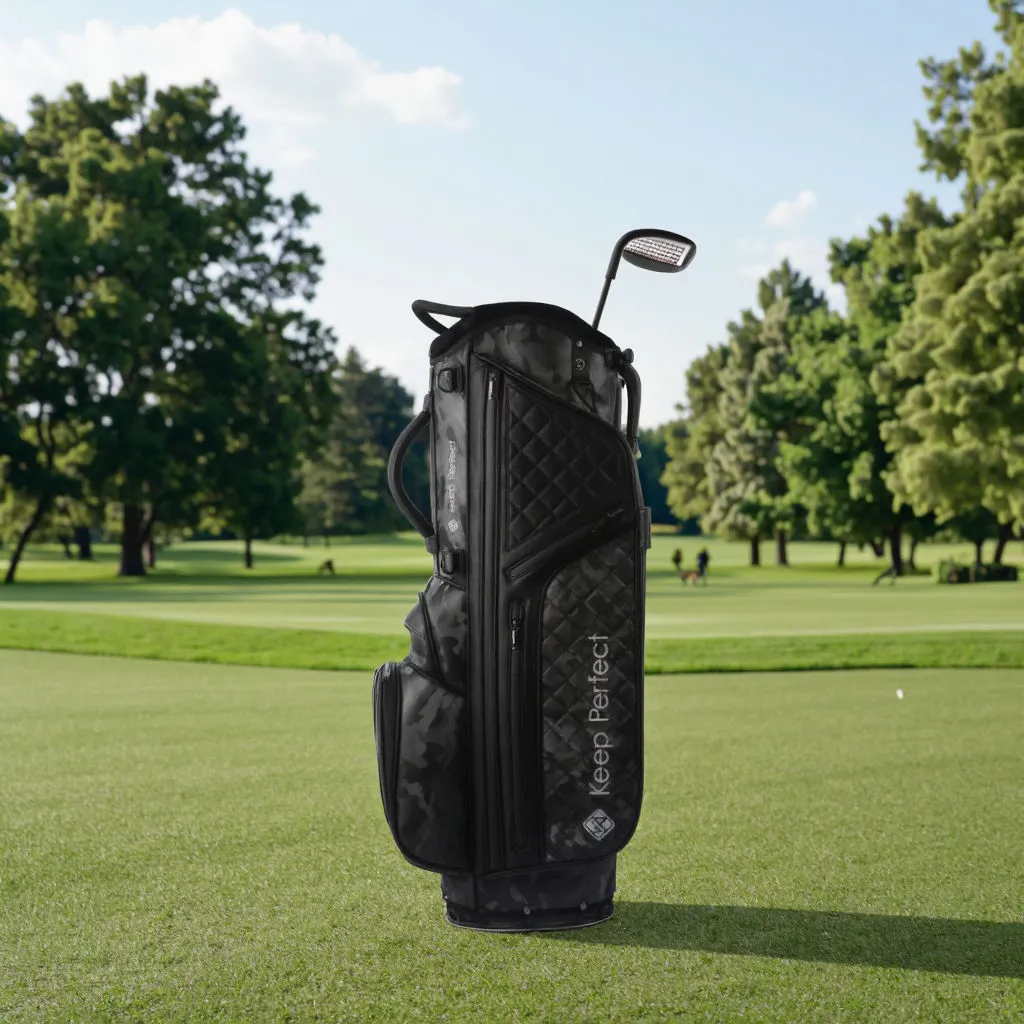
Key Takeaways
- A competitive carry weight of 3.8-4.5 lbs plus full-length 6/7-way dividers is the core performance recipe; weight and organization are the two levers a serious player feels most.
- A tour-grade stand needs a reinforced composite hinge and a 3,000-cycle test; the hinge is the most failure-prone part and the first thing to spec defensively.
- Moisture management comes from a water-repellent 420D/600D shell, covered valuables pocket, and quick-drain details rather than a heavy full TPU laminate.
- Performance comes from disciplined QC at the same material cost as a tour build — test the hinge, straps, and drop standard before you ship.
What a competitive golfer actually optimizes for
Competitive golfers are a small but disproportionately influential segment: they buy more, practice more, and their gear is watched by every shop and every amateur in their club. Unlike the casual player who wants simplicity, a competitive player optimizes for performance in three measurable buckets — carry weight, club organization, and forgiveness during high-frequency use. Each maps to a specific design decision, and each is verifiable in a spec sheet rather than a marketing claim.
The competitive round is also a different physical event. These players walk 18 holes regularly, practice at the range several times a week, and handle the bag hundreds of times per session. The bag is not a weekend accessory; it is a training tool that undergoes thousands of deployment, load, and carry cycles a season. That makes lifecycle durability — hinge cycles, strap anchors, zipper cycles, seam integrity — a genuine performance spec, not just a QC nicety. A bag that fails in week five on a competing golfer is returned, talked about, and photographed by a follower base.
There is also a merchandising truth worth exploiting: the competitive line sets the brand's technical credibility. It is the SKU that demonstrates you know weight engineering, full-length dividers, and stand mechanics. Even a buyer whose main volume is in entry or casual bags should keep a competitive hero model in the catalog, because it is the proof point that raises trust across the whole range and justifies the premium buyers will later place on mid-tier models.
Weight engineering: the 3.8-4.5 lb performance band
Competitive players walk and practice the most, so they are the most weight-sensitive audience of all. The target is 3.8-4.5 lbs empty, a band that holds the performance trifecta: light enough to carry twice a week, strong enough to keep full-length dividers and a durable stand, and stable enough to sit upright. Above 4.8 lbs you reintroduce the fatigue that quietly costs a player a shot on the back nine; below 3.6 lbs you start sacrificing shell toughness and stand reliability that competitive players depend on.
Reaching 3.8-4.5 lbs requires deliberate weight control across the bill of materials. The levers, in order of cost-effectiveness, are: a lighter 420D shell on non-wear panels, minimized interior lining, an aluminum-frame lightweight stand, and hardware gauge reduction on non-structural parts. The conflict a competitive buyer must manage is that the same audience also demands full-length dividers and a quick-deploy stand, which both add weight. So the engineering task is a negotiation — shave everywhere else so the features that matter can stay.
Production consistency is where weight targets are won or ralised. We pin the target with a tolerance like "4.2 lbs +/- 0.15" and verify on a mid-production weigh-in, because fabric-lot density and lining depth can silently add 3-5% to a claimed number. A competitive SKU that drifts heavy across lots will draw sharp complaints from the exact buyers who notice, so the weight record should be part of the inline QC, not an afterthought.
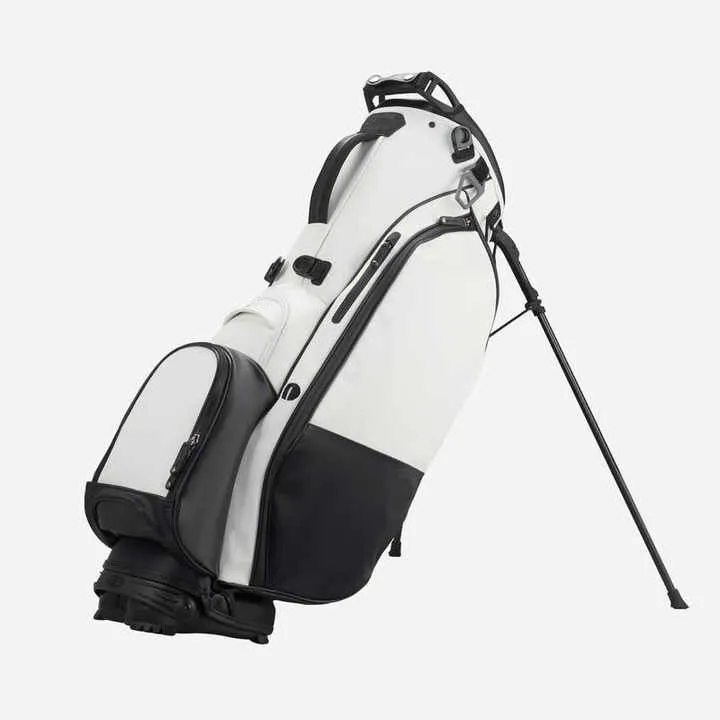
Dividers: full-length is the competitive baseline
Between shots, a competitive golfer pulls and returns clubs quickly, often while walking to the next lie. The divider must deliver clubs without tangling or grabbing two at once, which is precisely what full-length dividers solve. Full-length tubes run to the bottom of the bag, separating the club heads the whole depth and preventing the "clang" of heads colliding and the frustration of a snagged grip. For this audience, full-length dividers are not an option — they are the expected baseline.
The layout that balances organization and weight is a 6/7-way top: separate slots for driver/woods, a few iron zones, and a wedge/putter area, all full-length. A 14-way organizer gives maximum separation but adds notable weight and makes the top less forgiving for a player who grabs clubs by feel. Most competitive walkers prefer a well-designed 6/7-way full-length over a 14-way unless they are also playing off a cart. Offering both on the same shell is a clean way to cover the walk/cart split without two full tools.
Divider quality is a silent-substitution risk we watch closely. A factory may quote full-length and ship partial tubes to save material, and on a competitive line that defect is felt immediately. Lock the tube length as a percentage of bag depth (we hold 90%+ for true full-length), measure an actual production unit at first article, and photograph it for the QC record. When a serious golfer restocks a competitive bag, divider integrity is one of the first things they confirm at the shop.
The tour-grade stand: quick, stable, and 3,000 cycles
A competitive golfer deploys the stand on virtually every shot and is impatient with a slow or wobbly deploy. The stand must open in one smooth motion, lock firmly, and sit stable enough that the golfer does not glance back. That is a systems problem spanning the hinge block, the leg pump mechanics, the leg material, and the foot pads. A tour-grade stand is the difference between a bag that feels engineered and one that feels ordinary.
The technical recipe we hold is: a reinforced composite or aluminum hinge block, lightweight aluminum legs with steel pivot pins, a smooth quick-deploy spring captured so it cannot pop out, and rubber foot pads that bite on grass and hardpan. The measurable gate is a 3,000-cycle deployment test with no cracking, no loosening, and legs that lock every time. Competitive programs sometimes require 5,000+; 3,000 is a strong, honest floor that separates a real tour stand from a lightweight imitation.
Stability matters because competitive courses are not manicured practice ranges — they include slopes, hardpan, wet rough, and wind. The legs must hold on a 15-degree incline and resist tipping in a breeze. That comes from leg-spread width, a low center of gravity from the shell, and aggressive foot geometry. Naming the deployment angle, leg spread, and incline test in the tech pack is how you keep a light bag from being a tippy one.
Straps and carry feel for high-frequency walking
A competitive player may carry the bag for 5-10 practice and tournament rounds a week, so strap comfort is a pure performance feature. The band has moved to a dual, self-balancing EVA-molded strap that weight-shares across both shoulders and adjusts on the fly for different layers and postures. A strap that digs or shifts becomes a distraction at the exact moments a player wants to focus on the next shot.
The comfort levers are foam density and contouring rather than raw thickness. Over-thick straps add weight without proportionally better comfort; the right approach is contoured 10-14 mm high-resilience foam with a breathable mesh contact face that does not trap heat, plus a quick-adjust cam that holds through a round. The strap should be removable and washable, and its anchors must pass a static load test of 25-35 kg with no stitch failure, because a torn anchor is a competitive-program returns event.
For B2B planning, offer the standard dual strap on the base and a quick-adjust, extra-contoured version as the premium tier of the same shell. It is a low-cost way to ladder a competitive line upward and directly answers the first thing a serious walker evaluates — how the bag shoulders and distributes over two hours.
Moisture management, not full waterproofing
Competitive golfers play in mist, morning dew, and light showers, and they want gear that sheds moisture without the weight penalty of a full waterproof build. The answer is deliberate moisture management: a water-repellent 420D/600D shell with a durable water-repellent (DWR) or PU coating, a covered valuables pocket with a tight zipper cowl, seam taping at the highest-exposure points, and quick-drain details like a mesh bottom or a drainage grommet so a little unavoidable water does not pool.
The competitive line benefits most from protecting the things that matter: the clubs stay reasonably dry, the valuables pocket stays sealed, and the bag dries quickly after a damp round. That is achievable at a modest weight cost. Full TPU lamination is the dedicated all-weather path, and it typically adds 8-12% to cost and 0.4-0.6 lb of weight — a penalty most competitive walkers will not accept on their everyday carry bag. Keep TPU as a separate all-weather model, and let the primary performance SKU win on weight and breathability.
Drying behavior is a real QC point. A bag with hidden moisture traps (thick unlined foam pockets, taped-in linings) breeds mildew and odor in a competitive use pattern. Specify breathable lining in normally-ventilated zones and test that the bag returns to dry within a reasonable window, which keeps a competitive line smelling and performing clean all season.
Pockets the competitive player actually uses
A competitive golfer's pocket load is deliberate: a secure valuables pocket, one or two quick-access apparel pockets, a ball and tee pocket, a water sleeve, a rangefinder pocket with a soft microfiber liner and a secure closure, and often a small glove pocket. Access speed is the competitive difference — every pocket should open and close one-handed, with zipper pulls large enough to grab in gloves and a layout that does not require rotating the bag mid-shot.
The magnetic rangefinder pocket is a modern competitive favorite because it removes the fumble of unzipping a flap while lining up to a target. A magnetic closure with a soft liner keeps the rangefinder safe and instantly accessible. Similarly, a towel ring or magnetized towel attachment points keeps a towel within reach for grips and rain, which competitive players value far more than a decorative trim.
For cost and weight, cap the competitive line at 6-7 functional pockets. Each pocket is a seam, a zipper, and a QC point, and an over-loaded bag contradicts the weight target you set in the brief. Choose the pockets that serve the competitive motion — valuables, rangefinder, apparel, water — and leave cosmetic extras to the mid-tier. This keeps the pocket architecture honest and the bag light enough to perform.
High-performance spec table
Use this as the internal baseline for a competitive stand bag, then lock final numbers after sampling with your factory.
| Performance Block | Competitive Target | Why It Wins on Course |
|---|---|---|
| Carry weight | 3.8-4.5 lbs (tolerance +/-0.15) | Lowest fatigue over weekly practice and 18-hole walks. |
| Divider top | 6/7-way full-length (90%+ depth) | Stops club tangling and head clatter between shots. |
| Stand durability | Reinforced hinge, 3,000-cycle test | Quick, stable deploy on every shot and course slope. |
| Strap system | Dual self-balancing, contoured 10-14 mm foam | Comfort shades focus across high-volume rounds. |
| Shell material | 420D/600D DWR/PU, reinforced stress zones | Sheds dew and mist at a weight a walker accepts. |
| Pocket payload | 6-7: valuables, rangefinder, apparel, water, ball/tee, glove | Serves the competitive motion without bloat. |
| Moisture handling | Covered valuables, seam tape, quick-drain bottom | Protects gear and dries fast without full TPU weight. |
| MOQ / lead time | 200 pcs (100 pcs test); sample 10-20d, bulk 45-60d | Validates a performance model before tournament season. |
Competitive QC: gate what the player feels
A competitive line fails warranty at the same per-part rate as a lower-tier one, but the failure is amplified by an audience that returns, posts, and talks. The disciplined approach is to hold the competitive SKU to the strictest hinge, strap, and drop bars in your catalog — typically the same standards as a tour build — and let the premium margin come from lower volume and perceived value, not from cutting testing corners.
The acceptance gates map to what a serious player feels: the 3,000-cycle stand deployment test, a 25-35 kg strap anchor static load, zipper cycle and jam-rate on every pocket, a 15-degree-plus incline stability check, and a packed drop test covering corner/edge/face to the buyer's carton spec. We also verify weight on a mid-production unit and confirm full-length dividers on the first article of each run. Writing these as named tests with pass/fail numbers is how a competitive line stays honest.
Confirm the factory does inline inspection on the stand and strap subassemblies rather than only a final visual check. Catching a hinge or anchor issue in production beats dealing with it in warranty, and on a competitive line the reputational cost of a visible failure is far higher than the unit cost of the bag itself. This discipline is the entire value of sourcing from an SGS-verified plant like the one we work with in Quanzhou.
Briefing OEM or ODM for a competitive model
For a competitive line you are buying engineering judgment, not just production capacity, so the brief must be technical and specific. Send a one-page spec stating the target player (walk-heavy, practice volume, tournament cadence), the carry weight with a tolerance, the divider config and full-length requirement, the stand cycle and stability test, the strap spec, the pocket list, the material and moisture direction, and the MOQ and launch or event date. That precision lets the factory propose cost and weight levers instead of making assumptions.
Tell the factory whether you want OEM (your branding on a proven competitive architecture) or ODM (co-developing new divider systems, stand mechanics, or strap molds). At QUANZHOU JUNYUAN BAGS we support both from our affiliated Quanzhou plant, and we will flag any weight-versus-feature conflict before sampling so you do not pay for a redesign. Include your target market and expected MOQ with the RFQ, and reach us at service@junyuanbags.com or +86 17750020688.
A practical note: build the first production run toward a real competitive event or a shop demo calendar. A competitive SKU launches best when a few actual players use it in competition early — their feedback, photos, and on-course results are the marketing that sells the next thousand units far more than a spec sheet.
Hardware and finish details competitive buyers check
Competitive golfers notice the small hardware that casual players ignore, and these details are where a bag either looks engineered or looks generic. The zipper pulls should be large enough to grab in gloves and quiet enough not to rattle mid-swing; PVC-coated or anodized pulls with a low-profile shape are the common premium choice. The stand legs should sit flush when retracted with no protruding catch, and the hinge hardware should feel solid with no lateral play. Runners and closure plates should be color-banded to the shell so the bag reads as one cohesive design rather than assembled parts.
Stitching is another finish signal, and on a competitive line it is also a strength spec. Bar-tacking at stress points — the hinge surround, strap anchors, pocket corners, and zipper ends — prevents the seam-failure that causes returns. Competitive players grip and torque the bag constantly, so seam allowance and stitch density at load-bearing joints should be defined in the tech pack rather than left to the previous lot. We verify bar-tack presence and stitch integrity on the first article and on inline inspection, because a competitive buyer will find a single failed bar-tack in the shop.
Finally, consider the wear signature. A competitive bag that loses color at the bottom panel or scuffs visibly at the contact corners looks finished after one season even if it carries fine. Adding a scuff-resistant bottom wear panel and reinforced corner guards keeps the bag looking polished through a competitive lifecycle, which supports a premium price. When the finish, hardware, and stitching all read consistent, the bag earns the higher MSRP a competitive lineup demands.
Colorways and stocking strategy for a competitive hero SKU
A competitive line usually sells in fewer but more deliberate colorways, and the hero model sets the visual identity. Offer two to three sharp colorways per SKU — a classic black, a performance navy, and one accent or seasonal color — rather than a wide menu. Each colorway is a dye-lot and a QC point, and competitive buyers choose on confidence in the design. Approve a lab-dip or physical color chip per colorway and lock a Pantone reference so an accent trim never clashes across lots or between the hero bag and its accessories.
Stocking strategy should favor the hero routing: build the flagship competitive model ahead of the busy season or a major event window, and offer a 100-piece test order to validate a new colorway or a regional regulation before committing to full container volume. Because competitive volume is lower than casual volume, the factory's flexibility on MOQ and mixed-colorway consolidation is more valuable here than on a high-volume entry line. Ask about consolidating two colorways into one run to stabilize cost and inventory.
For retailers, the hero competitive bag is the one photographed in the window and the one used in comparison reviews. That means the color, the logo placement, and the silhouette need to photograph well on the front lower panel, away from the hinge and strap anchors. Pairing a memorable color way with a single clean logo placement gives the competitive SKU the shelf presence a serious player expects, and it reinforces the performance positioning every time the bag appears on course or in a review.
FAQ
What weight does a competitive golfer's stand bag need to hit?
A competitive carry bag should target 3.8-4.5 lbs empty. Serious players walk and practice often, so every 0.2 lb below the 5 lb mark meaningfully reduces fatigue; the floor is set by maintaining full-length dividers and a durable stand.
Should a competitive stand bag use full-length dividers?
Yes. Full-length divider tubes that run to the bottom prevent shaft tangling and club-head clatter between shots, which is exactly what a player does not want mid-round. A 6/7-way full-length top balances organization with carry weight.
What makes a stand tour-grade for competitive play?
A tour-grade stand needs a reinforced composite hinge block, lightweight aluminum legs with steel pivot pins, a quick-deploy mechanism, and a 3,000-cycle deployment test. It must deploy smoothly in one motion and stand stable on at least a 15-degree incline.
How do I manage moisture in a competitive stand bag?
Use a water-repellent 420D/600D shell, a covered valuables pocket, seam taping at critical points, and a quick-drain bottom or mesh pocket. A full TPU laminate is reserved for dedicated all-weather models because it adds weight a competitive walker avoids.
What is the most failure-prone part on a competitive bag?
The stand hinge, because it is deployed on every shot and carries the full bag weight. Reinforcing the hinge block, leg pins, and spring retention, then locking a 3,000-cycle test, prevents the most common competitive-program returns.
Can competitive specs be made without custom tooling?
Yes, for the most part. Full-length dividers, premium hardware, strap systems, and most shell materials are standard capabilities; you can OEM your brand onto a proven architecture or ODM co-develop new details. Only fully bespoke silhouettes require new molds.
What MOQ applies to a high-performance line?
A conventional order starts at 200 pieces, with 100-piece test orders to validate a new performance model first. Sampling runs 10-20 days and bulk production 45-60 days, so plan the calendar to hit a launch deadline or tournament season.
Related reading
- 14-way organizer and performance architectures
- OEM/ODM Service overview
- Factory & QC standards
- Golf Stand Bag Buying Guide
- Tour-grade features for professional players
Two final notes for a buyer launching a competitive line. First, anchor the brief on weight and the stand hinge, because those are the attributes a serious player verifies first and the two easiest to get wrong in production. Second, use the competitive SKU as your technical proof point: a bag that carries at 4.2 lb, organizes with full-length dividers, and stands reliably for 3,000 cycles demonstrates the engineering that lifts trust across your entire catalog. Reach us at service@junyuanbags.com or +86 17750020688 to start the conversation.
Recommended internal links
Request a B2B quote for golf stand bags
Send your target market, expected MOQ, and reference photos. We respond within 24 hours with a sampling plan.