For a versatile two-in-one build, review our hybrid golf bags — For a B2B buyer planning a custom golf stand bag program, the four decisions that lock most of your landed cost and quality are the target weight band, the divider configuration, the material denier and finish, and the stand/zipper hardware standard — and getting these right before sampling typically cuts your rework rate from one in three samples down to almost nil. This guide gives you the sourcing framework our team at QUANZHOU JUNYUAN BAGS applies to every OEM and ODM program: how to translate a retail positioning ambition into a repeatable, audit-ready spec, and which measurable targets protect you across a 200-piece first order and a multi-season reorder.
Key Takeaways: What This Guide Locks For You
- Eight measurable specs decide 80% of the quality-to-cost balance on a custom stand bag
- Target weight band (roughly 3.0-6.8 lbs) should be set by your walking-versus-cart mix, not by fashion
- Divider config (4/5/6/14-way) drives both the play experience and a chunk of the labor cost
- OEM lets you launch on proven architecture; ODM gives you a distinctive silhouette for a premium price
- A four-row procurement worksheet below turns your brief into a factory-ready RFQ
1) Why the Spec, Not the Photo, Decides Your Outcome
When a buyer sends us a reference photo of a competitor stand bag and asks us to "make something like this", the first 45 minutes of the call are spent pulling measurable requirements out of that image. A photo encodes very little: it does not tell us the fabric denier, the number of full-length dividers under the hood, the stand deployment angle, the zipper cycle rating, or the strap padding thickness. Every one of those hidden variables changes the unit cost and the on-course behavior, and none of them survive in a JPEG.
Across the 200+ brands we serve, the programs that move fastest are the ones that start with a one-page spec rather than a mood board. The reason is simple: a measurable target gives the production team something to hit on the first attempt. If you tell us "carry bag, under 4.4 lbs, 5-way with full-length dividers, 600D nylon, dual-strap, reinforced hinge", we can quote and sample toward that exact target. If you tell us "premium feel", we have to guess which part of premium you mean — weight, finish, hardware, or all of it — and any guess costs a sampling round.
This article is built around that reality. It takes the common search intent behind "custom golf stand bag" and turns it into the concrete sourcing requirements a manufacturer can act on, so you walk away with a framework rather than a wishlist.
2) Positioning First: Who Walks and Who Rides
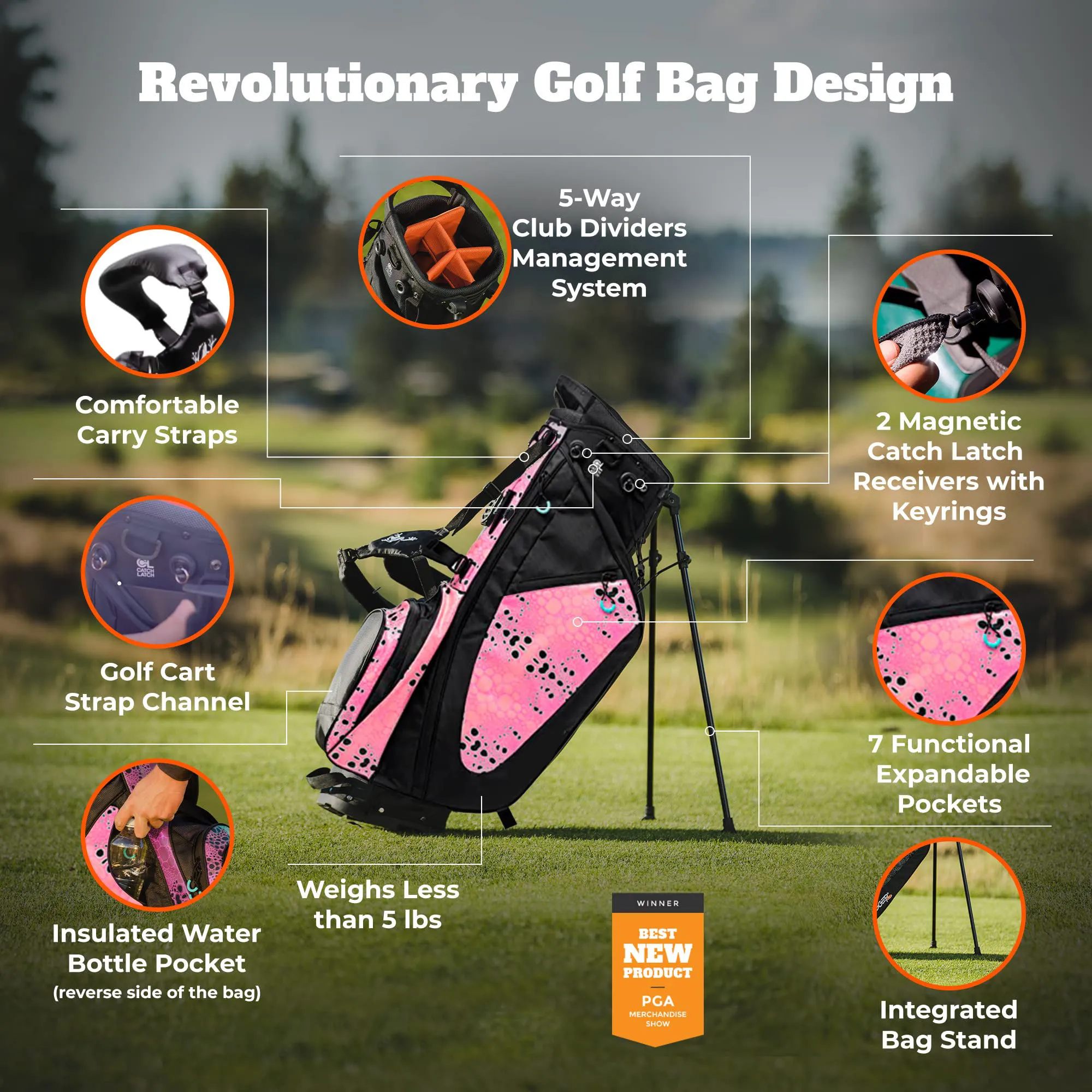
The very first decision is not the fabric — it is the player. A stand bag that will live on a push cart or be carried for 18 holes by a walker has opposing engineering priorities. A walker wants the lowest feasible weight (roughly 3.0-4.2 lbs) with comfortable dual straps and a stable stand, and will forgive a leaner pocket set. A rider or hybrid player, by contrast, does not feel the weight on their shoulders and will trade weight freely for organizer pockets, a cooler, full-length dividers and a heavier, more durable shell.
So set your target market segment before you set the spec. If your retail line is aimed at the weekend walker, lock a lightweight architecture. If it targets the club rider who wants everything organized, a 14-way organizer or a hybrid cart/stand build suits better. We host both poles in our product range — a lightweight carry architecture and a 14-way organizer — and most of our OEM buyers land somewhere between them once they decide the walking ratio in their target country.
The useful trick is to write the positioning down as three numbers: the percentage of buyers expected to walk, the target retail price, and the acceptable weight ceiling. Those three numbers resolve most arguments later in the process, because they give the sourcing team a decision rule instead of a debate.
3) The Eight Variables That Control Quality and Cost
In our experience a custom stand bag program is decided by eight measurable specifications. Change any one and the others react, which is why we always review them as a system rather than as isolated fields.
1. Target weight — dictates fabric denier, frame and hardware choices. 2. Divider configuration — 4-way is cheapest and lightest; 14-way with full-length tubes carries the most labor. 3. Material denier and finish — standard 400D/600D nylon versus laminated TPU waterproof sheeting moves unit cost noticeably. 4. Stand deployment and base geometry — a reinforced hinge block plus a stable base angle is what keeps legs from splaying. 5. Pocket architecture — the pocket list and their access logic decide a large share of the sewing labor. 6. Zipper standard — lock a cycle target and a pull-force spec for bulk QC. 7. Strap system — dual self-balancing straps with defined padding change carry comfort. 8. Branding density — embroidery digitizing and multi-panel placement add 3-8%.
When you present these eight to a factory in one block, you get a fast and honest quote. When you present them one at a time, you invite renegotiation and rework. This is the core habit of buyers who land good programs.
4) Divider Configuration: 4/5/6-Way Versus 14-Way
The divider layout is the most visible piece of "architecture" on a stand bag, and it is a genuine cost driver. A 4-way top keeps the overall build light and the cost low, which suits an entry carry bag. A 5-way or 6-way adds a little organization while staying walker-friendly. A 14-way organizer separates every club shaft, prevents grip tangle, and reads as premium in retail photography — but it adds structural labor, often full-length divider tubes, and weight that a serious walker will feel.
The decision rule we give buyers is: match the divider to the walking ratio from step 2. High-walk lines should cap at a 5/6-way; rider-heavy and premium lines can carry the 14-way. If you are not sure, order a 6-way as the safest middle and keep the option to lock a 14-way in a second season.
One detail buyers underestimate is whether the dividers are full-length. A full-length divider tube keeps shafts separate all the way down and prevents club rattle on a cart, but it costs more and weighs more. If your bag will spend time on a cart, full-length dividers are often worth the premium; if it is purely a carry bag, top-level dividers may be enough. State this explicitly in the spec — it is one of the most common gaps between a sample photo and the production bag.
5) Materials: Denier, Finish, and Waterproof Scope
Fabric choice is the single biggest lever on both cost and perceived quality. Standard nylon in 400D and 600D is the workhorse for carry and mid-tier bags; 600D polyester offers a slightly different hand and dye behavior; a laminated TPU or PU-coated panel adds water resistance at a measurable premium. For a custom program, the right answer depends on your market's weather and your target price.
Our guidance: for a dry-climate walker, 400D/600D nylon at reinforced stress points is the value sweet spot. For a wet-market or all-weather line, plan a waterproof TPU shell or sealed PU coating, plus water-resistant zippers. Specify the denier, the finish and the reinforcement scope (base wear plate, stand hinge, cart-contact strips) so the factory does not round the spec down to save cost in a corner you did not name.
Ask the factory to describe the material on the sample label — the actual supplier and denier, not just "nylon". A waterproof overlay or a heavier base webbing is where a lower-priced quote often hides, and naming it on the sample is the fastest way to catch that before bulk.
6) Stand System: Deployment Feel and Base Stability
The stand is the mechanical heart of a stand bag and the area where cheap designs fail first. Look for a reinforced hinge block, a base geometry that keeps the legs stable on uneven ground, and a deployment mechanism that snaps out reliably and folds flat without snagging the straps. These feel like small things but they are what a walker judges every single round.
Two measurable tests protect you here. A stand deployment cycle test (we typically target 3,000-10,000 cycles) checks whether the hinge cracks or the legs wobble over time. A base stability check verifies the deployment angle and leg spread consistency. Pass/fail criteria should be written down so a reorder produces the same stand behavior as the approved sample.
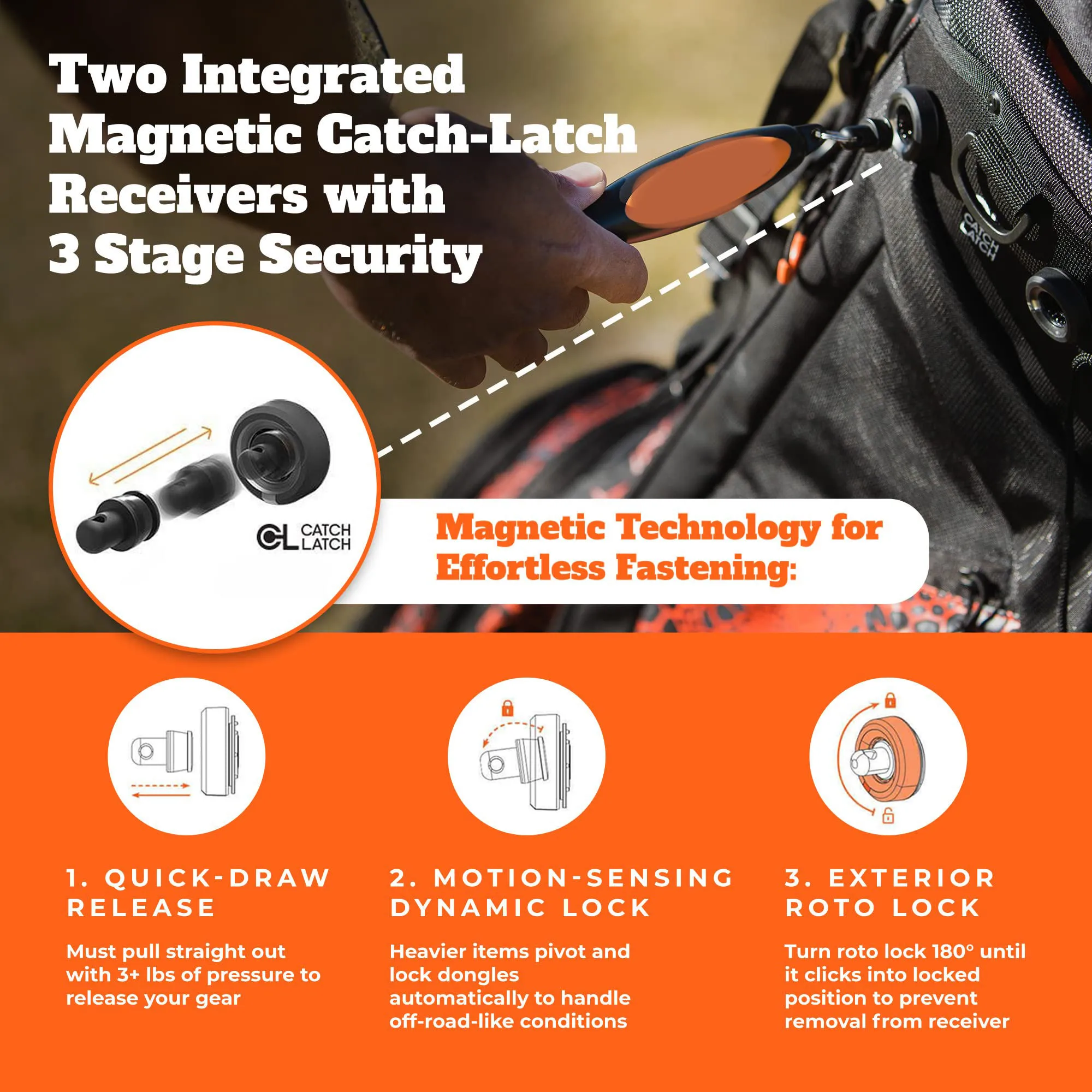
Because the stand interacts with the pocket layout and the strap anchors, we treat it as part of the system. If your spec calls for a cooler pocket or a magnetic rangefinder closure near the hip, we confirm it does not interfere with the stand mechanism before bulk. This is exactly the kind of cross-check a generic factory quote may skip, and it is why a dedicated stand-bag specialist adds value over a general bag maker.
7) Pocket Architecture and Access Logic
Pockets are what a buyer interacts with on the course, so their layout directly shapes satisfaction — and returns. The modern stand bag pocket set typically includes an insulated cooler, a magnetic or zipped valuables pocket, a rangefinder sleeve, a large apparel pocket, and an accessory or ball pocket. The ordering of these around the shell and how they open (zip direction, whether they are accessible while the bag stands) is the "access logic" that separates a great bag from a cramped one.
For a custom program, list your pockets in priority order rather than as a wishlist. If you must drop one to hit a weight or cost target, the factory should know which is first to go. This is a deceptively simple step, but it prevents the common failure where a bag ends up with more pocket zip than usable space, and every one of those zips is a future failure point and a labor cost line.
We also recommend you specify water-resistance on the valuables pocket and a secure closure on anything near your phone or rangefinder. These are the pockets where users are least tolerant of failure, and a small upgrade there disproportionately protects your brand reputation.
8) Hardware and Zipper Standard
Zippers and hardware are the most numerous moving parts on a stand bag, so their standard sets your durability floor. Specify a zipper cycle target, a smoothness criterion and a pull-force limit, and name the hardware finish you want on the base plate and strap buckles. In our view, durable zippers are non-negotiable on a custom program because a broken zip is the single most returnable defect on a golf bag.
The QC side matters here: a zipper that feels smooth on a sample can fail on the 500th pull of real use if the tape tension is wrong. We hold a zip-cycle acceptance test in bulk inspection so your reorder does not silently downgrade the zipper standard. Put this in the AQL notes, not just in the sales conversation.
9) Strap System and Carry Comfort
A dual-strap, self-balancing system is the modern expectation on a carry bag because it distributes weight across both shoulders and sits comfortably on a walker. The variables that matter are the padding thickness and placement, the adjust range, and whether the straps are removable. If your line is genuinely carry-focused, do not economize here — the strap is the part your customer feels for three hours.
We test strap anchors with a static load to confirm the stitching holds, and we confirm the strap does not tangle with the stand deployment when the bag is set down. These are quick checks that catch real-world frustrations before they reach your retail shelf.
10) Positioning Matrix for Catalog Planning
Use this matrix to align your product, sourcing and sales teams. Replace the placeholders with your target-market values before you brief the factory.
| Segment | Target MSRP | Weight | Divider | Material Direction | Feature Focus |
|---|---|---|---|---|---|
| Entry | $$ (define) | 4.0-5.5 lbs | 4/5/6-way | Polyester/Nylon | Simple pocket logic + durable base |
| Mid-tier | $$$ (define) | 3.0-4.2 lbs | 5/6-way or 14-way option | Nylon 400D/600D | Walking comfort + stable stand |
| Premium | $$$$ (define) | 3.0-6.8 lbs | 14-way organizer or premium 5-way | PU synthetic leather / upgraded trims | Hardware branding + refined finish |
| All-weather | $$$$ (define) | 4.0-6.8 lbs | 5-way or 14-way | Waterproof TPU/laminated | Seam sealing + water-resistant zippers |
This matrix works because each row names a target price, a weight band, a divider, a material and a feature focus together. A single row is a complete product decision, which means it can be quoted and sampled as one unit instead of as five disconnected wishes.
11) Sampling and QC: The Test Plan That Protects Reorders
A sample is only useful if its numbers transfer to bulk. We recommend a pre-production sample produced on the exact production fabric, with the approved hardware and stand, then a locked set of acceptance criteria before the line runs. The five tests that matter most on a stand bag are: strap anchor load, packed-product drop, stand deployment cycle, base stability, and zipper smoothness/cycle.
- Strap anchor load test (static load + stitch failure criteria)
- Drop test for packed product (carton corner/edge/face drops)
- Stand deployment cycle test (3,000-10,000 cycles + failure criteria)
- Base stability check (angle, slip resistance, leg spread)
- Zipper smoothness + cycle test (pull force and jam rate)
Write these down and the whole program stabilizes. Reorders stop drifting because every season is checked against the same locked targets and, where possible, a sealed master unit we keep for the life of the program.
12) Recommended Starting Targets
These are starting points for discussion — not laws. Lock the final numbers with your factory based on your segment and risk tolerance.
| Test / Metric | Recommended Starting Target | Notes |
|---|---|---|
| Stand deployment cycles | 3,000-10,000 cycles | No cracking, no severe wobble, consistent deployment. |
| Zipper cycle test | 3,000-10,000 cycles | Track jam rate and pull force; define acceptable failures. |
| Strap anchor load | Static load test (define kg + duration) | Define stitch failure criteria and reinforcement scope. |
| Fabric abrasion | 20,000-50,000 cycles (method-defined) | Set by segment; confirm the method used by the factory. |
Agreeing these numbers before bulk is what makes the difference between a bag that survives a season and one that gets returned. They also give your retail partners a credible quality story — an increasingly important selling point in a market where buyers compare durability claims.
13) The Procurement Worksheet: Turn Your Brief Into an RFQ
Use this worksheet to collect inputs from product, sourcing and sales before you send the RFQ. Filling every row once saves you roughly half the sampling rounds.
| Requirement | Your Target | Notes / Questions |
|---|---|---|
| Target customer / market | Where will it be sold and at what price level? | |
| Bag type & sizing | Carry-focused, hybrid, or organizer-focused? | |
| Divider configuration | 4/5/6-way or 14-way; full-length tubes required? | |
| Material direction | Nylon/Polyester/PU/TPU; denier and finish preferences? | |
| Pocket list | Cooler, magnetic rangefinder, valuables, apparel, ball pocket? | |
| Branding method | Embroidery/patch/heat transfer; placements and sizes? | |
| QC & testing | AQL level + functional tests for stand and zippers? | |
| MOQ & lead time | First order quantity, reorder plan, timeline? |
14) Related Product Architectures to Land On
Move from article intent to a concrete model path. These are the landing points that match the buyer intents we see most, and each maps to a proven architecture in our range.
Lightweight Carry
If you prefer to explore all the base architectures before choosing, our product index lays out the lightweight, 14-way, hybrid and waterproof builds side by side, and the buying guide walks through matching them to a market. For controlled manufacturing detail, our factory & QC page explains the SGS-verified environment these bags are produced in.
14b) Cost Drivers to Watch When You Upgrade a Standard Layout
A common mistake is assuming the gap between an entry bag and a premium bag is one big jump. In practice it is a pile of small, named upgrades, and each one has a distinct cost curve. A cooler pocket with a sealed liner costs differently than a plain zipped pocket. A magnetic rangefinder closure is cheap as a component but forces the pocket pattern to change. Full-length dividers add material and a sewing operation. A TPU waterproof panel changes the lamination step before the bag is even cut.
Because each of these is a separate line item, you can manage cost by choosing which upgrades to include rather than by negotiating a single vague discount. We recommend you ask the factory to price a "baseline" bag and then list each upgrade with its delta, instead of asking for a single quote for "the big one". That gives you a menu you can tune to hit a retail price point exactly. It also exposes any hidden coupling — for example, a waterproof shell may force a change in the zipper standard, which changes the delta on both lines.
The discipline of a line-item menu pays off twice: once at quote time and once at reorder time, when you can drop a costly feature for a value tier without renegotiating the whole program. In our experience buyers who think in upgrade deltas consistently land better margin than buyers who negotiate a lump price, because they know exactly where the money is going.
14c) Matching Your Custom Bag to a Retail Pricing Tactic
Your retail pricing strategy should influence the spec you choose, not just the price you mark up. A loss-leader or entry-tier SKU must hit a weight and simplicity target, because a pared-down spec is what earns the retail price point. A premium or "hero" SKU, by contrast, can afford the organizer dividers, the hardware branding and the upgraded trims, because those visible signals justify the higher ticket in the aisle and in photography.
The practical rule is to design the entry and the hero from the same base architecture so the line reads as one family, then differentiate with the upgrade deltas above. This keeps your tooling, your QC language and your branding consistent while the retail stack covers multiple price tiers. Retailers respond well to a coherent family because it simplifies their shelf story and their reorder math.
If your hero includes hardware branding or a distinctive silhouette, treat it as the flagship that earns margin, and let the entry tier carry the volume. Our OEM buyers often start with one approved baseline and then request a value trim and a premium extension in the same program, which is efficient because the technical file, the embroidery digitizing and the QC standard are all reused across the family.
15) The Practical Order-of-Operations That Saves Time
Experienced buyers run the process in an order that avoids loops. First, fix the three positioning numbers (walking ratio, target retail price, weight ceiling). Second, draft the eight-variable spec in one page and add a reference-silhouette note or two. Third, send a customization brief with your target market, expected MOQ and timeline. Fourth, approve a pre-production sample on the real fabric with locked values. Fifth, hold an inline inspection during bulk rather than only a final random check.
Two final notes. Even a short colorway run-down of 20-30 units before a full container lets you photograph the real bag for your retailers and confirm the stand and strap behavior on the production silhouette — this is the cheapest insurance in the whole process. And if your range spans products beyond stand bags, keep the same artwork and QC language across the line so manufacturers quote more efficiently against an already-audited spec. Reach us at service@junyuanbags.com or +86 17750020688 and we will support your evaluation sample.
FAQ
How much does it cost to produce a custom golf stand bag for my brand?
Landing cost is driven mainly by material denier, divider spec, pocket count, branding density and ordered volume. Locking materials and dividers first is what controls your landed price; a small colorway run-down protects against expensive surprises at bulk.
What is the difference between OEM and ODM for golf stand bags?
OEM means you brand an existing, proven stand bag architecture; ODM means co-developing the structure and materials from your brief. Choose OEM to launch fast and cheaply, and ODM when you need a differentiated silhouette for a premium price.
What is the minimum order quantity for custom golf stand bags?
The regular MOQ is 200 pieces and a test order can start around 100 pieces. Layout dye lots, hardware finishing and multi-panel embroidery set the effective floor, and larger volume unlocks better per-unit pricing.
How long does sampling and bulk production take?
Sampling typically runs 10-20 days and bulk production 45-60 days. Confirming your spec early lets us schedule the line so your launch date is protected.
Which specs matter most when choosing a custom golf stand bag?
Weight, divider configuration, material and finish, stand stability, pocket architecture, zipper standard and strap anchors are the seven that drive most of the quality and cost picture. Define them before sampling.
Can I get a custom colorway and logo on a proven stand bag architecture?
Yes — that is the standard OEM path. You choose a baseline bag type and we lock your brand colorway, embroidery and hardware finish onto it, keeping the structure proven while the appearance is fully yours.
What should I send to get an accurate custom stand bag quote?
Send target market and price positioning, expected MOQ, bag type and sizing, divider and material direction, a pocket list, branding method and your launch timeline. Reference photos or a tech pack cut sampling rounds.
Request a B2B quote for golf stand bags
Send your target market, expected MOQ, and reference photos. We respond within 24 hours with a sampling plan.