For a versatile two-in-one build, review our hybrid golf bags — For the most compact small carry, see our pencil bags — For a B2B buyer sourcing a stand bag that will ride a golf cart, the three decisions that decide customer satisfaction are the divider tubing (full-length keeps shafts from rattling), the base geometry (must fit the cart rack), and the folded-leg profile (must stay clear of the cart strap) — and getting these right on a hybrid build converts a single SKU into a product that covers both riding and walking rounds. This guide walks brand teams through the cart-specific specs we check in our SGS-verified Quanzhou facility (4,950 sqm, 7 lines, 149 machines, 137 staff) when an OEM buyer asks for a bag that performs on the cart without giving up the walk.
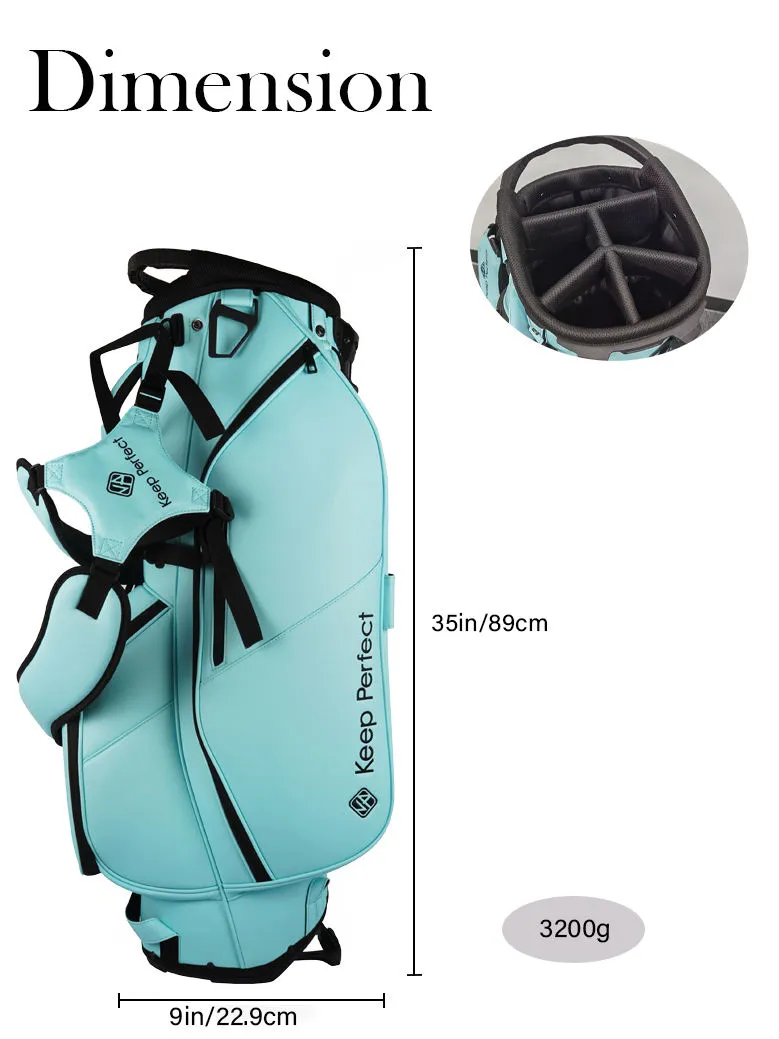
From a factory build standpoint, our dedicated ultralight stand bags page walks through the materials, hardware, and quality checks in detail.
Key Takeaways: What "Cart-Ready" Actually Means
- Full-length dividers are the top cart priority because they stop club rattle and tangle
- A stable base with the right bottom profile keeps the bag from spinning or tipping on the rack
- Folded-leg placement matters: it must avoid the cart strap and the rack clips
- A hybrid cart/stand build lets one SKU serve both riding and walking segments
- Cart riders tolerate extra weight, so you can spend the weight budget on organization and insulation
1) Why a Stand Bag on a Cart Is a Different Product
Most buyers start from the assumption that any stand bag will work on a cart, and most returns start the same way. A classic carry stand bag is engineered to sit on the ground and ride on a walker's shoulder — its base is narrow for balance, its dividers may stop short to save weight, and its legs fold into a profile that can fight the cart strap. When that bag is strapped to a cart rack, three things can go wrong: the clubs rattle and tangle, the bag tips or slides because the base does not match the rack, and the strap wears or misaligns the folded legs.
The way to think about it is that a cart-borne stand bag needs the structural virtues of a cart bag (stability, full-length separation, protection) while keeping the carry virtues (weight, straps, stand) for the walking half of the round. That combination is what the trade calls a hybrid cart/stand bag, and it is the fastest-growing segment in several markets precisely because a growing share of golfers ride a cart one day and walk the next.
For a factory, the hybrid build is not harder — it is just a different spec discipline. You lock the divider and base first, because those are the cart-critical parts, then fit weight and pocket decisions around them. This guide gives you that order so your sample is cart-ready on the first try instead of the third.
2) Full-Length Dividers: The Number One Cart Priority
On a cart, every bump and turn shakes the clubs together, and if the divider tubes stop halfway down the bag the shafts come free at the bottom and cross each other. The result is tangled grips, cosmetic scuffing on shaft finishes, and a fiddly first hole. Full-length divider tubes separate each shaft all the way down to a base ring, so the clubs stay put through 18 holes of cart travel.
The trade-off is honest: full-length dividers add material, a small amount of weight, and a little sewing labor, so they are not the cheapest option on a pure carry bag. But for a cart-forward line they are close to non-negotiable. Confirm on the pre-production sample that the dividers actually run full-length to the base — a photo of the top cluster does not prove the tubes descend, so ask for a flipped-over shot or a dimensional statement in the tech pack.
Divider count matters too. A 5-way splits the bag into top regions but still lets mid-to-long clubs cross low down without a full-length divider. A 14-way with full-length tubes is the gold standard for cart riders who want every shaft isolated. For most hybrid lines we recommend a 6-way or 14-way with full-length dividers as the middle ground: enough separation to stop rattle, still light enough to walk with between cart and green.
3) Base Geometry: Fit on the Rack, Not Just on the Ground
A stand bag's base does double duty: it must sit stable when the bag is deployed on its feet, and it must fit the cart rack when folded. On many rack systems the bag nests in a cradle or against a clip, so the bottom profile and the width matter as much as the stand angle. A base that is too wide for the rack rocks; one that is too narrow allows side-to-side flex and lets the bag slide under hard braking.
When you brief the factory, state the cart system your line targets — a push cart, a ride-on rack, or universal — because the base may need a slightly different profile for each. If the line is truly universal (most are), we design a base that clears the widest common rack while staying narrow enough to be carried. The bottom wear plate also matters on a cart bag because it takes abrasion when the bag drags against stop bars and cart edges.
Ask for a base-stability check that simulates the rack, not just a ground deployment test. We hold a check that confirms the folded bag does not rotate in the cradle and that the base legs spread to a consistent angle on uneven terrain. This one test catches most of the "bag slides in my cart" complaints that otherwise become retailers' return tickets.

4) Folded-Leg Profile and the Cart Strap
The cart strap is the part buyers forget until it fails. When you strap a stand bag into a cart, the strap usually wraps around the bag body or through a central channel, and if the folded legs sit right where the strap lays, the strap abrades the legs, misaligns the hinge, or fails to cinch the bag firmly. The fix is a low-profile hinge block and a leg-folding geometry that tucks the legs close to the shell, clear of the strap line.
On a hybrid build we also pay attention to the trigger mechanism. Some buyers prefer a passive trigger that stays put during cart travel, while others want a manual lock so the legs cannot deploy unexpectedly mid-ride. Specify which behavior your market expects, because a bag that pops its legs open while strapped to a cart is a genuine safety annoyance.
Put a simple check in the QC plan: strap the folded bag to a test cart (or a representative rack) and confirm the strap sits flat, the legs stay folded, and there is no stress line forming at the hinge. That 60-second test catches a problem that otherwise only surfaces after a customer unwraps the box at the course.
5) Spending the Weight Budget on Cart Riders
Here is the honest advantage of a cart-focused line: your buyer does not carry the bag for three hours, so weight is a real but secondary constraint. That frees the weight budget for what cart riders actually want — full-length dividers, an insulated cooler, a range-finder sleeve with secure closure, a roomy apparel pocket, and a sturdier shell that shrugs off the cart's edges.
We build cart-compatible stand bags comfortably in the 4.2-6.2 lbs band, and some hybrid lines push toward the top when a waterproof shell and a thermos-friendly cooler are specified. The rule is: set the walker's weight ceiling first (if any share will walk), then spend the remaining budget on the cart-friendly features without letting them blow past that ceiling.
This is where the positioning matrix pays off. A "mostly cart, some walk" line will sit in the mid tier, while a "pure cart premium" line can carry the 14-way organizer and the upgraded trims. Both ride the same base platform, so your tooling and QC language stay consistent across the family.
6) The Cart/Stand Specification Table
Use this as your internal cart-ready spec. Confirm each row on the pre-production sample and lock the numbers before bulk. All values reflect typical practice at QUANZHOU JUNYUAN BAGS.
| Parameter | Typical Spec | Cart Buyer Notes |
|---|---|---|
| Divider | 5/6/14-way, full-length tubes | Full-length is the cart-critical minimum. |
| Base profile | Universal rack fit + wear plate | Confirm it clears the widest common rack. |
| Folded legs | Low-profile hinge, tucks to shell | Must clear the cart strap line. |
| Weight | 4.2-6.2 lbs | Spend budget on insulation and dividers. |
| Pocket set | Cooler + rangefinder + apparel + valuables | Prioritize by cart-rider usage, not wishlist. |
| Zippers | Durable, cycle-rated | Cart travel opens/closes pockets a lot. |
| Strap | Dual self-balancing, removable | Keeps the walk option intact. |
7) Positioning Matrix for a Cart-Forward Line
Align product, sourcing and sales with a matrix that names each row's price, weight, divider and feature focus together.
| Segment | Target MSRP | Weight | Divider | Material Direction | Feature Focus |
|---|---|---|---|---|---|
| Entry | $$ (define) | 4.0-5.5 lbs | 5/6-way | Polyester/Nylon | Simple pockets + stable base |
| Mid-tier | $$$ (define) | 3.0-4.2 lbs | 6-way or 14-way option | Nylon 400D/600D | Hybrid carry/cart comfort |
| Premium | $$$$ (define) | 3.0-6.8 lbs | 14-way organizer | PU synthetic leather / upgraded trims | Full organization + branded hardware |
| All-weather | $$$$ (define) | 4.0-6.8 lbs | 5-way or 14-way | Waterproof TPU/laminated | Seam sealing + water-resistant zippers |
The cart-friendly lesson in this matrix is that the mid and premium tiers carry the full-length dividers and insulation, while the entry tier keeps a stable base and a simple pocket logic to protect its price floor.
8) Pockets That Survive Cart Travel
A cart rider opens pockets constantly — tees, ball, rangefinder, phone, drinks — so pocket access logic and closure security matter more than on a purely carried bag. Specify the pocket order so the most-used items are easiest to reach with the bag upright on the rack. A front-facing rangefinder sleeve and a hip valuables pocket with a secure or magnetic closure are the pair our cart players ask for most.
The valuables pocket on a cart bag should also resist theft-of-opportunity: a zipped or magnetic closure that is not trivially openable from a passing cart matters on busy courses. We check valuables-pocket closure in QC and offer upgrade options that do not disturb the shell pattern.
Insulation is the other cart favorite. An insulated cooler lining is a small per-unit cost that cart riders feel every round, and it is one of the strongest "premium feel" signals you can add at modest cost. Specify whether the cooler needs to hold a specific bottle and whether it shares space with a ball pocket or is a dedicated compartment — that decision affects the pocket pattern and the cost delta.
9) Test Plan and Acceptance Criteria for Cart Use
Branch the standard stand-bag test plan so it covers the cart life of the product, not just the walking life.
- Base stability check (rack-fit, angle, slip resistance, leg spread)
- Folded-leg + cart strap clearance check
- Zipper smoothness + cycle test (pull force and jam rate)
- Strap anchor load test (static load + stitch failure criteria)
- Packed-product drop test (carton corner/edge/face drops)
- Stand deployment cycle test (3,000-10,000 cycles)
Write the cart-specific rows into the AQL notes so they are not dropped at the inspector's discretion. A stand bag purchased for cart use should be held to the same durability floor as a dedicated cart bag, because that durability claim is what your retail partners will repeat.
10) Recommended Starting Targets
Start here and lock final numbers with your factory based on your cart/walk mix and risk tolerance.
| Test / Metric | Recommended Starting Target | Notes |
|---|---|---|
| Stand deployment cycles | 3,000-10,000 cycles | No cracking, no severe wobble, consistent deployment. |
| Zipper cycle test | 3,000-10,000 cycles | Track jam rate and pull force. |
| Strap anchor load | Static load (define kg + duration) | Define stitch failure criteria and reinforcement. |
| Fabric abrasion | 20,000-50,000 cycles (method-defined) | Confirm the method used by the factory. |
11) Sourcing the Hybrid Cart/Stand Build
If a hybrid cart/stand build is right for your market, brief it as one product with a defined cart/walk split, and confirm your cart-critical specs in the same exchange as your branding. The buyers who launch fastest pair their target market and expected MOQ with a note on the cart systems their end users own — that single detail lets us tune the base profile instead of guessing.
You can launch OEM on our proven hybrid architecture, or co-develop a distinctive silhouette with us under ODM. Either way, start from the base-and-divider decision, then spend the remaining budget on the features your cart riders will feel. For a deeper walk through matching a bag to a market, the buying guide and our hybrid product page cover the silhouette; our factory & QC page explains how the SGS-verified environment keeps every hybrid reorder consistent.
12) The Order of Operations for a Cart-Ready Program
Run the process in an order that avoids loops. Fix the cart/walk split first. Draft an eight-row spec that names dividers, base, folded legs, weight, pockets, zippers and straps. Send a customization brief with your target market, MOQ and timeline. Approve a pre-production sample on the real fabric with locked values. Then hold an inline inspection during bulk for the cart-specific tests above rather than only a final random check.
Two final notes. Order a short colorway run-down of 20-30 units before a full container so you can photograph the real bag on an actual cart and confirm the base and strap behavior — it is the cheapest cart-test insurance in the process. And keep the same artwork and QC language across your whole bag line so manufacturers quote efficiently against an already-audited spec. Reach us at service@junyuanbags.com or +86 17750020688 and we will support your evaluation sample.
13) Hardware Finish and the Cart-Contact Surfaces
A bag that rides on a cart takes a different kind of abuse than one that only walks: it slides against stop bars, brushes cart edges, and gets strapped and unstrapped dozens of times a season. That makes the hardware finish and the cart-contact surfaces two of the quietest but most important specs in a cart program. The base wear plate, the lower shell fabric, and the clip points all need a density and a protective treatment that a pure carry line might not require.
When you choose the material for a cart-forward bag, ask specifically about abrasion on the lower third of the shell and the wear plate. We recommend a reinforced base fabric and a wear strip on the surfaces that drag, because that is where a cart bag shows age first. The hardware — buckles, zipper pulls, base clips — should be color-banded and corrosion-resistant, since a cart bag spends more time in damp cart storage and trunk heat than a shoulder-carried bag.
This is also where a specialist factory earns its keep. General bag makers may not know that a cart strap abrades a hinge block differently than a walker's shoulder does, or that a cooler pocket needs a sealed liner to survive the condensation of a cart-day. Naming these surfaces in your brief prevents the classic failure of a bag that looks great folded and wears badly after one season on a cart.
14) Branding That Reads on a Cart, Not Just on a Shoulder
Branding behaves differently on a cart bag because of how the product is seen. When a bag is strapped upright on a rack, the front panel and the top lid are the visible zones in course photography and retail shelves; the side panels only read when the bag is carried or photographed at an angle. So a cart-forward program usually wants the hero logo on the front lower panel, a compact brand mark on the lid, and a small tonal logo on the hip or the valuables pocket.
The method matters for the same cart-abuse reason. Embroidery on the front panel and lid is the durable baseline, while heat transfer on a high-flex zone such as the hinge area is risky because the constant cart-strap pressure can start an edge peel. Molded patches layer cleanly onto a waterproof shell without piercing a sealed area, which matters when a cart bag includes a TPU cooler panel.
If your line mixes cart and carry, consider a placement strategy that survives both: logo on the stable front and lid, with secondary trim branding on the straps. We keep a sealed master and a color-sealed chip per program so a reorder two seasons later matches the original lockup — the same discipline that keeps the cart surface treatments repeatable.
FAQ
Is a golf stand bag good for a cart compared to a cart bag?
Yes if you pick a hybrid or cart-compatible build with full-length dividers and a stable base. It rides fine on a cart and doubles as a carry bag when you walk nine.
What prevents club shafts from tangling when a stand bag rides on a cart?
Full-length divider tubes that separate each shaft all the way to the base. Even a 14-way top is not enough if the dividers stop halfway, because shafts still cross low down.
Does the stand get in the way when the bag is strapped to a cart?
Not if the legs fold flat and the hinge block keeps them out of the strap line. That prevents stress on the mechanism and holds the bag firmly on the rack.
Should the bag be heavier if it will mostly ride on a cart?
For a mostly-cart line you can spend extra weight on organization, insulation and full-length dividers; a cart rider does not feel 1-2 lbs the way a walker does.
What is a hybrid cart/stand bag and who should choose it?
It pairs a stable cart-friendly base and generous pockets with a working stand and carry straps, so one product covers both riding and walking rounds.
What stand bag specs matter most for cart use in bulk QC?
Base width and profile, full-length divider confirmation, leg fold-flat behavior, zipper cycle and strap-anchor stitching. Lock these on the sample.
Can a cart-facing stand bag still be lightweight enough to walk with?
Yes at the 3.0-4.2 lbs end of the range, though full-length dividers and a cooler push it up. Set the walker ceiling first, then fit cart features within it.
Request a B2B quote for golf stand bags
Send your target market, expected MOQ, and reference photos. We respond within 24 hours with a sampling plan.