For the most compact small carry, see our pencil bags — Practice golfers can also browse our range and simulator golf bags — Choose a kickstand whose hinge block outlives the bag: plan for at least 3,000 clean open-close cycles and a leg spread of roughly 36-50 cm on a loaded bag. The stand system decides whether your stand bag stays upright on a slope, survives a season without wobble, and works for both walkers and cart riders. Here is how to evaluate legs, base geometry, and deployment stability before you commit to bulk.

How a Stand System Actually Works
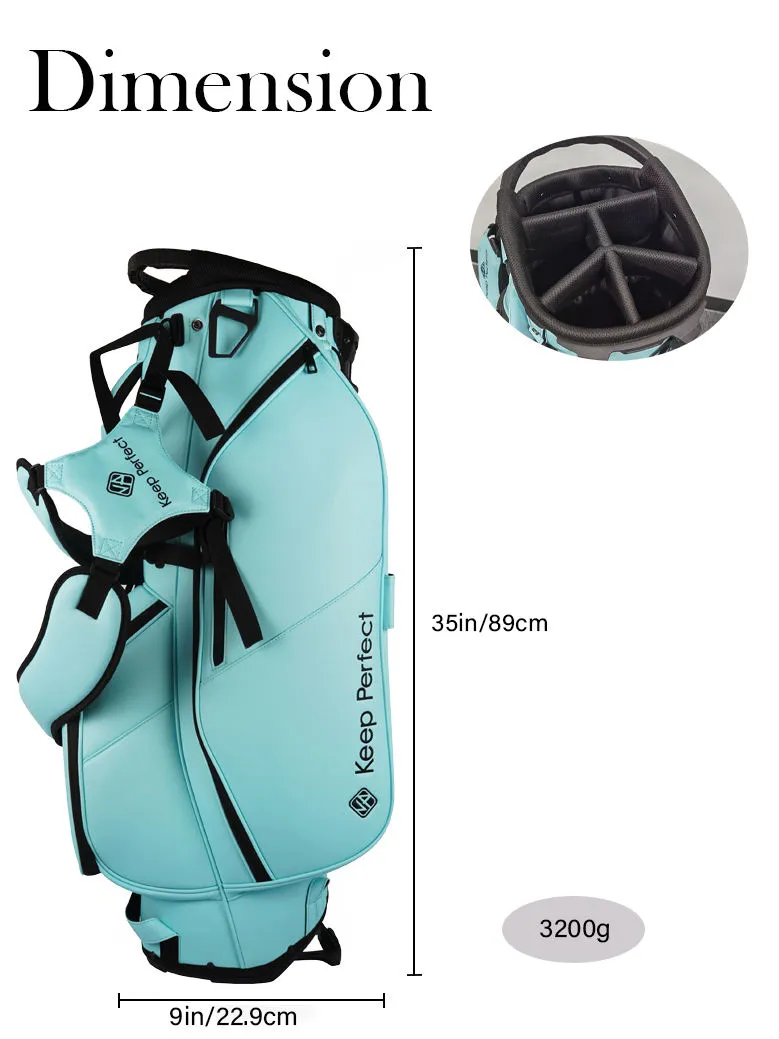
The phrase "stand system" bundles three things that work together: the hinge block that carries the mechanism, the two or three legs that extend outward, and the base geometry that keeps the loaded bag level. When you lift the bag, the legs retract flush against the shell and a tension lock holds them in place; when you set it down, the back panel hits the ground and the legs spring out automatically. That entire cycle is a mechanical system, and every part of it wears with use.
For a B2B buyer, the practical difference between a mediocre and a good stand is not marketing language - it is measured in cycle life, foot stability, and consistency across units in the same run. A hinge that locks inconsistently, legs that open to different lengths, or a base that tips forward on uneven ground will generate returns and bad reviews even if the fabrics and zippers are flawless. That is why the stand deserves its own section in your spec rather than one line.
There are broadly two architectural families. The traditional two-leg design is the workhorse: light, simple, and reliable on walkers. A growing number of hybrid and premium designs add a stabilization bar or a wider base plate that trades a little weight for noticeably better tipping resistance when the bag is packed full. Knowing which family your target waistline and price point want is the first decision, and it should be made with a club-loaded sample rather than a spec sheet.
Hinge Block: The Part That Fails First
In our experience and in the wider OEM market, the hinge block is the single most common failure point on an inexpensive stand bag. The mechanism is a small plastic or reinforced assembly that anchors the legs into the bag body. When the bag is set down hundreds of times, all that load concentrates at the hinge, so the material and the anchor method decide how many cycles the bag survives.
A cheap bag often uses a compact plastic bracket that is riveted or sewn into a small patch. It works for the first weeks, then the hinge develops play, the legs stop returning to a clean closed position, and eventually the block cracks under a full club load. A reinforced hinge block spreads the load across a wider stress area and is anchored into the shell or an internal plate. The extra material adds a little cost and weight but shifts the failure curve from months to years.
When you sample, do three checks. First, open and close the stand 50 times and watch whether leg travel stays smooth and identical. Second, load a full set and set the bag down firmly 20 times; listen for creaking and look for any stress whitening at the hinge. Third, ask the factory for a cycle-test record on the exact mechanism they quote - some list 3,000 cycles, better builds claim 10,000. Make the number part of the commercial agreement.
Legs: Length, Spread, and Tip Design
Leg geometry is the least visible but most influential part of the stand experience. Two values matter most: the length of the legs and the spread when fully open. On a loaded stand bag, you want a footprint roughly between 36-50 cm wide so the bag resists tipping on the slopes and rough terrain where players actually use it. Legs that are too short or too narrow create a bag that falls over on mild ground.
Consistency is just as important as the raw numbers. In a production run, both legs must open to the same effective length, and the base spread must be uniform from unit to unit. We check leg alignment and spread angle during first-article inspection, because a batch that drifts toward narrower legs will produce a whole range of tippy bags. Ask your supplier how they control this and confirm it with a measured sample, not just a photo.
Tip design also earns attention. Good tips add grip on grass and soft ground, while over-worn or brittle tips accelerate instability. For a premium tier, tip materials can be chosen for wet-slope grip. If your market includes riders who leave the legs retracted on a cart, confirm the tips and hinge do not scrape the cart bed or add bulk that fights the straps.
Base Geometry: Where Stability Is Won or Lost
The base is the platform the whole system rests on, and its shape quietly drives stability. A wider, better-contoured base gives the legs a solid anchor point and keeps the bag level when you set it down. A narrow or poorly contoured base makes a stand look fine on a shelf and feel tippy on a slope. Since a golf course is rarely flat, slope behavior should be part of your sample test.
Base geometry interacts with the divider layout too. A 14-way organizer full of steel shafts is heavy, and that weight shifts the balance point higher, demanding a wider foot and more disciplined leg spread. Light carry bags can use a slimmer base without penalty. Matching base width to the configured weight is the kind of nuance that separates a tuned custom bag from a generic file.
We recommend testing the base on three surfaces during sampling: a flat mat, a gentle side slope, and a bumpy patch. Set the bag down loaded and unloaded, front-facing and back-facing, and note how often it needs a second nudge to stand clean. One strong, repeatable stability test beats a page of packaging claims and gives your QC a concrete pass/fail to lock for bulk.
| Characteristic | Entry / Lightweight | Mid-tier | Premium |
|---|---|---|---|
| Hinge anchor | Plastic bracket | Reinforced block | Reinforced block + plate |
| Cycle-life target | ~3,000 | 5,000-6,000 | 8,000-10,000 |
| Leg spread (loaded) | ~36 cm | 40-46 cm | 45-50 cm |
| All-weather base | Optional | Optional | Standard option |
| Stability bar | No | Optional | Common |
Starting targets to discuss; lock final values with your factory on a loaded sample.
Deployment Feel and the Two-User Test
Stand feel splits along the walker-versus-rider line, and it is worth designing for one primary user rather than half-serving both. A dedicated walker wants a light bag whose legs spring out reliably but stay locked while carrying - the worst failure is a bag that pops its legs open on your shoulder mid-round. A dedicated rider mostly wants the legs out of the way, retracting cleanly and not scraping the cart.
Test both behaviors on the same prototype. Carry a loaded sample through a walk-and-turn path and check that the legs stay locked; then set it down repeatedly to feel deployment reliability. On the cart side, strap the bag in and check for leg contact and smooth retraction. If your line splits between user types, spec the hinge and leg spread so the single mechanism satisfies the stricter requirement.
Deployment feel is partly subjective, so make it measurable. Standardize a checklist: legs lock 100 percent when carried, open automatically in one setting, return to closed without assistance, and stay aligned after the open-close test. Record a pass/fail plus a note for each unit in first-article inspection so feel does not drift across a run.
Stand Versus Cart: Getting the Balance Right
A stand bag is a single bag asked to be two things, and the stand adds complexity every cart rider may not need. If your channel is dominated by cart riders, you can prioritize a rigid, stable base and tidy retraction over feather-light legs. If your channel skews to walkers, weight and hinge smoothness rise in priority. Knowing the split before you spec avoids building a bag that is awkward for your main buyer.
Hybrid designs try to satisfy both with features like a stability bar or a wider foot that still tucks under cart straps. These are legitimate if priced and tested correctly, but they add components that each become a sourcing and QC line item. For a first program we usually recommend choosing the dominant use case, nailing that experience, and offering the cart-friendly base option as a variant rather than trying to optimize one mechanism for both extremes.
Whichever direction you choose, keep the mechanism comments in your RFQ. Naming target cycle life, leg spread, and deployment behavior up front lets the factory quote the right hinge and base from the start instead of discovering the mismatch at the pre-production sample.
Stand into Manufacturing and QC
Once the mechanism is chosen, it moves into the same production and inspection pipeline as the rest of the bag. Define the functional checks that your inline QA performs on every stand: hinge lock, leg alignment, spread angle, and cycle behavior. These are the measurements that keep a 14-way organizer or a feather-light carry option consistent across a full container.
We run a standard set of acceptance checks that you can adapt, anchored on deployment cycles, base stability, and hinge integrity. Because the stand interacts with fabrics and zippers at mounting points, record any stress whitening, fabric pull, or misalignment at inspection so corrective action happens before the batch ships rather than after the customer complains. This is the difference between a process and a gamble.
If you are building a full custom range, the stand can also carry brand and positioning cues. Leg colorway, hinge cosmetics, and tip materials can be selected to match a premium tier. Reach us at service@junyuanbags.com or +86 17750020688 with your target market and quantity, and we will size the right stand architecture for your program.
Material Choices for the Moving Parts
Stand parts are molded from a handful of engineering materials, and the choice trades weight, cost, and longevity. Nylon-based hinges and base components are common because they combine strength with flexibility and resist the low-temperature brittleness that plagues brittle polymers. Cheaper builds may use a softer polypropylene that flexes fine when new but creeps and develops play over a season. For a premium tier, a reinforced composite or glass-filled nylon block costs a little more and holds geometry much longer.
The legs themselves are typically hollow aluminum tubes for the lightweight tier or reinforced profiles for a heavier organizer bag. Aluminum keeps weight down and resists bending, while heavier steel or thick plastic tubes add stability at the cost of ounces everyone feels on the shoulder. Match the tube profile to the configured weight again: a feather-light carry bag does not need a heavy duty leg, and a 14-way organizer does.
Because moving parts sit in sunlight and weather, fade and corrosion should be part of your color and finish spec. UV-stabilized resins and coated or anodic aluminum resist the sun damage that turns exposed stand parts chalky and brittle. If your market sells in high-UV regions, confirm the resin grade and finish at the sample stage rather than discovering whitening on the shelves later.
How the Stand Affects the Rest of the Bag
Nothing on a stand bag lives in isolation, and the mechanism shapes choices across the whole product. The hinge block and control panel consume fabric and structure at the back of the bag, so the pocket architecture has to work around them rather than through them. A generous large apparel pocket and a stand mechanism can fight for the same space on a compact chassis, and resolving that trade early avoids a bag that looks good flat and bulges in real use.
Weight is the second spillover. Every ounce the mechanism adds is an ounce you must save somewhere else to hit a walker-friendly target, which pushes fabric choices toward lighter panels and slimmer pockets. That is fine, but only if the lighter spec does not undermine the stand's stability requirement. The tension between light and stable is the defining compromise of stand bag design, and it is best decided by the same loaded sample used for stability testing.
Finally, the stand affect exports and packaging. Legs and hinge parts must be packed so they are not stressed in transit, and the shipping footprint has to accommodate the mechanism. Confirm that your carton and handling instructions treat the stand properly, or a container can arrive with deformed legs and failed hinges that turn a quality bag into a return problem before it ever reaches a player.
Stability, Sourcing, and the Bottom Line
When you connect everything, stability is not one feature but the outcome of hinge, legs, base, and weight decisions made together. A bag that stands cleanly, carries with legs locked, and rides on a cart without scraping is the result of a coherent stand spec, not a single premium part. That coherence is what a custom program should deliver, and it is why we recommend choosing architecture before pricing.
From a sourcing standpoint, the stand is one of the most valuable things to test early because it is expensive to fix late. A fabric tweak is a graphics change; a hinge redesign touches tooling, molds, and your whole timeline. Investing in a quick mechanism eval sample before the full pre-production sample costs a little time and saves the far larger cost of rebuilding a stand that fails in the field.
Bring us your target segment, expected MOQ, and a reference bag, and we will recommend a hinge class, leg spread, and base geometry matched to your program - then confirm it on a loaded sample before bulk. Contact service@junyuanbags.com or +86 17750020688 to begin.
Building a Simple Stand Test Plan
You do not need a laboratory to catch most stand defects; a disciplined field test on a loaded sample surfaces nearly all of them. Build a short routine and run it identically at first article and on a couple of units from every bulk delivery. The goal is a repeatable pass/fail record, not subjective impressions, so your QC team stays consistent and your supplier knows what will be checked.
A practical plan covers four acts. First, the carry test: strap the bag on a shoulder and walk a turn so you feel whether the legs ever release and wander under your arm - they should stay locked for a full walk. Second, the set-down test: place the loaded bag on flat, on a side slope, and on a mild bump, and record whether it stands clean on the first attempt each time. Third, the cycle test: open and close the stand 20 times in a row and watch for travel that becomes noisy or uneven with wear. Fourth, the cart test: strap the bag onto a cart and confirm the legs retract and nothing scrapes the cart bed.
Grade each act as pass or fail with a one-line note, and attach a photo of any anomaly ranging from stress whitening at the hinge to a leg that no longer aligns. Over a container, those records tell you whether the mechanism is drifting across the production run. If a batch begins to fail the same act, call it early and ask for corrective action rather than shipping a growing percentage of weak stands.
Agreeing this test plan with the factory up front also calibrates expectations about quality. When the acceptance criteria are written before bulk, there is no ambiguity at inspection time about what "stable" means in practice. For help drafting a stand test plan matched to your segment, reach us at service@junyuanbags.com or +86 17750020688.
Related Product Architectures
Move from article intent to a concrete model path. Use these as landing points, then submit an inquiry with your targets.
Lightweight Carry
Recommended Internal Links
FAQ
What makes a golf stand bag stand stay locked when you carry it?
A hinge-and-tension mechanism. When the bag is lifted the legs retract flush against the shell and a tension lock holds them so nothing rattles on your shoulder; when you lower the back to set the bag down the legs spring out automatically. Confirm the lock engages on a hand test before bulk.
How wide and how stable should stand bag legs be on a full set?
For a loaded bag, design for a base spread of roughly 36-50 cm so the footprint resists tipping on uneven ground. Check that both legs open to the same length and that the bag stands level without rocking when clubs are in place.
What is the difference between a hinge block and a plastic bracket stand?
A reinforced hinge block anchors the mechanism into the bag body so the leg load is spread across a wider stress area, improving cycle life. A simple plastic bracket costs less but is a common silent downgrade that cracks sooner under full-club weight.
How many stand open-close cycles should the mechanism survive?
Treat 3,000-10,000 cycles as a practical acceptance target, defined as clean deployment, no cracking in the hinge, and consistent leg spread. Ask the factory for a cycle-test record on the exact mechanism you are buying.
Do stand bag legs damage the car that moves them or the golf cart?
When the legs stay retracted during cart travel, contact is minimal. Spec leg tips and hinge placement so nothing scrapes, and check that the bag sits flat against the cart straps without the mechanism pushing outward.
Can I customize the stand mechanism for export or brand needs?
Yes. In an ODM program you can choose hinge material, load rating, leg length and spread, tip design, and even a low-fade colorway for the moving parts. Include the stand spec in your RFQ so it is priced and tested correctly.
Request a B2B quote for golf stand bags
Send your target market, expected MOQ, and reference photos. We respond within 24 hours with a sampling plan.