Practice golfers can also browse our range and simulator golf bags — For a B2B buyer of golf stand bags, the rangefinder pocket is an ergonomics and protection engineering problem, not a "just add a pouch" line — placement height and side control one-handed reach while you walk, and a missing floor buff or a wrong closure can let a USD 300-800 rangefinder slide out or rattle against the stand base. This guide covers how we set pocket height, side, reach axis, closure, and drop protection at our SGS-verified Quanzhou plant (4,950 sqm, 7 lines, 149 machines, 137 staff), so the pocket is actually used instead of awkward and the device stays safe.
Key Takeaways
A modern stand bag serves a player who reaches for a rangefinder scores of times per round, so the pocket's placement directly affects pace of play and satisfaction. Get it wrong — too low, under the strap, or a rattling oversized pocket — and the player fumbles or stops using the pocket entirely, storing the device in the valuables or a side pouch instead. Get it right and the rangefinder is reachable in one motion, quiet, and protected, which reads to your retailer as a thoughtful, premium design.
At QUANZHOU JUNYUAN BAGS we approach the rangefinder pocket with a short spec sheet: the device dimensions, the reach height, the side handedness, the closure type, and the protection layer. The values below are the levers we lock — a pocket height against the strap line, a floor buff thickness, a closing force — and we verify them on a loaded sample rather than on a drawing, because a pocket that works in the flat pattern can sit awkwardly on the three-dimensional siluette with a strap draped across it.
- Placement height and side control one-handed reach while walking
- The strap line dictates where a usable rangefinder pocket cannot go
- A floor buff and soft lining protect a precision optic from drop shock
- Closure and pocket sizing decide whether the device rattles or stays put
- Handedness flips the mirror layout for left- and right-handed players
Where the reach actually happens
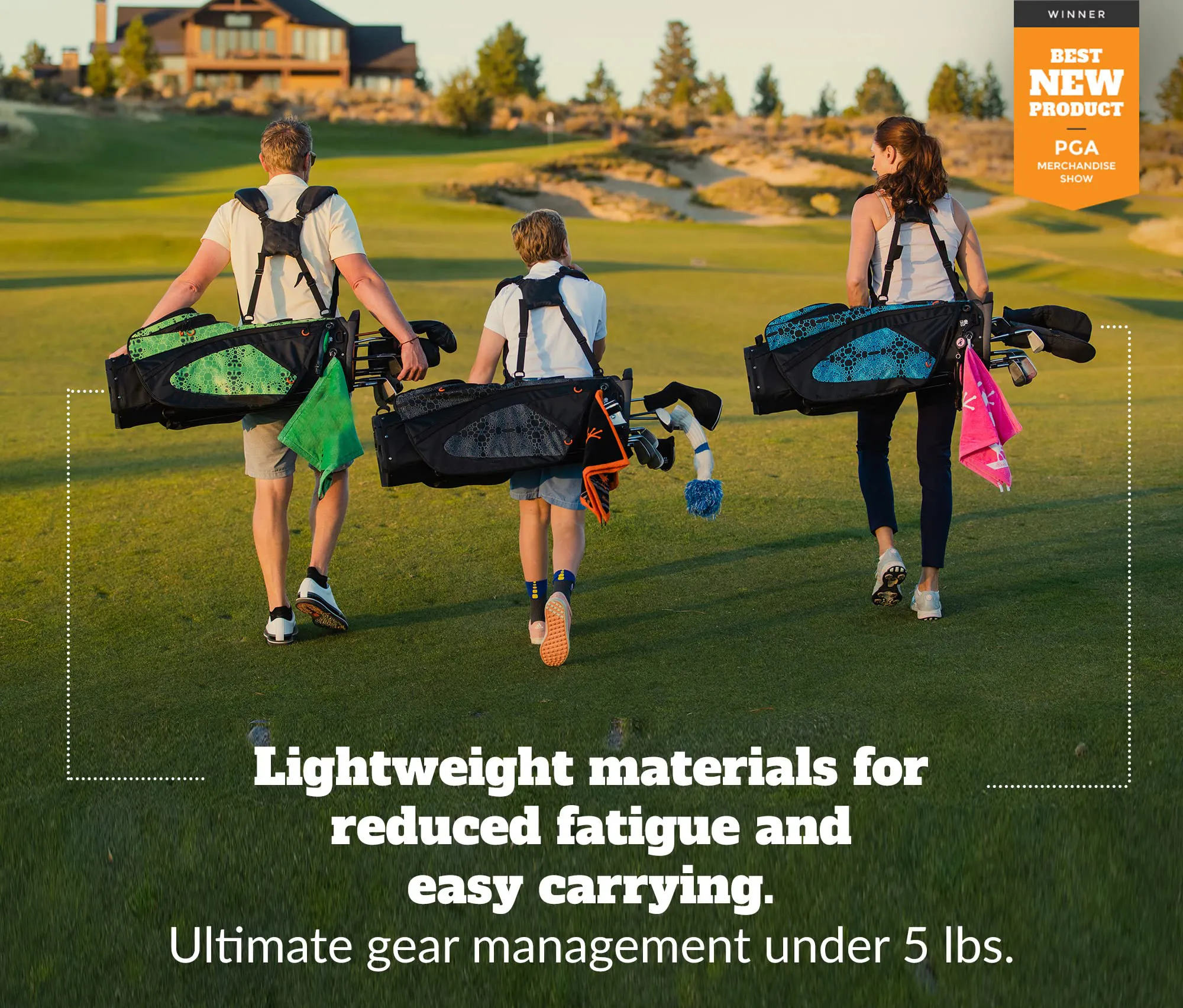
The ergonomics of a rangefinder pocket start with how a player moves on the course. A player walking with a dual-strap bag carries the bag on both shoulders, so the pocket a player reaches into must sit where the shoulder straps do not cross it and where the natural line of sight and arm reach lands. On most carry stand bags the usable band is the front flank from roughly thigh height up to lower-rib height; above that the shoulder strap lies, and below that the reach is a deep bend. We aim the rangefinder pocket's opening into that band.
Side is the next decision. A right-handed player typically carries and reaches with the right or dominant hand while the left arm steadies, so a rangefinder pocket placed on the side the player faces and reaches as the bag rests on the shoulder tends to be the most used. There is no universal rule because carry preference varies, so we offer the pocket on either flank and default to the side consistent with the target market's dominant hand. Mirroring the layout for a left-handed program is a pattern change we plan up front rather than a retrofit, and it costs little when it is in the original spec.
Placement height: the strap-line rule
The single most common placement error is a rangefinder pocket that sits under the shoulder strap. A pocket looks correctly placed on the flat designer's drawing but once the dual strap is anchored across the shell, its webbing can lie directly over the pocket opening, forcing the player to dig under the strap. We avoid this by defining the pocket's top edge against the strap-line measurement on the actual loaded silhouette, not the empty shell. On the production bag, the strap foot prints somewhere on the upper shoulders; the rangefinder pocket must clear it.
Height relates to comfort, too. A pocket placed too high raises the loaded weight and sits close to the integral lug; too low forces a bend and can collide with the stand leg housing. We typically target the pocket so its base sits around the middle-to-upper third of the front flank, a position that reaches naturally when the bag is on the shoulder and clears the bottom wear plate and stand hinge. If the program must carry two devices — a range finder and a larger binocular — we spec a taller single pocket rather than two small ones, because two shallow pockets rattle and each needs its own buff.
Closure: magnet speed versus zipper seal
The closure choice for a rangefinder pocket is a genuine trade-off that depends on how the device is used. A magnetic closure gives the fastest, quietest one-handed open-and-close, which suits the "grab the device, scope the flag, drop it back" rhythm on the course — and our earlier engineering guide covers magnet grade and holding force in detail. A zipper gives a positive seal so the device cannot slide out, which matters in a cart or through rough carry, but it is slower to use and can snag.
Our guidance is to decide by drop risk and access frequency. For a walker who reaches constantly, a magnet with a correctly tuned breakaway force is the more fluid answer. For a player who uses a cart or stores the rangefinder for long stretches, a zipper is the safer enclosure. We also size the pocket so the closed flap holds the device snugly — an oversized pocket lets the device rattle against the seam, which is both noisy and a stress point for the optics. Define the model and the use pattern and we will route the closure accordingly on the pattern.
Protecting the optics: lining, buff, and floor pad
A rangefinder is a precision optic with a lens that scratches and an interior that does not survive repeated impacts, so protection is a real engineering input rather than optional padding. We line the pocket interior with a soft, non-scratch material and add a padded buffer so the device never rests directly on a naked seam. The floor of the pocket gets the most attention: when the loaded bag is set down on its stand, the shock travels down the pocket walls to the base, and a foam floor buff absorbs that impact so the device does not strike the plastic bag base.
We also protect the lens edge. Many rangefinders sit lens-up in a pocket, so the top of the pocket should have a soft lip or a pocketed inner hood rather than a bare zipper tape that could graze the lens. If the device has a lanyard or carabiner, we can add a small interior anchor loop so the player can tether it — a detail that both improves safety and looks considered in retail photography. When you brief us, share the exact model and its dimensions so the buff, the floor pad, and the lens protection are matched to the real device rather than a generic "small electronics" assumption.
| Rangefinder Pocket Element | Typical Spec | Protection / Ergonomics Note |
|---|---|---|
| Position on flank | Front mid-to-upper third, clear of shoulder strap | Confirmed on loaded silhouette, not flat pattern. |
| Reach height | Hip-to-rib band, one-hand reach | Reverse flank for left-handed program. |
| Interior lining | Soft non-scratch fabric | Prevents lens and finish scuffing. |
| Floor / base buff | 5-12 mm padded foam insert | Absorbs drop shock; protects device and bag base. |
| Closure | Magnetic or zipper | Magnet for speed, zipper for positive seal. |
| Pocket sizing | Snug to device + padded insert | Prevents rattle and stress on optics. |
Handedness and mirroring the layout
Handedness is more than a sidebar: it determines which flank the pocket faces and therefore whether the target player actually reaches it. A right-handed golfer usually drops the rangefinder on the side they face and reach with the free hand while the bag hangs; an all-right-handed assumption can leave a left-handed market with an awkward, unused pocket. When we build a program for a specific region or a retailer that skews one way, we confirm the handedness before pattern.
Mirroring is cheap when it is designed in, and costly when it is a retrofit. Because the rangefinder pocket sits within the shell panel, moving it to the other flank changes the pocket layout, the strap anchor clearance, and possibly the divider alignment. We therefore ask for the target market's dominant hand and mirror the whole pocket map — rangefinder, valuables, cooler — together, so the geometry stays coherent rather than flipping one pocket into a conflict. It is a one-line decision on the RFQ and it prevents a whole season of "nice bag, awkward pocket" returns.
How the pocket interacts with the stand structure
Because a stand bag folds, the rangefinder pocket must be positioned and constructed so the stand deployment does not deform it. The rear leg housing and the hinge block move when the legs extend; a pocket stitched across those zones would buckle, crease, or pull its seam as the bag stands. We keep the rangefinder pocket on the non-folding flank and verify that the loaded pocket does not push against the center divider tube or shift the bag's center of gravity noticeably when a heavy device is inside.
Weight balance is the quiet half of placement. A rangefinder is not heavy, but combined with a fully loaded cooler and a slotted club arrangement, a device toward the outer shell can contribute to a side-heavy carry. We consider the rangefinder pocket in the overall balance map — pairing a device pocket on one flank with the ball or apparel pocket on the other is a common way to keep the loaded bag reasonably centered. State your full pocket list and the device weights, and we will assemble the flank layout to protect both the device and the carry balance.
Sample validation: test the reach, not just the look
The definitive test for a rangefinder pocket is a loaded wear test, not a visual check. We load the sample with a real or dummy device of the correct weight and dimensions, put it on a stand silhouette, and confirm three things: that the pocket clears the strap and the hand reaches it in one motion, that the device sits snug without rattling, and that setting the bag down does not transmit shock to the device or deform the pocket. These three checks are quick but invisible to a flat-pattern review, and they are why we advise an actual evaluator sample rather than relying on product photos.
If you are a buyer launching a rangefinder-carry line, order a small armed sample — even 20-30 units — and have a few players of the target hand use it for a round before you commit to a full container. The feedback on reach, closure feel, and device safety will be worth far more than a photographed mock-up, and we will make the pattern adjustments at the pre-production stage, which is the cheapest point in the process to change. Our sampling window for a rangefinder-pocket evaluation is 10-20 days before bulk production at 45-60 days.
It is also worth testing in the two states the bag actually lives in: on the shoulder and standing on its legs. On the shoulder the strap line and reach matter; standing, the pocket must hold the device securely so it does not slide toward the base when the bag tips back. Both states change how the pocket behaves, and a pocket validated only in one orientation will surprise you in the other. We recommend you specify the intended storage habit of your target player — does the rangefinder live in the pocket all round, or is it lifted out after every shot? — because that changes whether a snug friction pocket or a quick-release one is the better engineering answer for your line.
Sizing the pocket to the device family
Rangefinders are not one size, so a "one-size rangefinder pocket" is usually a wrong-size pocket for someone. A compact laser rangefinder, a full binocular, and a GPS golf watch each need a different interior. Rather than guess, we ask for the exact model, and we design a pocket that is snug around the real device with a little room for the padded buff. A pocket that fits a rangefinder loosely lets it list sideways in the bottom of the bag — noisy, awkward to grab, and stressful on the lens housing.
The depth of the pocket matters as much as the width. A deep pocket swallows a rangefinder so it sits at the bottom, which is fine for protection but poor for quick access; a shallow pocket shows the device handle for a fast grab but gives less drop protection. We balance depth so the device's grip or lanyard loop clears the opening — that is exactly where players grab it, and it also lets a lanyard tether anchor without crowding the lens area. If your line spans several device sizes, we can offer two pocket depths or an adjustable inner baffle, and we cost the two options on the quote so the decision is driven by your segment rather than a single model assumption.
QC checkpoints for the rangefinder pocket
On the inspection line, the rangefinder pocket earns specific checks. We measure the interior dimension against the sealed pattern to confirm the device fits snugly, check that the floor buff is present and correctly padded on the run's first article, verify the closure's breakaway force or zipper smoothness, and inspect the inner lens lip for any loose stitching that could scratch optics. A first-article inspection on the first unit of each bulk run locks all of this before the rest of the batch moves through.
Because the closure and the protection stack are mechanical and repeatable, a sealed master per program lets reorders match the approved feel. We keep the device spec, the buff spec, the closure force window, and the placement coordinates with the master, and re-verify on reorders so a new fabric batch or a new magnet lot never quietly changes the pocket your buyer approved. Because the device travels inside the pocket during transit, we also add an outbound packaging note: the rangefinder pocket should be packed empty at carton level so the insulation and buff are not crushed flat before the bag reaches the retailer, which would change the device fit from the sealed sample.
Closing brief — what to send the factory
To quote a rangefinder pocket accurately, send the exact rangefinder model and its dimensions, the target market's dominant hand, the use pattern (walker versus cart), and a closure preference. Add your expected MOQ, timeline, and target market, plus photos of a rangefinder pocket you like, and we will map height, side, closure, and buff before sampling. That compact brief gets you a locked architectural tolerance instead of an estimate and cuts the sampling loop in half.
We support OEM (fitting a rangefinder pocket to proven stand-bag architectures with correct placement and protection) and ODM (co-developing the pocket depth, buff, lining, and closure from your brief). Reach our sourcing team at service@junyuanbags.com or +86 17750020688 and we will schedule your rangefinder-pocket evaluation sample inside the 10-20 day window.
Recommended Internal Links
- Products (Stand Bag Architectures)
- OEM/ODM Service
- Factory & QC
- Golf Stand Bag Buying Guide
- Magnetic Pocket Design Guide
FAQ
Which side should the rangefinder pocket go on a golf stand bag?
Most right-handed golfers carry the bag so the left flank faces forward, so a left-side rangefinder pocket at hip-to-rib height lets a one-handed reach while walking. Reverse it for a left-handed program. Height matters more than side because the pocket must sit where the strap does not cover it.
How protected does a rangefinder need to be in a stand bag pocket?
A rangefinder is a precision optic, so the pocket should have a soft inner lining, a padded or corduroy buff, and some shock-absorption at the floor, plus a secure closure. We avoid a bare naked seam floor so the device does not knock against the plastic base assembly.
Should a rangefinder pocket zip or use a magnet?
Both work depending on the priority. A magnet gives fastest one-handed access and a quiet close; a zipper gives a positive seal so the device cannot slide out in a cart. For a drop-prone device we prefer a magnet with a high holding force or a zipper, and we size the pocket so it grips the device rather than rattles.
What size should a rangefinder pocket be for a common laser rangefinder?
Most laser rangefinders are roughly 7-13 cm tall, 6-10 cm wide, and 4-6 cm deep. We spec the pocket a little larger than the device with a padded insert, so it holds the model snugly without squeezing the optics. Confirm the exact device dimensions when you send the brief so the buff and floor pad are correct.
Why does a rangefinder pocket need a floor pad?
A rangefinder dropped into the bag and then the bag set down hard transmits shock to the base of the pocket. A foam or padded floor buffers that impact and stops the device from striking the plastic stand base. We add a floor buff and specify a modest drop tolerance in the QC plan.
Do you support OEM and ODM for rangefinder pockets?
Yes. We support OEM by fitting a rangefinder pocket to proven bag architectures with correct placement and lining, and ODM by co-developing the pocket depth, buff, and closure. Send your rangefinder device model and target market to start — ship from our Quanzhou facility.
How do I make sure the rangefinder pocket is accessible while walking?
Place the pocket where the dual strap does not cross it and where the hip-to-rib reach is natural, usually the front upper-to-mid flank. Confirm on a sample by wearing the loaded bag and checking the reach — a pocket that looks fine on a drawing can sit under the strap on the production silhouette.
Request a B2B quote for golf stand bags
Send your target market, expected MOQ, and reference photos. We respond within 24 hours with a sampling plan.