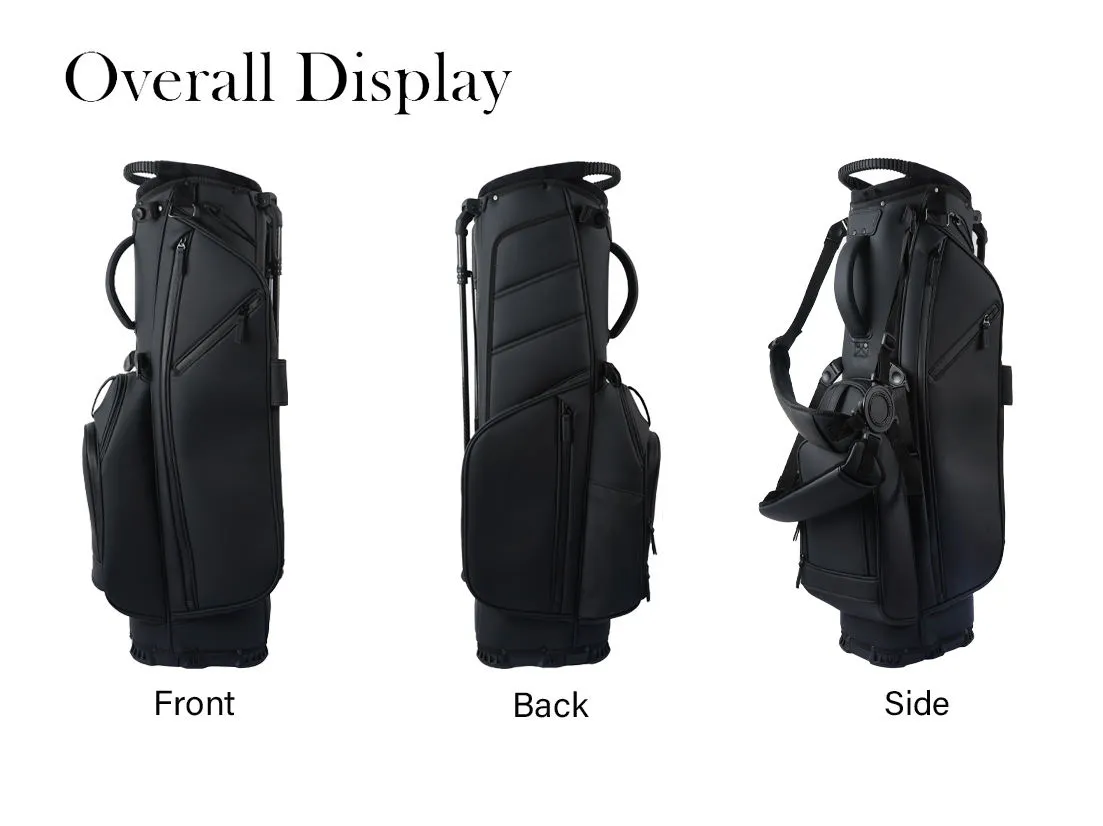
For a B2B golf brand, OEM means putting your branding on a proven stand bag architecture — you get a field-tested build with your identity, at a 200-piece MOQ per colorway (100-piece test order), sampling in 10-20 days and bulk in 45-60 days. This guide explains the concrete advantages of OEM versus a fully custom build, how to differentiate inside a proven shell, and the QC records a professional factory keeps so your brand stays consistent every season. For brands that want a fully customized silhouette — structure, dividers, pockets and hardware — our custom golf bag factory team specializes in OEM/ODM programs.
Key Takeaways
- OEM rides on a field-tested architecture, cutting development risk.
- Faster sampling and lower cost than a fully custom build.
- Brand identity still carries: logo, colorways, trim, packaging.
- 200-piece MOQ, with a 100-piece test order available.
- Sealed masters and AQL logs make reorders a straight repeat.
OEM vs. ODM: Where the Advantage Lives
It helps to be precise about the split, because buyers often use the terms loosely. OEM, original equipment manufacturing, means the factory takes a proven stand bag architecture it already produces and applies your branding, colorway, and packaging. ODM, original design manufacturing, means the factory co-develops the structure, pocket layout, materials, and hardware from a more open starting point. OEM is the lower-risk, faster path; ODM is the fuller ownership play.
The advantage of OEM is that you inherit the result of every previous production run. The stand geometry has been cycle-tested, the zipper has been vetted, the divider alignment has been refined, and the sewing patterns have been debugged on real orders. You are not betting on an untested design; you are renting a proven one and making it yours on the surface. That is the single biggest advantage, and it is easy to understate until you have watched a full custom build go through multiple painful sampling rounds.
Inside that proven shell you still own a real product. Your logo, your color palette, your trim, your hardware finish, and your packaging all carry your brand into the market. Most buyers differentiate an OEM line enough to own a distinct shelf presence while keeping the development risk near zero.
Faster and Cheaper to Launch
Time and money are the two hardest currencies in a season, and OEM spends both more slowly. Because the architecture is already proven, the sampling cycle shrinks: instead of multiple concept rounds to validate an unproven structure, you move quickly to colorway and branding refinements on the known build. At our affiliated plant the sampling loop runs about 10-20 days, and bulk production 45-60 days — a cadence you can actually schedule a retail launch against.
Cost behaves the same way. An OEM build reuses existing patterns, learned production flow, and proven material trim, so you are not absorbing development cost for structural reinvention. Your per-unit price lands closer to the standard build, letting a new brand or a new SKU enter the market with a healthier margin than a fully custom first run would allow. For a brand testing a new retailer or a new category, that margin is the runway that gets you to a second season.
The risk reduction compounds, too. A first custom build can eat three or four sampling rounds and still arrive with a structural surprise on the course. An OEM build reduces that surface, so your first season focuses on selling and sell-through data rather than firefighting a flawed new architecture. That predictability is worth real money to a launch.
How You Differentiate Inside a Proven Shell
New buyers sometimes worry that OEM means a generic bag. It does not. Your differentiation lives in the choices you control: the colorway and any contrast panels, the accent trims and hardware finish, the logo method and placement, the pocket accessories, and the packaging. A distinctive two-tone colorway with a tonal logo and premium hardware can read completely differently from the same base architecture in a flat color with screen-print branding.
Functionally, you can add signature options atop the base: a removable cooler pocket, a magnetic rangefinder closure, a full-length divider upgrade, or a valuables pocket with a specific closure. These functional add-ons turn a proven build into your SKU while keeping the structural core validated. The factory can often suggest which options attach cleanly to which architecture so you spend on features that fit rather than features that fight the build.
The packaging and hang-tag story is part of the differentiation too. Premium cartons, custom hang tags, and a consistent logo treatment on the hood and strap make an OEM product carry your brand voice. Buyers who treat OEM as "just relabeling" miss half the advantage; buyers who treat it as "proven core, fully branded surface" build a real brand on a reliable base.
The Economics of a 200-Piece OEM Program
Because the architecture is proven, the MOQ economics are friendly to a first program. The regular 200 pieces per colorway lets you order a workable season without over-committing capital, and a 100-piece test order is available to validate the look, photography, and early sell-through before the full run. It is an entry point designed for a brand that wants a real product line without betting the company on a custom container.
Multi-colorway planning stays disciplined on an OEM line. Each colorway is its own dye lot and minimum, so we recommend keeping a first season to two or three colorways on one architecture. That keeps you above the minimum comfortably, spends your photography budget on shots that convert, and builds a clean baseline for reorders — the same discipline that applies to any stand bag program.
The total landed cost also benefits from the proven trim. Because the material list is stable, freight and duty are more predictable, and the unit price at the 200-600 piece range reflects the volume break. For a buyer comparing OEM against a fully custom first run, the per-unit delta at launch is usually the deciding factor, and it favors the proven path every time.
QC and Repeatability Are Inherent to the Model
A professional OEM factory does not just brand a bag; it manages the records that make the brand repeatable. The sealed master captures the exact approved build, the color chips freeze each colorway, and the AQL inspection logs track every lot. For an OEM program those records mean a second season looks identical to the first, and a reorder is a straight execution rather than a re-discovery.
At our SGS-verified affiliated plant, seven lines, 149 machines, and 137 staff run inline checkpoints from material to final inspection, holding tolerances on the stand, zippers, and straps while producing about 150,000 bags a month. That installed QC depth is what backs the OEM promise: you are not buying a sample and hoping; you are buying a controlled process with a documented history.
For your due diligence, request the AQL plan, the sealed-master reference, and the inspection log of the last lot before your first PO. A professional factory provides them without hesitation because repeatability is the product it sells. That documentation, plus a reference from a current brand client, is the fastest way to confirm the OEM promise is real. If a supplier cannot produce those records for its proven architecture, the "proven" part of its pitch deserves a second look.
When OEM Is the Right Call — and When It Is Not
OEM is the right call for most first launches, most replenishable core lines, and any SKU where time-to-market and margin matter more than radical product novelty. If you need to be in retail for a season that is twelve weeks away, OEM gets you there. If you need a proven bag under your new brand while you build category evidence, OEM is the lower-risk entry. It is the sensible default for the majority of B2B golf programs.
ODM or a fully custom build makes sense when the architecture itself is your competitive story — a signature divider system, a unique stand mechanism, a proprietary waterproof construction that defines the brand. In that case the extra sampling rounds and development cost are the price of ownership, and they are justified because the product cannot be bought anywhere else. Most mature brands run a hybrid: a core OEM line for proven sellers and a custom ODM line for the hero SKU.
Reach out with your market position and we will recommend which mode fits. If you are testing the water, an OEM test order gives you the fastest evidence; if you have a signature concept, we will scope the ODM path with the sampling and QC plan in place. Either way the decision is about what your brand needs, and the factory's job is to match it.
OEM vs. ODM Comparison
Use this table to position your program and brief the factory cleanly.
| Consideration | OEM | ODM |
|---|---|---|
| Architecture | Proven, field-tested | Co-developed with factory |
| Development risk | Low | Higher |
| Sampling to launch | Faster (10-20 days sampling) | Longer, multiple rounds |
| Per-unit cost | Closer to standard build | Adds development amortization |
| Brand differentiation | Color, logo, trim, packaging | Full structure and ownership |
| Typical MOQ | 200 pcs (100 test) | Often higher for full custom |
| Best for | First launch, core line | Signature or hero SKU |
Branding That Carries an OEM Bag
The surface treatment decides whether an OEM bag reads as your product or as a generic factory bag. Start with the colorway, because it is the strongest visual signature — a distinctive two-tone or tonal-block palette instantly separates your SKU from the base architecture in a thumbnail. Pair it with a coherent trim story: the zipper pulls, the strap accent, the logo thread, and the hardware finish should echo one family of colors so the bag feels designed rather than assembled.
Place the logo with intent. The front lower panel is the hero zone in retail photography, the top lid is the second mark, and an interior woven label carries the brand quietly. Adding a small tonal logo on a valuables or cooler pocket gives a third impression without clutter. Brief the artwork as vector AI or EPS, color-separated by Pantone, and lock the placement coordinates in the tech pack so the same lockup repeats every season.
Finally, let the packaging finish the story. Premium cartons, a consistent hang-tag design, and a matching hood and strap label turn a low-risk OEM build into a shelf-ready brand moment. The factory can advise which accessory and packaging choices attach cleanly at the best value, so the differentiation you add spends budget where it returns on the shelf. That is how a 200-piece OEM order becomes the beginning of a real line.
The Roadmap for Your First OEM Run
A first OEM run is straightforward when you follow a sequence. Step one, pick the base architecture from the proven line that matches your market — lightweight carry, 14-way, waterproof, or hybrid. Step two, write the one-page brief: target market, colorway, logo method and placement, accessories, packaging, and target quantity. Step three, approve the pre-production sample and lock the color chips and sealed master.
Step four, schedule the run against your season: sampling in 10-20 days, bulk in 45-60, leaving a buffer for a colorway correction. Step five, agree the AQL plan and functional tests with the factory before the run, and step six, review the first-article inspection on run unit #1. With those six steps handled, the first season ships on time and on spec, and the records you collect make every reorder simply a matter of confirming the date and quantity. That is the quiet payoff of the OEM model: the structural risk never has to be taken more than once.
Most of the friction buyers feel on a first OEM order is actually a briefing gap, not a factory problem. A complete brief removes the back-and-forth that eats the sampling window, and a willingness to approve the sealed sample before bulk removes the release-time surprises. Treat the OEM line as a program you manage, not a transaction you place, and the advantages compound across seasons rather than fading after the first. Keep the same brief discipline on the second order and the third, and what was once a six-step launch becomes a routine repeat that you can schedule with confidence.
Getting a Fast OEM Quote
The fastest path to an accurate OEM quote is to send a complete brief: your target market and price positioning, the base architecture you are interested in, the colorway direction, the logo method and placement, the accessory and packaging wishes, and the expected quantity. With that, we can quote the true additive cost of branding and options rather than a generic placeholder, and confirm the MOQ and lead time against the season you are chasing.
Attach reference photos or a vector artwork file so the branding is priced correctly the first time. A buyer who sends the full spec gets a quote that is actually accurate; a buyer who asks for a number with no detail gets a range that means nothing. The documentation discipline that runs the factory is the same discipline that should run your RFQ.
From there we will confirm the sampling plan, the AQL checkpoints, and the lead time, and you will be on a track to a repeatable program. Our OEM/ODM service section details the modes, and the products page maps the base architectures you can build your OEM line on. For the broader picture, the buying guide frames the same decisions from the sourcing side.
OEM for Retailers, Clubs, and Tournament Lines
OEM is not just for private consumer brands. Retailers use it to build an own-label stand bag that competes beside tier-one brands at a sharper price. Clubs and resorts use it to extend a course identity into carry gear and pro-shop merchandise. Tournament and charity organizers use it to create a seasonal commemorative bag that carries a logo, an event date, and a theme — often in limited quantity that a custom ODM build could not justify economically.
For each of those programs, the OEM advantages look slightly different. A retailer needs margin and speed to market, which the proven architecture and short sampling deliver. A club needs a repeatable, consistent look that matches its crest year after year, which the sealed master guarantees. A tournament needs a small, on-time run that photographs well, which the 100-piece test order and 45-60 day bulk cadence make possible against an event calendar.
When you brief those programs, tell us the endpoint — the retail shelf date, the season opening, the event day — because it lets us schedule sampling and production against it. A commemorative run that ships a week late has lost its value; a club line that matches the crest exactly builds equity. OEM adapts to each, and the records we keep make the second tournament, the second season, and the second shelf an easy repeat.
Why a Professional Factory Wins on OEM
Not every factory delivers the OEM promise equally. A professional factory brings three things a small workshop cannot: a proven pattern library, a controlled QC process, and the records to prove repeatability. The pattern library means your colorway and branding sit on an architecture that has already been debugged; the QC process means that architecture is reproduced faithfully every run; and the records mean your reorder is a documented repeat, not a fresh gamble.
The scale helps too. Seven lines, 149 machines, and 137 staff give the depth to run your line without disrupting others, and the export history across 100+ countries means the documentation, freight, and compliance workflows are proven. When your OEM line scales into a second colorway or a second SKU, the factory absorbs that growth without a quality dip, because the process is designed for volume with control.
That is the real advantage of OEM from a professional factory: you buy a proven product, a proven process, and a proven relationship — and your only job is to make the brand on the surface compelling. The architecture, the QC, and the records carry the risk, which is exactly where a serious B2B buyer wants it. If you are deciding between building from scratch and riding a proven base, start a conversation with us at service@junyuanbags.com or +86 17750020688, and we will advise where OEM saves you time and where a custom element earns its cost.
Recommended Internal Links
- OEM/ODM Service
- Products (Stand Bag Architectures)
- Factory & QC
- Golf Stand Bag Buying Guide
- How to Negotiate Prices with a Stand Bag Factory
- Custom Stand Bag Lead Time
FAQ
What is OEM for golf stand bags?
OEM means your brand and artwork are applied to a proven stand bag architecture that the factory already produces. You get the reliability of a tested build with your own branding and packaging.
How is OEM different from ODM?
OEM brands an existing, proven architecture, while ODM co-develops the structure, materials, pockets, and hardware with the factory. OEM is faster and lower-risk; ODM gives full product ownership.
Why would I choose a proven OEM architecture over a fully custom build?
A proven architecture has already been field-tested and refined, so the stand, zippers, and structure carry lower development risk. It also shortens lead time and sampling to a faster and cheaper cycle.
Can I still differentiate my brand with an OEM golf stand bag?
Yes. Branding, colorways, trim, logo, and packaging carry your identity, and you can add functional options like a cooler pocket or magnetic closure atop the base architecture to create a distinct SKU.
What MOQ and lead time come with OEM stand bags?
The regular MOQ is 200 pieces per colorway with a 100-piece test order. Sampling runs 10-20 days and bulk production 45-60 days at our SGS-verified affiliated plant.
Do you hold QC records for OEM programs?
Yes. We keep the sealed master, approved color chips, and AQL inspection logs per program, so a reorder and a second season repeat the original build exactly.
Can I mix OEM and ODM across my product range?
Yes, many brands run a core OEM line for proven sellers and an ODM line for signature products. We support both from the same affiliated facility, downstream of QUANZHOU JUNYUAN BAGS.
Request a B2B quote for golf stand bags
Send your target market, expected MOQ, and reference photos. We respond within 24 hours with a sampling plan.