For a featherweight minimal carry, explore our Sunday bags — Practice golfers can also browse our range and simulator golf bags — For a B2B buyer launching a stand bag line, the material decision is a three-way trade between nylon, PU leather, and polyester — and the practical answer is usually a mix, with a coated polyester or nylon shell carrying the unit cost 15-30% below a leather-faced build while PU leather earns its place only on trim and branding zones. This complete guide walks you through the weight, durability, water behaviour, cost, and best-use of each family, so you can build a material map that matches your retail price point instead of copying a catalogue.
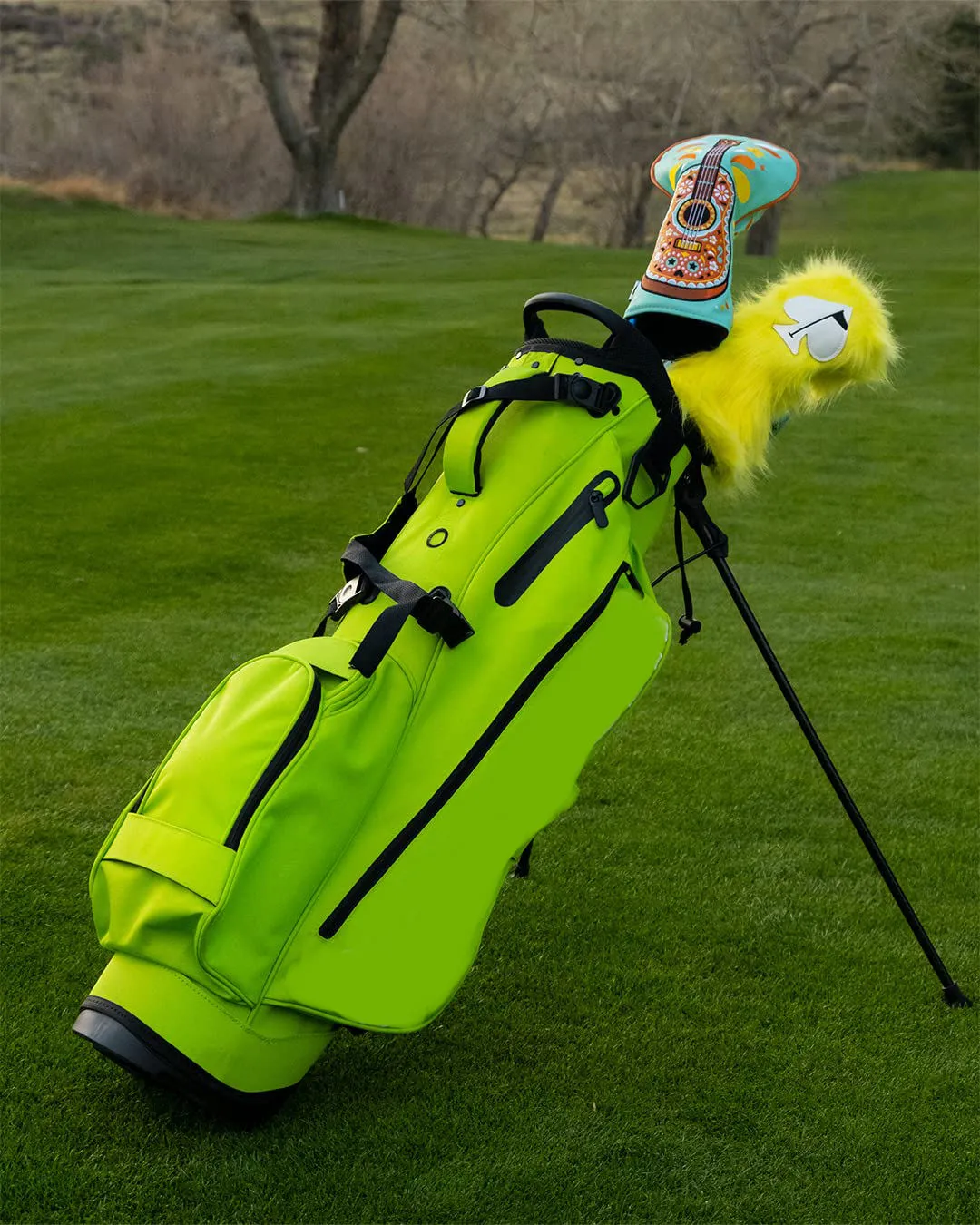
Key Takeaways
- No single material is "best" — the right choice is a mix matched to price point, weight target, and climate.
- Nylon wins on strength-per-gram; polyester wins on cost and colour consistency; PU leather wins on premium feel, used sparingly.
- Water resistance comes from coating and seam system, not from the fibre family itself.
- Shell-to-shell material changes typically move unit cost 3-8%; the rest of the BOM dominates.
- Write panel-by-panel material specs in the tech pack — "mixed material" is only a rough direction.
Setting up the comparison: the three families
Every stand bag shell is a compromise between weight, durability, feel, waterproofing, and cost, and the three material families each own one end of that trade. Nylon is the strength-per-gram specialist: it carries the lightest weight at a given tear and abrasion resistance, which is why it anchors featherweight and travel lines, at the price of higher yarn cost and moisture absorption when uncoated. Polyester is the value workhorse: cheaper, colour-stable, and predictable under a coating, it anchors the volume and mid-tier half of any catalogue. PU synthetic leather is the aesthetic layer: it delivers the premium, structured look that photographs well in retail, but it is heavier and less abrasion-resilient than a coated technical fabric when used in volume.
The most important framing is that these are not competitors for one shell — they are building blocks for different zones of the same bag. A typical well-engineered stand bag uses a polyester or nylon main shell, PU leather on the branding patch, the top collar, and the valuables-pocket front, and a coated nylon or polyester on the wet-facing base. Deciding between the families is really deciding where each earns its cost, and that requires a panel-by-panel material map rather than a single-material brief. We build these maps in every OEM/ODM quote at our affiliated plant in Quanzhou (SGS-verified March 2026, 4,950 sqm, 7 lines, 149 machines, 137 staff), because the margin is in the mix.
Material-by-material comparison table
The table below summarises how the three families behave across the specs a B2B buyer actually signs off. Figures reflect typical Quanzhou/Xiamen OEM practice and the tolerances we hold at QUANZHOU JUNYUAN BAGS; confirm each on the production sample.
| Spec | Nylon | Polyester | PU Leather |
|---|---|---|---|
| Weight per strength | Best (lightest at given tear) | Good (slightly heavier per denier) | Heaviest (adds grams in volume) |
| Tear/abrasion | High (ripstop variants) | Good | Fair; prone to age-crack on flex |
| Relative yarn cost | High (15-30% over poly) | Low | Moderate per meter |
| Colour consistency | Good, needs care | Excellent (disperse dye) | Good; embossed grain can vary |
| Water behaviour | Absorbs unless coated | Coats predictably | Not naturally waterproof |
| Waterproof build | PU/TPU coated + taped seams | PU/TPU coated + taped seams | Trim only on all-weather lines |
| Hand feel | Technical, light | Clean, sportive | Premium, structured |
| Primary role | Featherweight/travel shell | Volume/mid-tier shell | Trim + branding zones |
Nylon: when strength-per-gram wins the line
Choose nylon when the buying decision is dominated by weight. A 210-400D ripstop nylon shell is the standard entry for featherweight and travel stand bags because it holds a given tear and abrasion load at a lower gram count than an equal polyester panel — typically letting a factory shave 150-300 grams off the shell without trading structural confidence. Nylon's energy return under flex also helps the areas that fail fastest: the leg hinge block, dual-strap anchors, and base corners tolerate repeated bending and compression better than a comparable polyester at the same gauge.
Where nylon demands discipline is water and dye. Uncoated nylon absorbs moisture and gains weight when wet, and some constructions hold colour less evenly than polyester across dye lots. So a nylon program usually pairs a coated shell (PU or TPU) with a colour-sealed chip and a first-article inspection. If your line competes on "lightest bag" or targets frequent flyers or the lightest golf stand bag segment, nylon is your material; if it competes on price at volume, the premium is harder to defend. A full nylon shell moves unit cost 3-8% versus polyester before branding — a delta worth trading up into the stand mechanism or dividers in most cases.
Polyester: the volume and value workhorse
Polyester is the default for volume because it wins the three operational arguments that decide a mass-produced line: cost, colour repeatability, and coating predictability. It costs less per meter, dyes to a tight tolerance across lots with disperse dyes, and takes PU and TPU coatings evenly, so a waterproof claim is easier to make repeatable at scale. If you run four seasonal colourways across a 200-piece MOQ and beyond, polyester's dye consistency is the single most de-risking property in the catalogue.
The trade-off is that polyester is marginally heavier than nylon at an equal strength target, and it does not flex-recover quite as cleanly on the hinge. In practice those penalties rarely matter on a 4-6 lb bag where hardware dominates weight. For a value retail line that needs to hit a margin and ship volume, a graded coated polyester build — lighter above the waist, heavier at the wet-and-wear zones — delivers the best durability-per-dollar in the business. It is why most mainstream and budget stand bags, and nearly all waterproof-spec volume lines, are polyester first.
PU leather: the premium accent, used sparingly
PU synthetic leather earns its place on premium-feel lines, but almost never as a full shell. It photographs beautifully, carries embroidery and debossing cleanly, and reads "expensive" in retail imagery — which is why the branding patch, the top collar, the valuables-pocket front, and the handle wrap are classic PU-leather zones on a quality stand bag. It is also easy to wipe clean, which buyers selling into hospitality, corporate, and rental segments value.
The honest limits are weight and flex durability. PU leather is heavier than a coated technical fabric, and over years it can age-crack on high-flex zones like the hinge. It is not naturally waterproof, so on an all-weather bag it belongs on trim, not the wet-facing shell. As a deliberate accent on maybe 5-15% of the panel surface, PU leather upgrades perceived value far beyond its cost; used as a full shell it drags weight and price with no functional gain. The skill is placing it where the eye lands — and letting a coated technical fabric do the heavy lifting underneath.
How to actually choose: a decision-mapping framework
Stop asking "which material" and start asking four questions in order. First, what is the price point — because it sets the shell budget and rules out a leather-faced build above a certain threshold. Second, what is the weight target — a featherweight travel line forces nylon or a light open polyester weave. Third, what climate and abuse — a rainy or cart-heavy market pushes you to a coated shell and heavy base reinforcement. Fourth, what does the brand need to photograph — PU leather trim for premium retail, clean technical nylon for a performance line.
Work those four answers into a panel map. It is common to land on a polyester shell with PU-leather branding zones for a value-premium line, or a coated nylon shell for a travel-specialist brand, or a full polyester waterproof build for a budget all-weather SKU. The map also fixes the joins — PU leather onto technical fabric needs a clean piping or bound seam, and coated panels need the coating shielded at the sewing line. When you bring that map to a factory, the quote, the sample, and the warranty rate all improve because the mix is decided, not improvised.
Cost: where the 3-8% really sits
Buyers overestimate the cost of material choice because they look at fabric per meter, not the finished bag. On a complete stand bag the shell is a minority of the BOM — the stand mechanism, divider system, zippers, straps, hardware, branding, and labour dominate. Shifting the shell from polyester to nylon typically moves unit cost by 3-8%; adding a PU-leather trim package adds proportionally on top. So a "which material" decision rarely changes the landed price by double digits; it changes the story the bag tells at retail and the warranty rate it earns over a season.
The smarter budget move is to fix the material mix first, then decide where to spend the difference. If a nylon shell frees a few percent, spend it on a stronger hinge or full-length dividers — features shoppers feel and repurchase. If a polyester shell saves a few percent, spend it on a better zipper or a rainguard spec that reduces returns. At QUANZHOU JUNYUAN BAGS we lay the material and functional options side by side in the quote, with our standard 200-piece MOQ (100 for a test order), 10-20 day sampling, and 45-60 day bulk, so you can pilot the mix before committing to a container.
Waterproofing across all three families
Water resistance is an envelope, not a fabric property, and it applies the same logic whichever shell fibre you choose. The envelope has five layers: a face finish that beads off rain, a coating or lamination that blocks pressure, seam taping at pocket lips and the base hem, a rainguard or flap zipper, and base drainage so pooled water escapes the harness. Coated nylon and coated polyester both reach high water columns — a TPU-laminated shell can hold to 5,000-10,000 mm — while PU leather is not naturally waterproof and appears only as trim on an all-weather bag.
The fibre choice does change one thing: how easy the coating is to hold in bulk. Polyester takes coatings predictably and is the safe default for a waterproof volume line; nylon takes them well too and wins when weight is the driver. Either way, write the water-column in millimetres, the coating type, the seam-taping scope, and the zipper spec into the tech pack, then validate with a water-column and flex test on the production panel. A "waterproof" claim is only as good as the four or five line items that support it, and those are identical in spirit across every material family.
Panel-by-panel material map (worked example)
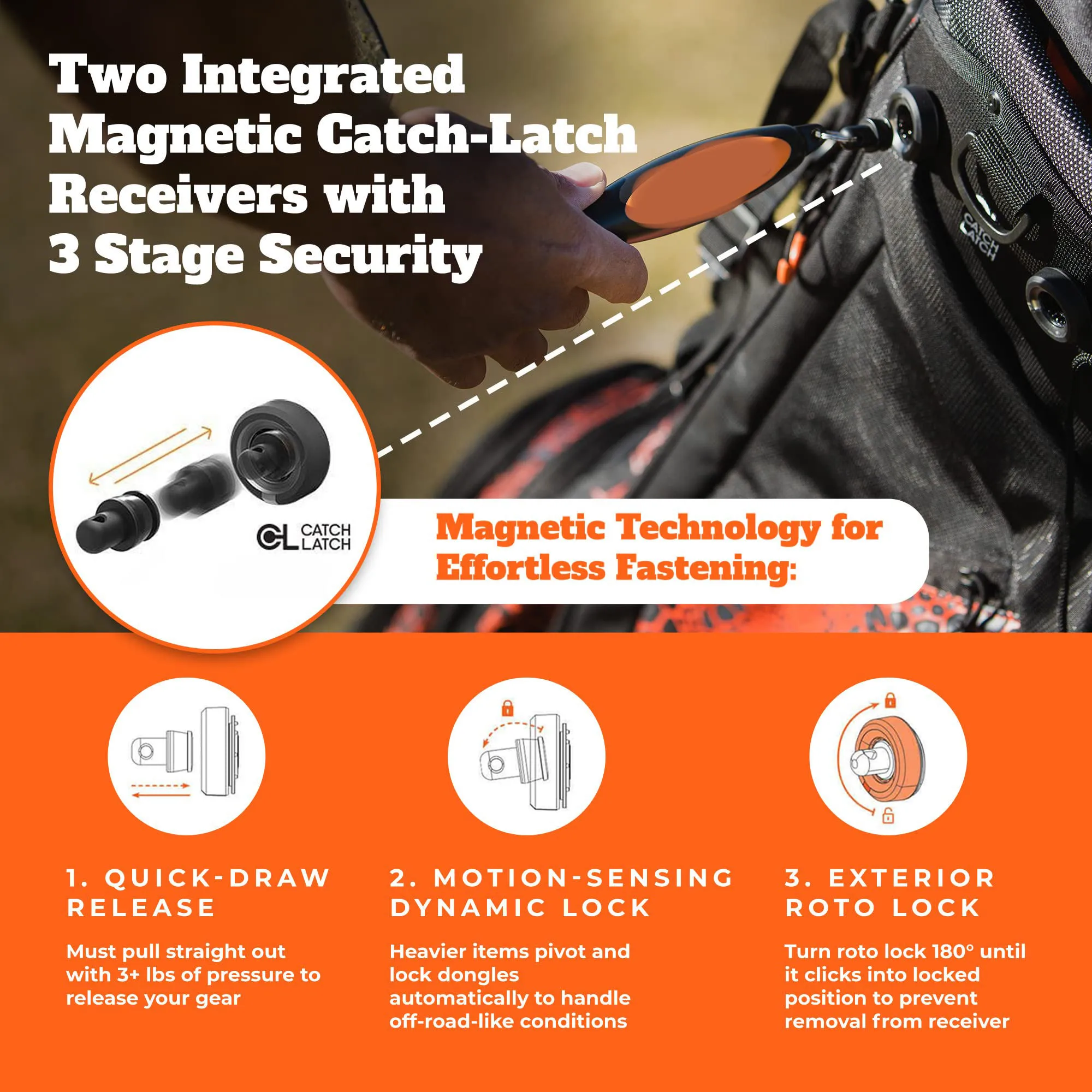
To make the mix concrete, here is the map of a typical value-premium waterproof stand bag we quote. The main body is 300D polyester, PU-coated, keeping weight and cost in check. The base, leg panel, and pocket lips step up to 600D TPU-laminated polyester for the wet-and-wear abuse. The branding patch, top collar, and valuables-pocket front are PU synthetic leather for the premium read. The interior lining is a light 150-210D plain polyester to shave grams off unexposed fabric, and the hinge and straps carry stitched reinforcement with a bound seam.
Each of those zones is a line item in the tech pack with its own material, coating, and join method. This is what "mixed material" should mean in practice: not a vague phrase, but a precise allocation that lets the factory cut, coat, and sew to a repeatable standard. If you send a factory only "nylon vs PU vs polyester", you invite improvisation; if you send the map, you get a sample and a bulk run that match your intent. Most of the warranty gaps we see are traceable to a map that was never written — the material was right, but the placement and the join were guessed.
Sampling and QC for a mixed-material program
A multi-material build asks QC to check more seams and interfaces than a single-shell bag. On the pre-production sample verify each material is the approved grade, that the PU-leather-to-fabric joins are clean with no edge lift, that the coated panels have even film without delamination at fold lines, and that branding placement sits correctly on the selected material. Inline inspection should watch colour consistency between the technical shell and the PU-leather trim, since the two substrates may not match exactly — order a trim-down sample pack and approve the tonal pairing before bulk.
We keep a sealed master unit and a colour chip per material program for the life of the line, so reorders and seasonal relaunches repeat cleanly. A first-article inspection on run one checks the map is being followed panel by panel. For a first mixed-material order we recommend the evaluation-sample route — even 20-30 units — so you can photograph the real lockup, approve the tonal pairing, and confirm the durability balance before a full container. That pilot is the cheapest insurance a multi-material line can buy, and it is how premium-feel stand bags stay consistent season to season.
Matching the material mix to silhouette and climate
The same three families arrange differently depending on the silhouette and the market you sell into. For a featherweight Sunday or carry bag aimed at walkers in a dry climate, a 300D nylon shell with minimal PU trim delivers the lightest bag and the cleanest technical story. For a 14-way organizer bag aimed at resort and corporate buyers, the visual weight of the top divider and the pocket face carries the premium read, so PU-leather trim on the collar and pocket fronts earns its cost even though the body stays a coated polyester. For an all-weather line aimed at a rainy coastal market, everything shifts to a TPU-laminated shell, sealed seams, rainguard zips, and drainage — and PU leather retreats to a thin branding strip.
Climate is the variable buyers most often under-weight. A shell that is fine for a dry, cart-heavy course will fail differently in a humid, rainy region where coating quality and drainage dominate, or in a cold market where PU-leather flex cracking accelerates in the winter trunk. We advise mapping your top three export markets' dominant conditions before fixing the material mix, and we build the climate into the spec — heavier TPU base panels for wet zones, a rain-flap spec for drizzle markets, and a lighter open-weave polyester for hot-and-dry regions. The material families are the building blocks, but the climate is the editor that decides how much of each block a bag should carry.
Recommended Internal Links
- Products (Stand Bag Architectures)
- OEM/ODM Service
- Factory & QC
- Golf Stand Bag Buying Guide
- Nylon Pros, Cons & Best Uses
- Polyester Durability Guide
Two closing notes for B2B buyers. First, treat material choice as a map, not a single selection — the strongest programmes allocate each fibre to the zones where it earns its cost, then lock the map in the tech pack. Second, sample on the production fabric, not a generic swatch, so the weight, the coating, the tonal pairing, and the durability you approve are the ones that ship. Reach us at service@junyuanbags.com or +86 17750020688, and we will map a nylon / PU / polyester mix against your price point and order a small comparison sample of the winning allocation before you scale.
Final note — the mixture beats the single material
The best answer to "nylon vs PU leather vs polyester" is usually "a considered mix". Nylon buys you strength-per-gram and travel cred; polyester buys you cost and repeatability at volume; PU leather buys you the premium glance that sells on a shelf. Read your price point, your weight target, and your climate, allocate each fibre deliberately, and let the panel map — not the label — drive the build. A mixed-material stand bag that is specified zone by zone will outperform a single-material bag on both margin and warranty, and that is the definition of a line worth reordering. Invest the first sample round in locking that map, and every subsequent season — and every container — repeats to the same standard, which is where the real profit in a stand bag line is earned.
FAQ
Which stand bag material should a B2B buyer choose first?
Start from your price point and silhouette, not from the material. Featherweight and travel lines lean nylon; value and volume lines lean polyester; premium aesthetic lines use PU leather for trim and branding zones. Most bags then mix the three.
Is PU leather durable enough for a golf stand bag shell?
PU synthetic leather is durable and easy to keep clean, but it is heavier and less abrasion-resilient than a coated nylon or polyester shell, and it can crack with age on flex zones. It performs best as accent trim, branding panels, and valuables-pocket fronts rather than a full shell.
Can I mix nylon, PU leather, and polyester on one bag?
Yes — mixed-material builds are standard. A common pattern is a polyester or nylon shell with PU leather trim and branding, plus coated nylon on the wet-facing base. What matters is that the tech pack specifies each panel's material, placement, and join method.
Which material is best for a waterproof stand bag?
A TPU-laminated shell (nylon or polyester) reaches the highest water-column ratings, so coated nylon or coated polyester wins for waterproof builds. PU leather is not naturally waterproof and adds weight, so it is used only for trim on all-weather lines.
How much does material choice change the unit cost of a stand bag?
On a finished bag, shifting the shell from polyester to nylon usually moves unit cost by 3-8%, and adding PU leather trim adds proportionally to that. Hardware, the stand mechanism, and labour dominate the BOM more than any single fabric.
What is the difference between PU leather and genuine leather on a golf bag?
PU leather is a coated synthetic that is lighter, lower-cost, allergen-friendly, and consistent between panels; genuine leather is heavier, costlier, and varies lot to lot. Genuine leather is rare on modern stand bags for weight and cost reasons.
Request a B2B quote for golf stand bags
Send your target market, expected MOQ, and reference photos. We respond within 24 hours with a sampling plan.