For a featherweight minimal carry, explore our Sunday bags — Practice golfers can also browse our range and simulator golf bags — For a B2B buyer deciding between shells, a coated polyester panel hits a water-column of 5,000-10,000 mm with TPU lamination, holds colour consistently across dye lots, and typically costs 15-30% less per meter than an equal-weight nylon — which is why it dominates value and mid-tier stand bag programs. This guide breaks down how polyester durability and water resistance actually work at the fabric, coating, and seam level, so you can spec a waterproof stand bag with numbers instead of marketing language.
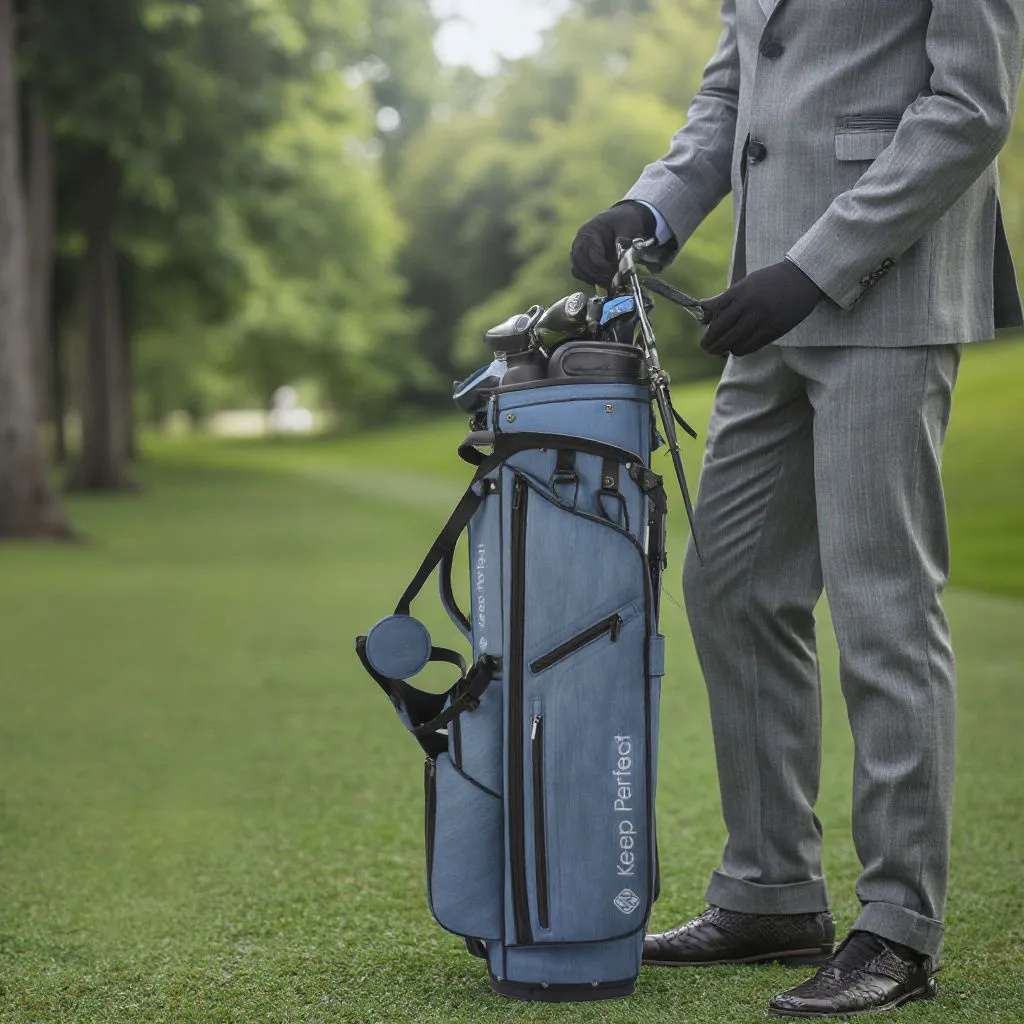
Key Takeaways
- Polyester is the value workhorse: durable, colour-stable, cheap per meter, and a predictable coating substrate.
- "Waterproof" is never one fabric — it is a layered system of face finish, coating, seams, zippers, and drainage geometry.
- Specify a water-column rating in mm, not the word "waterproof", in your tech pack.
- DWR, PU, and TPU are different tools for different budgets and flex demands.
- Polyester's dye consistency makes it the safer choice for seasonal colourways and large reorder volumes.
Polyester's real strengths: cost, colour, and coatability
The case for polyester in a stand bag programme is rarely about chasing the lightest weight — nylon usually wins that argument. Polyester wins on three operational grounds that matter across a volume run. First, cost: polyester yarn is cheaper than nylon, and because the panel weight and construction are cheaper to handle, a full polyester shell lands in a lower unit-cost band. Second, colour consistency: polyester is dyed with disperse dyes at high heat that penetrate the fibre uniformly, so batch-to-batch and reorder-to-reorder colour holds tighter than on many nylon constructions — a decisive advantage if you run four seasonal colourways and cannot tolerate tonal drift between batches.
Third, and most valuable for a waterproof line, is coatability. Polyester takes PU and TPU coatings predictably, and its structure holds a consistent film across panels, which reduces coating failures such as patchy sheen, delamination at fold lines, and uneven water-column performance. In a factory that runs waterproof programmes, standardising on a coated polyester shell gives the QC line a stable substrate to inspect. At our affiliated plant in Quanzhou (SGS-verified March 2026, 4,950 sqm, 7 lines, 149 machines, 137 staff), polyester is the default for value and mid-tier waterproof lines precisely because the coating layer behaves in bulk.
How water resistance really works on a stand bag
Water resistance is sold as a property of the shell, but it is designed as a system with five layers: the fabric face finish, the coating or lamination, the seam treatment, the zipper specification, and the drainage geometry of the base. A polyester shell with a 5,000 mm coating will still let rain in through an unprotected stitching line at the pocket lips or an open-topped zipper if the other layers are not specified. Buyers who approve a "waterproof fabric" swatch and stop there routinely get returned bags after the first wet round, not because the fabric failed but because the whole envelope was never engineered.
The practical sequence is to write each layer into the tech pack as its own line item. The face finish (often a DWR-style water-repellent) makes droplets bead off the visible surface. The coating or lamination is the pressure-rated waterproof barrier underneath. The critical seams — pocket lips, base hem, stand leg opening — get sealed or taped inside. The zippers are chosen as rainguard, waterproof-coil, or covered by a rain flap. And the base is designed so pooled water escapes through drainage eyelets rather than sitting in the harness. Only when all five are defined does "waterproof" become a deliverable you can test and claim.
DWR vs PU vs TPU: choosing the right waterproofing tool
Three common finishes cover most stand bag programmes, and buyers frequently confuse them. A DWR (durable water repellent) face treatment is a surface finish that makes water bead and roll off; it does not block pressure, it wears with use and wash, and it usually needs renewing mid-life. A PU (polyurethane) coating is the value workhorse: a film applied directly to the back of the polyester that adds genuine waterproofness at low cost and reaches water columns in the 800-5,000 mm range depending on the build.
For serious all-weather performance, TPU (thermoplastic polyurethane) lamination bonds a thicker, tougher film to the fabric, reaching 5,000-10,000 mm, resisting flex and abrasion better, and giving a stiffer, more premium hand. The trade-offs are cost and drapability: TPU costs more and makes the bag stiffer, which can fight a featherweight carry design. A smart program often combines them — a TPU panel on the base and lower shell where rain and abrasion meet, with a lighter PU-coated polyester above the waist to save weight and cost. That zoning is exactly the kind of decision a good factory walks a buyer through before bulk.
Waterproof Polyester Spec Table
The table below reflects typical Quanzhou/Xiamen OEM practice and the waterproofing options we hold for polyester programmes at QUANZHOU JUNYUAN BAGS. Confirm each row on the production panel before bulk.
| Parameter | Typical Spec | Buyer Notes |
|---|---|---|
| Shell grade | 300D-600D polyester | Higher denier for abrasion; lower for weight. |
| Base shell (wet zones) | 600D polyester, TPU-laminated | 5,000-10,000 mm; toughest wet-facing panels. |
| Upper shell (weight saving) | 300D polyester, PU-coated | 800-5,000 mm; lighter above the waist. |
| Face finish | DWR-style water repellent | Beads off rain; renews with re-treatment. |
| Water column target | 1,000-10,000 mm by zone | mm rating, not the word "waterproof". |
| Seam sealing | Critical seams taped/sealed inside | Pocket lips, base hem, stand opening. |
| Zipper spec | Rainguard / waterproof coil / rain flap | Fabric coat is useless against an open zip. |
| Abrasion target | ≥20,000 cycles (method-dependent) | Set the test method with the mill. |
| Dye tolerance | Lab-dip approved, delta-E ≤2 | Polyester dye repeatability is its asset. |
| Drainage | Base eyelets / drainage geometry | Prevents standing water in the harness. |
Where polyester durability concentrates: the abrasion map
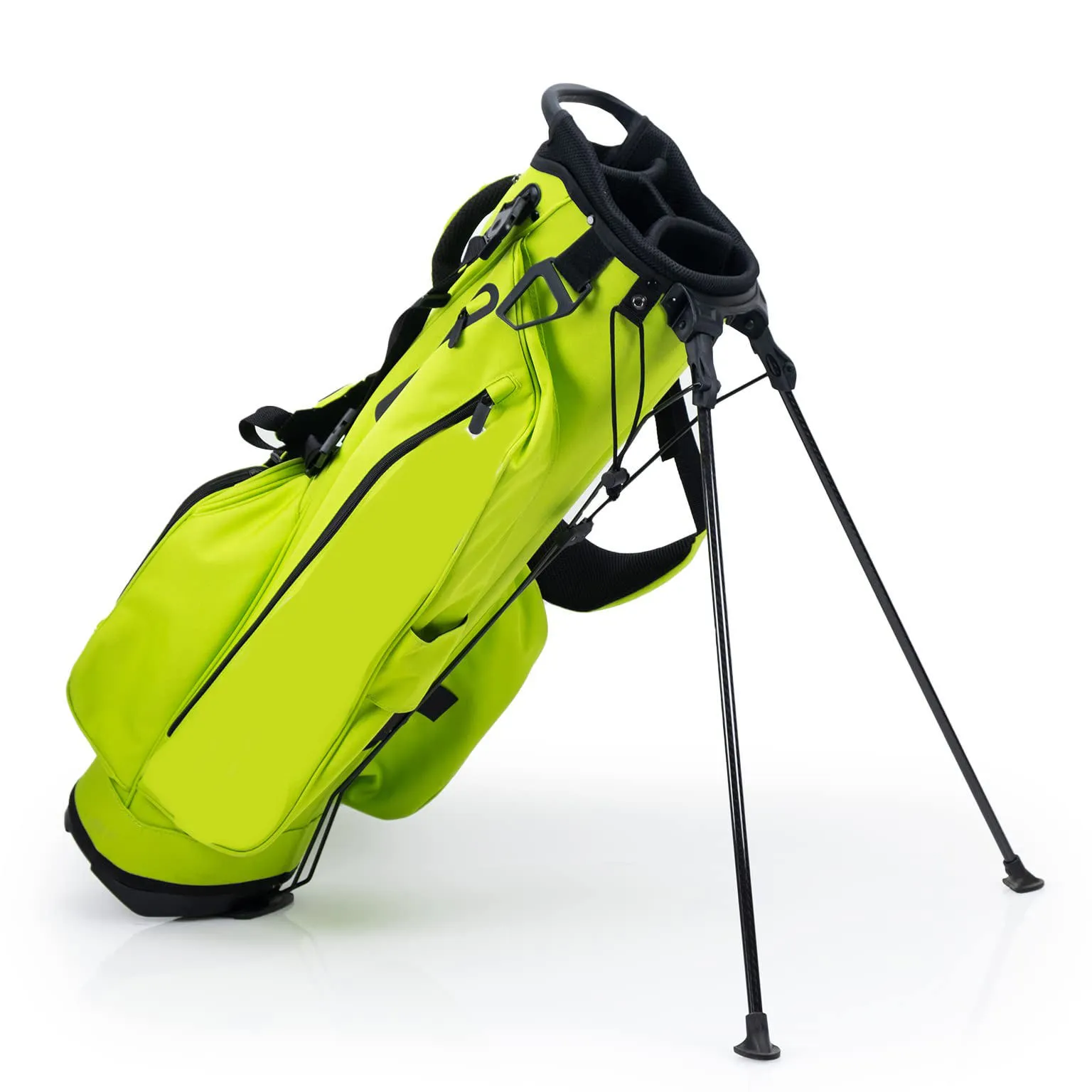
Durability in a polyester stand bag is not uniform across the surface — it concentrates where the shell touches the world: the base corners, the stand leg panel, the dual-strap anchors, and the pocket lips. A 600D coated polyester base will outlast a 300D mid-shell precisely because it carries the abrasion and the pressure. This is why the smartest polyester programmes use a graded shell: lighter poly above, heavier coated poly at the wet-and-wear zones, with a defined reinforcement map in the tech pack. The map also fixes the branding and drain placement, so the shell's strength and the envelope's integrity are planned together rather than discovered on a returned batch.
Beyond the shell, durability lives in the stitches and the hardware. A polyester shell that is strong in the cloth still fails at a poorly reinforced strap anchor or an under-specified hinge. Our QC routine pairs a fabric abrasion test (method + cycles) with a seam-strength test at the reinforcement points and a strap-anchor load test, so the durability of the whole construct is measured, not just the fabric. For a waterproof line we add a coating-adhesion check at the flex zones, because a coating that looks fine flat will delaminate at the hinge after repeated deployment. If your programme carries a rainwear or wet-weather claim, insist these tests appear in the acceptance criteria before you sign off.
Polyester and the weight conversation
The common buyer worry is that polyester is heavy. The reality is more useful: at the same denier a polyester panel is marginally heavier than nylon of comparable strength, and to match a given tear target on some constructions you step up a denier grade, adding a little more weight. But on a complete 4-6 lb stand bag, the shell is only part of the BOM — the stand mechanism, divider system, straps, and hardware dominate. The practical gap between an optimised polyester line and a nylon line usually resolves to a handful of grams within a specified tolerance, not a category difference.
So the question is not "will polyester be too heavy" but "where should I spend my durability budget". For a value retail line that ships in volume and needs to hit a margin, coated polyester is usually the right base shell, and the grams saved by a nylon shell on some panels rarely justify the cost. For a featherweight travel or high-end carry program, a strategic nylon upper with a polyester wet-zone base can outperform a single-material build. This material zoning is a conversation we have in every quote at QUANZHOU JUNYUAN BAGS, because the answer is never one fabric for the whole bag.
Repellet, recycled, and sustainable polyester options
Retail pressure around recycled content has reached the golf bag category, and recycled polyester (often rPET, made from reclaimed plastic bottles and post-industrial yarn waste) is now a practical, quoting option rather than a novelty. At the same denier, recycled polyester performs close to virgin polyester for abrasion and coating behaviour, which makes it an approachable entry into a sustainability-led program compared with the trickier colour control of recycled nylon. The main differences a buyer should budget for are cost and sourcing evidence: recycled yarn can carry a per-meter premium in the low double digits, and a "recycled content" claim on pack needs a verifiable chain from the yarn mill through to the finished fabric.
We also hear buyers ask for RPET plus a waterproof coating in the same brief — a combination that is very achievable. The coated substrate behaves like standard polyester, so the water-column and seam-taping guidance in this guide carries over unchanged. The discipline is documentation: keep the recycled-content certificate and pair it with the water-column test report, so the hang tag can truthfully tell both stories. If your channel demands sustainability, ask for a recycled-vs-virgin comparison sample alongside your waterproof sample, and let the cost, hand feel, and evidence trail — not the buzzword — decide your spec.
Branding behaviour on coated polyester
Because so many wet-weather lines are built on coated polyester, your branding choice interacts with the waterproof layer in a way buyers often don't anticipate. Embroidery, for instance, pierces the shell — and on a TPU-laminated panel that means the needle line can breach the sealed film and let moisture migrate along the threads unless the logo patch sits on a zone designed for stitching. Molded TPU patches layer on top of the waterproof film without piercing the sealed area, which is why they are a favourite for waterproof builds. Heat transfer keeps the film intact but can peel at flex zones, so it suits stable panels rather than the hinge.
The practical rule is to brief the branding together with the waterproofing, not after. If your hero logo sits on a pocket lip or a wet-facing panel, the placement and the method change what the coating can promise. In our OEM/ODM briefing we flag any branding placement that would conflict with the waterproof envelope before sampling, so you do not pay twice or discover the conflict on the first returned batch. A water-column rating means nothing if the embroidery grid turns the front panel into a sieve — the placement playbook and the rain spec have to be one conversation.
Cost economics of a volume polyester program
The reason polyester anchors most volume stand bag lines is economics that compound at scale. Lower yarn cost, faster and more predictable dyeing, cheaper coating substrates, and stable sewing at higher line speeds all reduce the unit cost of every bag in a container — and those savings are largest where they matter most, at 200-piece MOQs and above. Because coated polyester is predictable, factories can run it on the same line configuration with tighter inspection tolerances, which shortens sampling loops and stabilises reorder lead times. That operational reliability is a cost in its own right that never appears on a fabric pricelist.
In practical terms, a buyer trading nylon for a well-graded coated polyester on a mainstream line usually sees a 3-8% unit-cost movement, which can be redirected into the stand mechanism, the zippers, or the branding — the features shoppers feel and repeat-purchase on. Combined with our MOQ of 200 pieces (100 for a test order), sampling at 10-20 days, and bulk at 45-60 days, a polyester pilot is a low-risk way to test a waterproof line before committing to scale. The economics tend to argue themselves once the numbers are on the table.
Reading a waterproof claim before you buy
When you evaluate a supplier's waterproof stand bag, learn to read the claim. A credible spec names the water-column rating in millimetres, the coating or lamination type, the seam-taping scope, and the zipper specification. A claim that just says "waterproof" or "water-resistant" with no numbers is a risk, because it tells you nothing about the envelope. Ask also for the test standard behind the rating — a column tested to a recognised method means the number is comparable between suppliers; a home-brewed figure is not.
The other tell is the seam and zipper story. A factory that can talk about which seams are taped and why, and which zipper they choose for a rain-flap build, usually has a working waterproof program; one that can only show a fabric swatch is likely new to the discipline. This level of specificity also stabilises reorders: once the rating, the coating, and the seam scope are locked in the tech pack, a second season repeats to the same standard. That repeatability is what protects your brand against the rainy-round returns that quietly erode a retail line's profitability.
Common waterproof program mistakes (and the fixes)
The warranty graph of most rainy lines is dominated by five repeatable mistakes. First is specifying only the fabric — buyers approve a coated swatch and forget the seams, which then let water in along stitching lines. The fix is a seam-taping scope written into the tech pack. Second is a misleading claim: a panel rated 3,000 mm is called "waterproof" on pack, then fails the first sustained downpour because 3,000 mm is genuinely rain-shedding but not immersion-proof. The fix is to name the zone rating and the test standard honestly. Third is the open zipper: a full water-column shell is defeated by a standard coil zip, so a rainguard or flap spec is non-negotiable on wet zones.
The fourth mistake is drainage neglect — pooled water sitting in the harness because there are no base eyelets, which soaks the interior even with a dry shell. The fifth is coating damage at the hinge: a film that looks perfect flat delaminates after repeated stand deployment, so a flex test at the hinge needs to be in the acceptance criteria. Every one of these is a design decision a factory can flag before bulk — which is why we walk buyers through the full envelope in the briefing rather than quoting a fabric. A waterproof line that survives contact with the customer is one where the coating, the seam, the zip, the drainage, and the flex zone were all specified as a system.
Sampling and QC for a coated polyester program
Coated polyester asks for a few extra QC disciplines that plain cloth does not. On the pre-production sample, verify the coating is even (no sheen patches, no thin spots at panel edges), that it survives a flex test at the hinge, and that the taped seams sit flat without bubbles. During inline inspection, watch for coating pulled or delaminated at the sewing line, and for zipper installations that pierce the sealed film area where a rain flap should cover. These are the defects that quietly turn a "rainproof" bag into a returned one.
Our window for a polyester program is consistent with our standard offering: MOQ 200 pieces (100 for a test order), sampling 10-20 days, and bulk production 45-60 days. For a first waterproof line we recommend a water-column test on the production fabric and a small weather-simulation batch before the full run, so any coating or seam issue surfaces while there is still time to change it. A sealed master unit and a colour chip per colorway are kept for the life of the program, so your second and third seasons — and your reorders — hold the same tone and the same waterproof standard. esion check, a seam-tape inspection, and a drainage check in the QC routine, and you have a line you can sell into a rainy coastal market with real confidence. For a broader look across cart bags, staff bags and the full golf bag category from one source, our affiliated golf bag factory runs the complete line.
FAQ
How waterproof can a polyester golf stand bag be?
A coated polyester shell can reach water-column ratings of 5,000-10,000 mm with TPU lamination, which sheds heavy rain. True all-weather performance still needs taped seams and waterproof zippers because fabric alone is not the whole envelope.
What is the difference between DWR, PU coating, and TPU lamination?
DWR is a surface treatment that makes water bead off but does not block pressure; PU coating adds a waterproof film layer at low cost; TPU lamination bonds a tougher film for higher water-column and flex durability. They are often combined, not mutually exclusive.
How durable is polyester compared to nylon on a stand bag?
At equal denier, nylon usually holds slightly higher tear strength, but polyester earns its place with better colour consistency, lower cost, and predictable coating take-up. For value and mid-tier programs polyester is the workhorse; for extreme lightweight it trails nylon.
Why does polyester offer better colour consistency across dye lots?
Polyester is dyed with disperse dyes at high temperature, which penetrate the fibre evenly and repeat closely lot to lot. That repeatability matters when you run seasonal colourways and need tonal stability across bulk batches and reorders.
What water-column rating do I need for which weather?
Around 1,000 mm suits light drizzle; 2,000-3,000 mm handles most rain; 5,000 mm and up with taped seams covers serious all-weather rounds. Specify the rating in mm in your tech pack, not the word 'waterproof'.
Does a polyester shell add more weight than nylon?
At the same denier a polyester panel is slightly heavier than nylon of comparable strength, and you may need a higher denier to match a given tear target. On a full 4-6 lb bag the difference is usually a handful of grams within your tolerance.
Recommended Internal Links
- Products (Stand Bag Architectures)
- OEM/ODM Service
- Factory & QC
- Golf Stand Bag Buying Guide
- Complete Materials Guide
- Nylon Pros, Cons & Uses
- waterproof stand bags
Two closing notes for B2B buyers. First, spec your waterproof line as an envelope, not a fabric — put the water-column, coating, seam-taping, and zipper scope in the tech pack together, and your returns will drop sharply. Second, remember polyester's finest asset is repeatability: a coated polyester standard you lock once will reproduce season after season, which is the real economics of a volume program. Reach us at service@junyuanbags.com or +86 17750020688 and we will quote a water-column-tested polyester pilot against your price point.
Final note — durable polyester is a chosen system
Polyester gets a reputation for being the "cheap" material, but in a well-specified stand bag it is the disciplined, repeatable choice — cheap per meter, honest in colour, and stable under a coating. The brands that profit from polyester are the ones that treat durability and water resistance as engineered systems with numbers, not as adjectives on a spec sheet. Lock the grading, the waterproofing layer stack, and the QC tests, and a polyester line will quietly outlast and out-return many more expensive builds. Pair that discipline with a coating-adh
Request a B2B quote for golf stand bags
Send your target market, expected MOQ, and reference photos. We respond within 24 hours with a sampling plan.