For a B2B buyer of golf stand bags, a cooler pocket is rarely "just a pocket" — cheap PE foam at 3 mm can hold a can cold for under an hour, while a 6-8 mm multi-layer insulated shell with a welded TPU liner holds target temperature roughly 2-3 hours longer, and the difference typically moves unit cost by 4-9%. This guide breaks down the insulation stack, the lining decision, the drainage gusset, and the closure lockup we engineer at our SGS-verified Quanzhou plant (4,950 sqm, 7 lines, 149 machines, 137 staff), so you can spec a cooling pocket that plays well instead of failing after one wet season. For the wider golf bag category — cart bags, staff bags and more — our affiliated golf bag factory is the one-stop reference.
Key Takeaways
Before you brief a manufacturer, understand that a cooler pocket is a system of four interdependent layers — the outer shell fabric, the insulation core, the interior lining, and the closure — plus a drainage path. Change the insulation thickness and you change weight, stiffness, and how the pocket sits against the center divider. Change the lining and you change condensation management. Most cooler-pocket field failures are not one defect; they are a cascade: a thin foam that cannot hold temperature, a fabric liner that wicks moisture into the shell, and a sealed pocket with no way for condensation to escape.
On a stand bag this is harder than on a cart bag because the pocket sits on a folding structure. The stand hinge flexes behind the lower panel, the bag compresses when carried on a dual strap, and the whole assembly tilts when the legs deploy. A cooler pocket must be engineered to survive that motion without the insulation bunching or the liner tearing away from the seam. The numbers below reflect what we hold at QUANZHOU JUNYUAN BAGS so your program is repeatable across seasons.
- Insulation thickness drives cooling time and weight in equal measure
- The lining decides whether the pocket stays dry or sweats into the shell
- A drainage gusset converts a problem (condensation) into a solved one
- Closure type and length control how much cold air escapes
- Welded seams unlock true waterproofing; bound seams suit standard carry
What "cooler pocket" really means in a production spec
Retail listings call almost any insulated-looking pouch a "cooler pocket," but in a tech pack the term must resolve into measurable values. The three numbers that matter are the target delta — how many degrees below ambient the pocket should hold the contents after 2 hours — the thermal conductivity of the core, and the weight budget the insulation is allowed to consume. A pocket lined with a film and stuffed with loose batting may look insulated on spec sheets yet lose cold quickly because air moves freely through the fill.
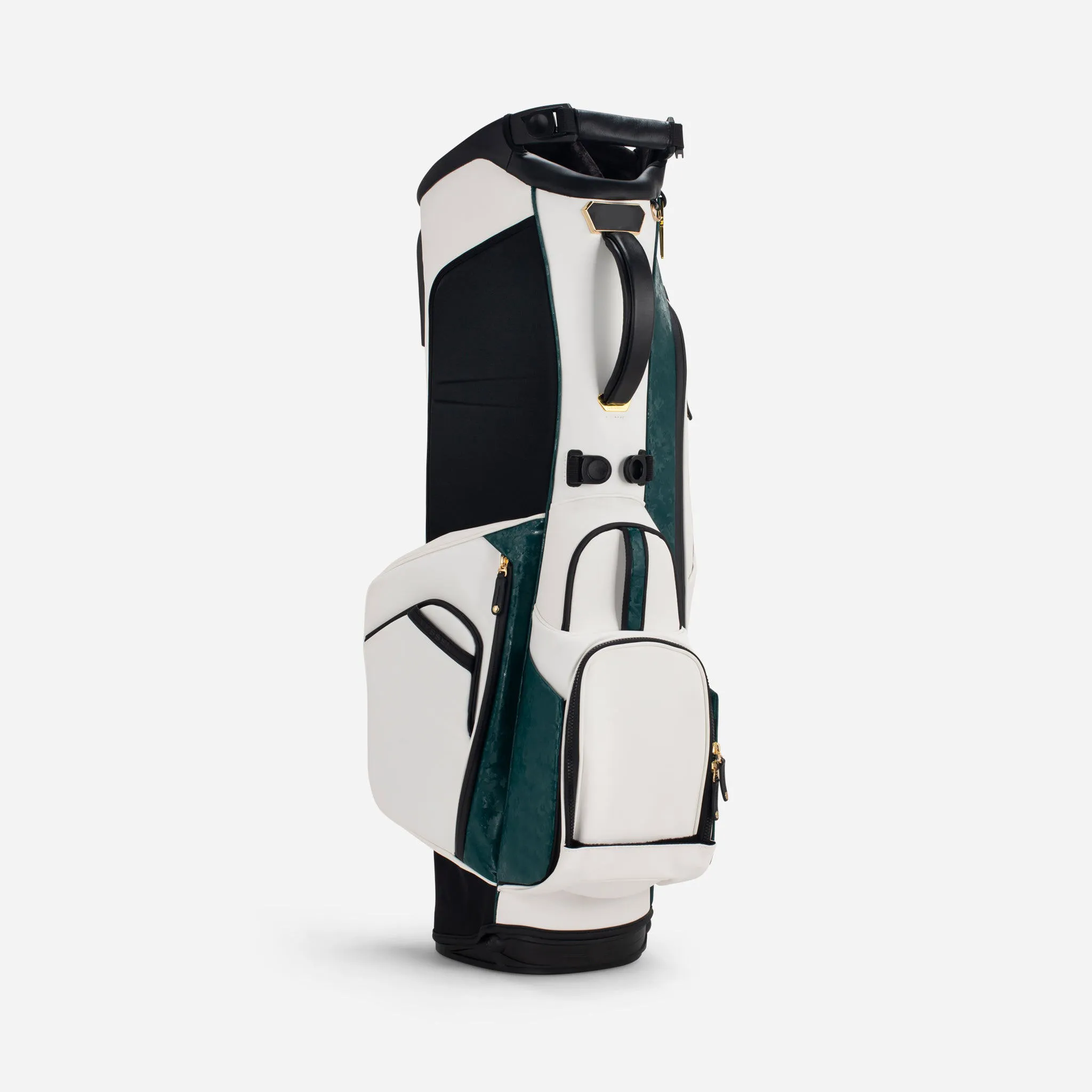
Our working definition for a stand-bag cooler pocket is: a structurally separate compartment, insulated on at least five faces (four walls and the floor), sealed by a full-width closure, and engineered to shed or contain condensation. We deliberately avoid the loose "insulated lining" label and instead specify a closed-cell foam core of defined thickness and density, because closed-cell foam blocks radiant and convective heat far better than an open textile layer. When you send us a cooler-pocket brief, the fastest path to an accurate quote is to state your holding-time expectation and your weight budget, because everything else in the pocket is a trade-off against those two numbers.
Insulation: PE foam, EVA, and the R-value trade-off
The insulation core is the heart of the pocket. On a carry-focused stand bag the practical options are closed-cell polyethylene (PE) foam and ethylene-vinyl acetate (EVA) foam, either used alone or stacked in a thin multi-layer lam. PE foam is light, inexpensive, and water-resistant, making it the default for the mid-tier cooler pocket; EVA is denser and more rigid, which improves puncture and compression resistance but costs more weight in the same panel. True rigid insulating panels exist, but on a folding stand bag they are usually too stiff and too heavy, so they are rare outside specialty all-weather lines.
Thickness is the lever a buyer actually controls and the one most often left vague. At 3 mm of PE foam the pocket is more cosmetic than functional — it will delay warming by a short window but not meaningfully. Stepping to 6-8 mm of a two-layer lam roughly doubles the practical holding time, at the cost of adding stiffness around the pocket opening, which is why we recommend you confirm the opening rigidity on a sample rather than on a drawing. Use the table below as the starting architecture; we lock the final thickness against your weight and cost targets at the pre-production-sampling stage, not on the RFQ.
| Insulation Option | Typical Thickness | Approx. Added Weight | Best Use Case / Notes |
|---|---|---|---|
| PE foam (closed-cell) | 3-8 mm | 60-140 g | Default for mid-tier; cheap, light, water-resistant. |
| EVA foam | 4-8 mm | 100-180 g | Higher compressive strength; suited to premium or heavier loads. |
| PE + foil lam (reflective) | 5-8 mm | 90-150 g | Reflective layer gives the best holding time per gram. |
| Rigid insulation panel | 6-10 mm | 150-220 g | All-weather specialty only; too stiff for most folding stands. |
Lining systems: film, coated fabric, and condensation control
Because a cooler pocket holds cold objects, its worst enemy is condensation. Warm, humid air meets the cold liner and deposits moisture, which then wicks into a textile liner, across the seam tape, and finally stains or watermarks the outer fabric. The lining is the layer that decides whether you get a clean product or a recurring interior-mold and fabric-watermark complaint. Two lining routes dominate: a thin poly film liner and a coated fabric liner, and on waterproof programs the lining is welded directly to the seam.
A welded or heat-sealed lining creates a smooth, non-pourous interior that condensation beads on and pools at the bottom rather than soaking in. This is the cleanest solution for hygiene and it makes the pocket genuinely cleanable, but a fully welded liner adds cost and limits how the pocket can be laundered or flexed. On a standard carry bag, a coated interior fabric with seam binding is lighter and cheaper; it handles normal condensation acceptably as long as there is a drainage path. The practical rule we give buyers is: if the cooler pocket will carry food or be sealed for hours, invest in the non-pourous lining; if it is a drinks-only pocket on a mid-tier line, coated fabric with a gusset is the cost-efficient choice.
Drainage: gussets, valves, and keeping moisture out of the shell
The single most under-specified element of a cooler pocket is drainage. Condensation will appear no matter how well the pocket is insulated, so the question is not whether water forms but where it goes. Without a designed path, moisture sits against the floor seam, wicks up the side seam tape, and eventually reaches the outer shell fabric and the stitching that carries the bag's main load — a failure that shows up weeks later as flaking lining or a stained lower panel.
A drainage gusset is a low, angled mesh or film channel stitched at the base of the pocket that lets pooled condensation sheet out or be wiped away, keeping the interior floor drier between uses. On a waterproof program we go further and add a small drain valve at the lowest point so a sealed pocket can be purged after a round. Spec the drain position carefully against the stand geometry: the lowest point of the pocket inside the bag is not always the lowest point when the bag is set down at a tilted stand angle, so we align the gusset with the bag's carry and ground orientation. Lock the drainage path on the pre-production sample by actually filling the pocket with water and checking where it pools.
Placement on a stand bag: the geometry trade-off
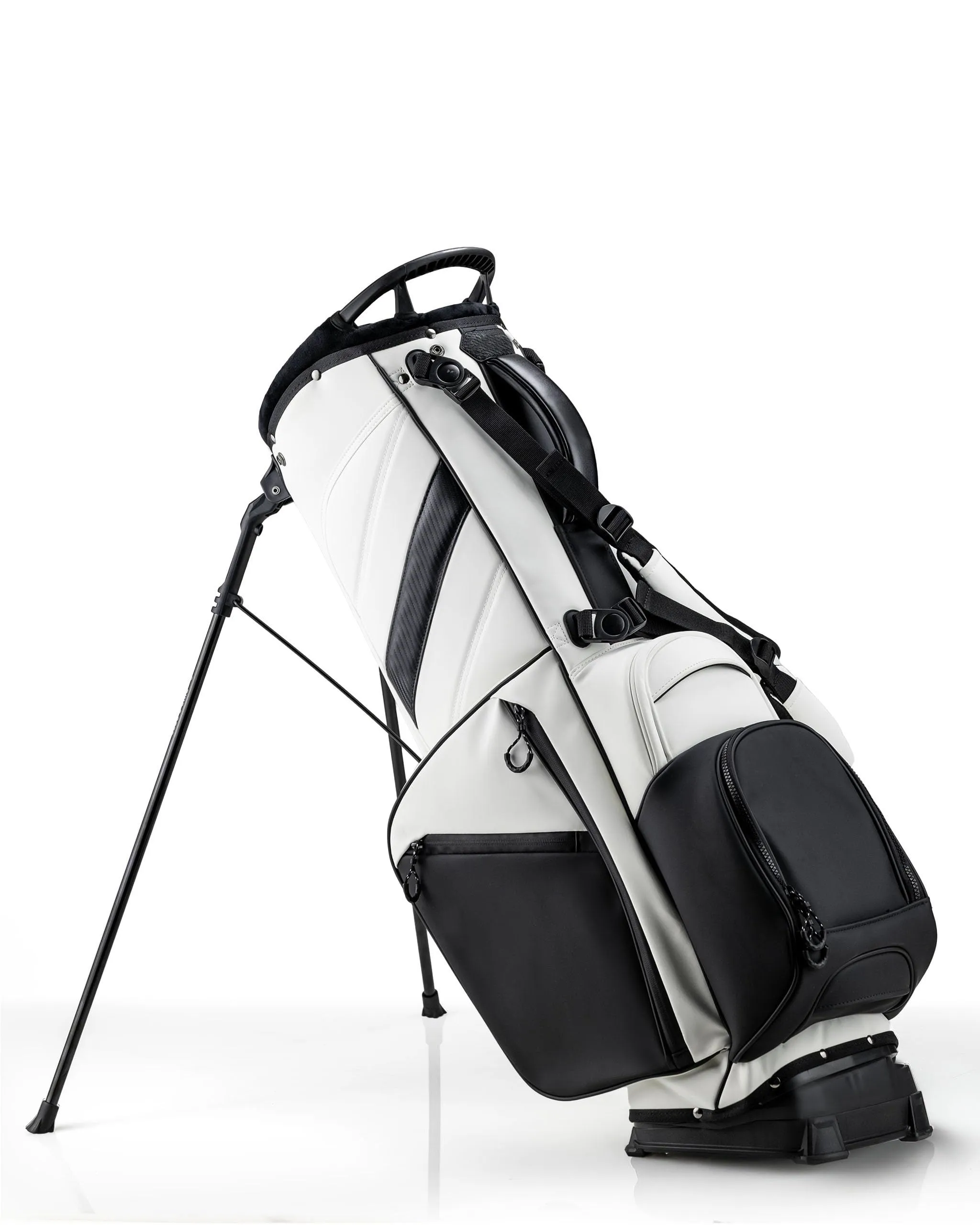
Where the cooler pocket sits is a compromise among three competing needs: accessibility while walking, weight balance against the center of gravity, and the rear stand hinge. On most carry stand bags the cooler pocket lives on the left or right lower flank, near where the golfer reaches when the bag is on the shoulder, which keeps the insulated mass low and close to the body. Placing it too high shifts the center of gravity and makes the loaded bag fall backward; placing it across the rear panel fights the placement of the dual strap anchors and the leg housing.
The flank location also protects the insulation from the worst abrasion — the stand legs and bottom wear plate take the ground contact, while the flank pocket rides higher. When we engineer the pocket onto the pattern, we check three things in sequence: that the pocket does not overlap the stand hinge bracket, that the insulated core does not add unplanned thickness against the center divider tube, and that the closure axis does not interfere with the strap width when the bag is closed. Getting these right in the pattern stage is why we ask for your full pocket list before we quote, not after.
Closure and zipper engineering
The closure is what keeps the cold layer close to the contents, and it is the part most likely to be cut on a cost sheet. A short flap or a single-point snap leaves a large opening through which warm air circulates, effectively bypassing the insulation. The correct architecture is a full-width closure with the zipper running the pocket's usable mouth, backed by a baffle or an internal lip that blocks the air gap above the puller.
We standardize on a water-resistant zipper for the cooler pocket because condensation and the occasional spill make a plain zipper rust or seize across a season. The slider should sit in a covered tunnel so water does not enter at the top, and the zipper tape should be specified with a cycle test target so it survives repeated open-close in hot weather when foam softens. A magnetic or hook-and-loop closure is faster for the golfer, but it does not seal against air movement as well as a zipper, so on a true cooler pocket we default to zipper and reserve quick closures for the separate non-insulated pocket. Tell us the closure priority — speed or seal — and we will route the engineering accordingly.
Waterproofing the pocket enclosure
On an all-weather or waterproof stand-bag program, the cooler pocket should be sealed as part of the bag's waterproof package rather than treated as an afterthought. A waterproof bag whose cooler pocket leaks defeats the whole claim, so the enclosure — walls, floor, and closure — must be sealed. The reliable route is a TPU or polyurethane coated outer fabric with a welded or seam-sealed liner, so there are no thread holes for water to enter at the base where condensation pools.
This is where the fabrication method — welding versus stitching — becomes the deciding spec. RF (radio-frequency) welding fuses two coated panels into a continuous seal with no stitch line, giving the strongest waterproofing but requiring matched tooling and increasing cost. Bound and taped seams are cheaper and lighter for standard lines, and are adequate when the claimed waterproof level is "splash-resistant pocket" rather than "submersible compartment." State your waterproof expectation in plain terms on the brief — a sealed cooler pocket rated to survive rain versus one that must stay dry during a cart wash — and we will match the enclosure method to the claim so you are not paying for a weld you do not need on a mid-tier line.
Weight control in a carry-first product
On a stand bag, every gram of the cooler pocket is borrowed from the carry experience. A 4.2-6.2 lb stand bag is expected to ride comfortably on a dual strap, and a heavy insulated pocket loaded with drinks shifts that feel more than a casual buyer realizes. Weight planning is therefore a real budget exercise: the insulation core typically contributes 60-180 g, the lining and closure another 40-80 g, and the gusset a few grams, so a fully equipped cooler pocket can land anywhere from roughly 100 g to 250 g depending on how premium the stack is.
We recommend you set a grams budget for the pocket and state it on the RFQ, because it forces an honest conversation about material choices. If you want the longest holding time and a reflective foil lam, that is the heavier end. If weight leadership is the selling point, we spec thin PE foam and a lightweight film liner and accept a shorter holding window. Because the difference can be 100+ g across the pocket — which is the difference between a 4.6-lb and a 5.0-lb empty bag — the decision belongs in the tech pack, confirmed on the sealed physical sample, and repeated on every reorder so the weight claim you advertise stays true.
QC and test plan for a cooler pocket
A cooler pocket deserves its own acceptance criteria, not just the general bag-shell checks. The most valuable test is a thermal holding test: load the pocket with a chilled item, monitor the internal temperature over a set time at a defined ambient, and confirm the delta against the target. We pair this with a condensation check (does moisture pool on the floor and exit the gusset, or soak the seam?), a closure cycle test, and a water-integrity test on waterproof programs.
Before signing off a cooler-pocket program, we also run a durability trio on the actual production panel fabric rather than on a mock-up: a repeated open/close cycle on the closure at elevated temperature to catch foam softening or slider binding, a moisture soak that checks whether water migrates from the floor seam into the seam tape, and a flex test at the stand hinge with the pocket fully loaded. Each test gets a recorded pass/fail threshold in the tech pack, so a reorder two seasons later still meets the same standards.
Because the pocket interacts with the stand structure, we also run a flex test that deploys the legs with the pocket loaded, to confirm the insulation does not bunch against the hinge and the seams do not pull. Record a first-article inspection on the run's first unit and keep a sealed master so seasons match. On the standard carry line the cost of a full cooler QC program is modest, and it is what separates a pocket that keeps its promise from one that ships a spec sheet that the field disproves. We run these checks at our Quanzhou facility and share the results with any buyer doing inline inspection during bulk.
Closing brief — what to send the factory
The buyers who get an accurate cooler-pocket quote fastest send a compact one-page brief: bag type and divider, expected MOQ and timeline, a weight budget for the pocket, a holding-time expectation, the lining preference, whether a drain gusset is required, and two or three reference photos of a cooler pocket they like. With that, we can quote the insulation stack, the closure, and the drainage path with real numbers instead of estimating against guesses. Send your target market and target price along with it and the quote comes back even tighter, because the costing reflects the segment you are actually serving.
From standard carry to fully waterproof welded enclosures, we support OEM (fitting a cooler module onto proven architectures) and ODM (co-developing the insulation, drainage, and closure from your brief). Reach our sourcing team at service@junyuanbags.com or +86 17750020688 and we will route your cooler-pocket sample at the 10-20 day sampling window before bulk production runs at 45-60 days.
Recommended Internal Links
- Products (Stand Bag Architectures)
- OEM/ODM Service
- Factory & QC
- Golf Stand Bag Buying Guide
- Pocket Layout Guide for Stand Bags
FAQ
How thick does cooler pocket insulation need to be on a stand bag?
On a carry-oriented stand bag the insulation shell is typically 4-8 mm of closed-cell PE foam, which adds roughly 60-120 g of weight. A denser EVA or multi-layer panel can raise R-value slightly but costs more weight and stiffness, so we balance thickness against the bag's carry weight target.
Does a cooler pocket keep drinks cold without a zipper closure?
No. An unsealed opening lets warm air circulate in, so the pocket depends on a full-width zipper or a gusseted flap to hold the cold layer close to the contents. We spec a water-resistant zipper with a covered slider so the seal lasts across a season.
Why does my cooler pocket sweat on the inside?
Condensation forms where a cold liner meets warm, humid air. A welded TPU film liner, a coated interior fabric, and a drainage gusset at the bottom let moisture pool and drain instead of soaking into the outer fabric, which prevents interior mold and fabric watermarking.
Can a cooler pocket be welded instead of stitched?
Yes, on a waterproof program. Radio-frequency welding fuses a TPU liner into a sealed, leaktight pocket with no thread holes, which is best for full waterproofing. On a standard carry bag a bound and taped seam is lighter and cheaper while still managing condensation.
How do I specify a cooler pocket that does not make the bag too heavy?
Set a weight budget for the pocket in grams — a typical insulated cooler pocket runs 90-150 g depending on insulation and lining. Choose thin PE foam, a lightweight film liner, and a low-profile gusset, and confirm the combined bag weight against your 4.2-6.2 lb target on the pre-production sample.
Do you support OEM and ODM for insulated cooler pockets?
Yes. We support OEM by fitting a cooler pocket module onto proven stand-bag architectures, and ODM by co-developing the insulation stack, lining, drainage, and closure. Send your pocket list and target weight to start — ship from our Quanzhou facility.
What is the fastest way to get an accurate cooler pocket quote?
Send a short spec: bag type, divider, insulation thickness and material, lining type, whether a drain gusset is needed, closure style, target MOQ, and a timeline. Include your target market and weight budget so we can quote without a long back-and-forth.
Request a B2B quote for golf stand bags
Send your target market, expected MOQ, and reference photos. We respond within 24 hours with a sampling plan.