For B2B buyers, the stand mechanism is the part of a golf stand bag most likely to fail in the field, and it is also the cheapest to design right — a reinforced hinge block, a matched spring or cam, and a stable base geometry keep deployment consistent for 3,000-10,000 cycles, so specifying the frame structure and checking it at every lot is what keeps a bag standing season after season. This guide explains the golf stand bag frame and stand structure, how to verify it, maintain it, and spec it, using the deployment and stability criteria our SGS-verified Quanzhou facility (4,950 sqm, 7 lines, 149 machines, 137 staff, 200,000-unit monthly capacity) applies to every carry programme. For the wider golf bag category — cart bags, staff bags and more — our affiliated golf bag factory is the one-stop reference.
Key Takeaways
- The stand is a system of legs, hinge, spring or cam, base, and guides, each with its own wear and failure mode.
- Deployment cycle and base-stability tests are the two numbers that prove a stand will last and stand straight.
- Tube grade, wall thickness, and hinge reinforcement determine whether the frame bends or survives a season.
- Seasonal checks — cleaning, lubrication point review, and leg-alignment inspection — extend frame life at low cost.
- Replacement parts and a defined "when to replace" rule protect your reorders and reduce warranty returns.
Anatomy of a Stand: What "the Frame" Really Is
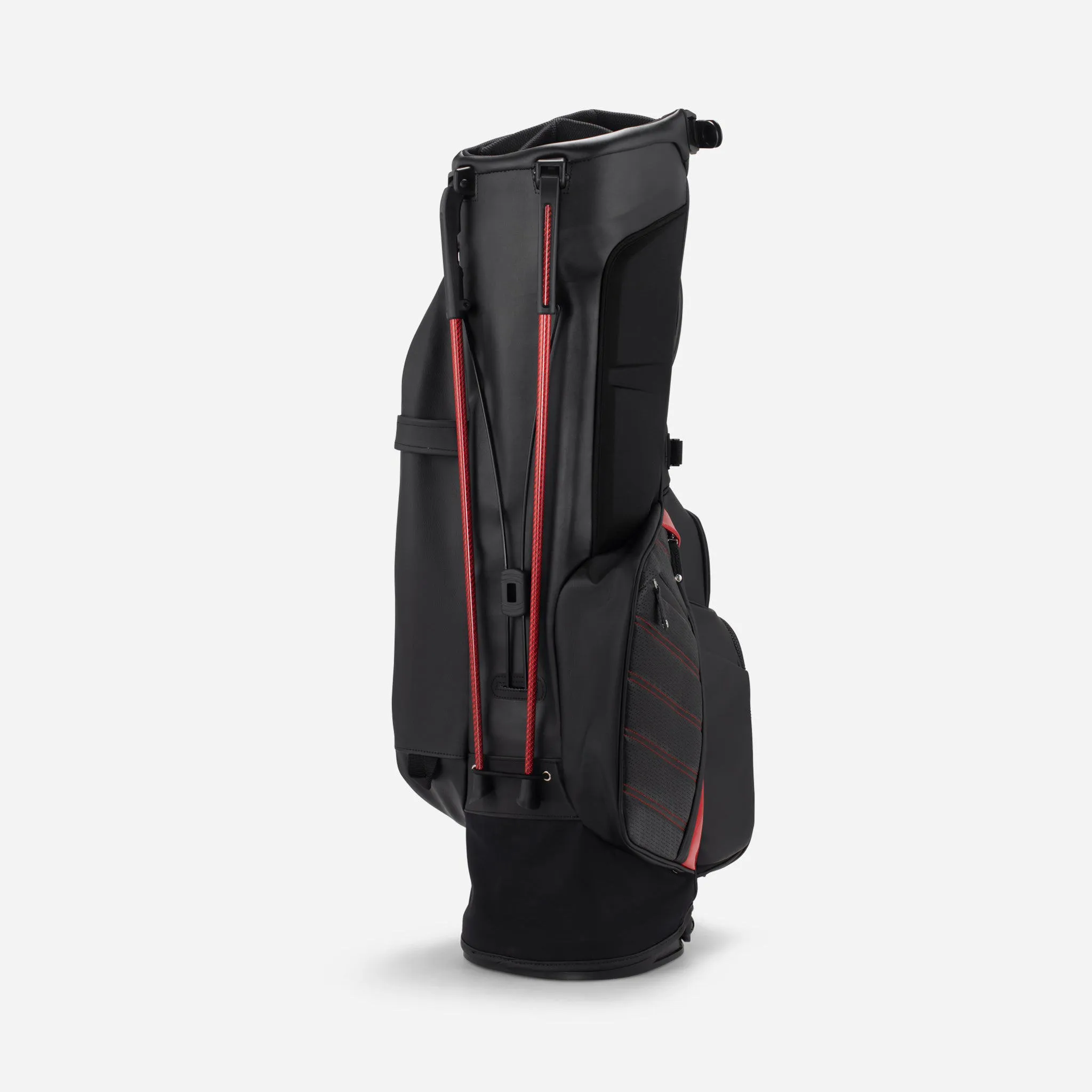
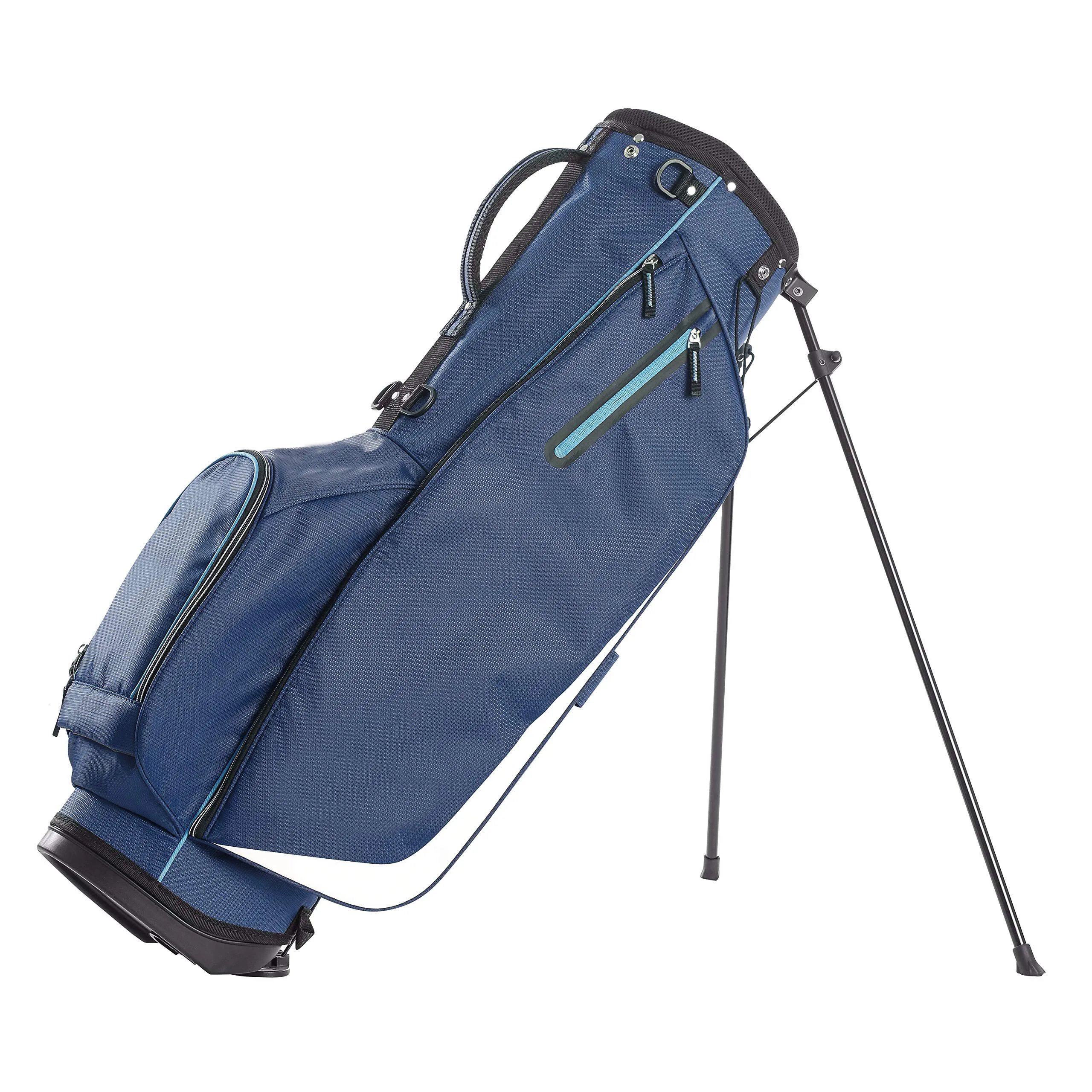
When buyers say "the stand frame", they usually mean the legs, but a stand bag frame is a coordinated system. It includes the leg assembly, the hinge block that joins the legs to the bag, the deployment spring or cam mechanism that snaps the legs out, the base foot that carries the weight, and the internal guides or channels that keep the legs aligned as they deploy and retract. Each component has a different wear pattern, so a bag that fails on the spring, the hinge, or the base is mis-diagnosed if everyone blames "the frame". Understanding the anatomy is the first step to predicting and preventing failure.
The frame also interacts with the shell. The hinge block is sewn and riveted into the lower panel, so a shell that is too thin or un-reinforced at that point will tear around the bracket even if the metal is perfect. The divider tube entry and the hip pad spread load from the frame into the fabric. This is why a spec that treats the frame as a standalone part is incomplete — a durable stand needs the frame, the base geometry, and the surrounding fabric reinforcement to be designed and built as one system. Our affiliated plant designs the hinge surround as a reinforced zone, not a mounting point, which is one reason its carry bags stay straight in the field.
Deployment Cycles: The Number That Decides Longevity
The most informative single test for a stand is the deployment cycle test: deploy the legs and fold them back, over and over, and record how many cycles pass before the spring weakens, the legs wobble, or the mechanism jams. A sensible starting target is 3,000 to 10,000 cycles depending on the segment, with pass criteria of no cracking, no severe wobble, and consistent deployment. Every golf bag's stand is exercised roughly each time the player drops it and picks it up, so the cycle count is a direct proxy for how many seasons the bag will stand before it stops cooperating.
The pass criteria matter as much as the count. "No severe wobble" must be defined: a predictable small degree of rock is normal, but a leg that folds inward and lets the bag tip is a failure. Record the deployment feel over the life of the test, because a spring that starts strong and degrades by the 2,000-cycle mark tells you the heater or the cam was undersized, while a fast initial failure points to a supplier or a hinge defect. At our facility we run the deployment test on the pre-production sample and during lot release, so the sample-approved stand is the production stand, not a lucky prototype.
Base Stability and Leg Alignment
Stability on undulating ground is what a stand bag must guarantee. When the bag sits, the base should spread to a stable footprint, resist slipping on a slope, and hold a consistent leg spread so the bag does not slowly fold. The base-stability check evaluates the angle at which the bag begins to slip, the slipping resistance of the feet, and the consistency of leg spread across repeated deployments. A bag that stands level on a flat floor but tips on a 5-degree slope fails the real-world test that matters to a walker.
Leg alignment is a QC landmark check as well as a performance test. The two legs must sit parallel at full deployment, the feet must contact evenly, and the hinge must not allow one leg to lag behind the other. Measure the leg-spread width and the height of the base in the deployed position against the tech pack, and confirm the bag returns to the same footprint every time. At our affiliated plant we record leg alignment, stability angle, and slipping resistance on the first article and on inspection, so a subtle leg-drift from one run to the next is caught while it is still cheap to correct.
Tube Grade, Wall Thickness, and the Hinge Block
The physical strength of the frame lives in the tube grade and wall thickness. Stand legs are commonly steel or aluminium alloy tubing, and a buyer should confirm the tube material, the outer diameter, and the wall thickness because they set both the weight and the bending resistance. A too-thin tube under the weight of a full 14-way bag will bow over a season, misaligning the feet and unsettling the stand. State the tube spec in the tech pack and check it at goods-inward, because a factory cutting to a cheaper equivalent is exactly the kind of silent substitution that erodes quality.
The hinge block carries the highest cyclic stress, so its reinforcement is decisive. A reinforced hinge block uses a stronger bracket, additional anchor points, and heavier stitching and rivet rows into the base panel. The deployment spring or cam must be matched to the leg weight and the bag's loaded weight; an undersized spring deploys weakly and wears fast, while an oversized one snaps the bag open harshly and stresses the hinge. We specify the hinge reinforcement and the spring match in the tech pack and verify them at the first article, because these are the parts a customer notices most when they stop working quietly.
Stand Frame and Structure Spec Table
Use this as a negotiation baseline for a mid-tier carry stand bag and lock the values before bulk.
| Parameter | Typical Mid-Tier Spec | Buyer Note |
|---|---|---|
| Leg tube | Steel or aluminium, stated OD + wall | Confirm grade and wall; check at goods-inward. |
| Hinge block | Reinforced bracket + anchor points | Heavier stitching/rivet into reinforced base. |
| Deployment | Spring or cam, matched to load | Undersized spring deploys weakly and wears fast. |
| Base foot | Grip sole, wear-plate protected | Confirm slip resistance on slope. |
| Cycle target | 3,000-10,000 deployments | No cracking, no severe wobble. |
| Stability angle | Stands level on stated slope | Record slipping resistance and leg spread. |
| Leg alignment | Parallel spread, even foot contact | Measure against the tech pack every run. |
Maintenance That Extends Frame Life
End-customers and retailers can extend a stand bag's frame life with low-cost seasonal care. Before storage, clean the legs and hinge with a dry cloth to remove sand and grit, which act as an abrasive in the hinge and springs. Check the legs for realignment every season: if one leg folds inward or the feet no longer sit flat, that is a sign the hinge or a tube mounting has drifted and should be checked rather than ignored. Avoid storing the bag fully loaded for long periods, because constant weight on a partially deployed leg can stress the hinge. Do not force the legs open against a stubborn spring; a clean, gentle deployment matches how the mechanism was designed to work.
There are a few lubrication points worth mentioning, but sparingly. Most modern stand mechanisms are self-lubricating plastics and nylon bushings, so adding oil can attract grit and gum the parts. The safer care is cleanliness rather than lubrication; if a hinge does become stiff, a dry lubricant on the joint and a wipe-down of the spring channel is usually enough. When you supply maintenance guidance in your programme, keep it simple and actionable — a one-page care card with these steps reduces field returns and keeps the product performing, which is better for the brand and the buyer than a warranty claim later in the season.
When to Replace Versus Repair
Some frame problems are simple repairs and others signal a replacement. A bent leg tube or a cracked hinge block cannot be reliably straightened or repaired on-site, because the metal has already fatigued; replace the component or the bag's lower assembly. A weak deployment where the legs still extend but slowly is usually a spring or cam nearing end-of-life and can be swapped for a matched part. A bag that has begun to wobble badly after many seasons is better retired, because the wear compounds and a repaired hinge will soon fail elsewhere. Defining these thresholds in your after-sales plan keeps a retailer or player from spending money on a doomed repair.
From a manufacturer's view, replace-vs-repair starts at lot release. If a stand fails the deployment cycle early in production, we trace the part back to its lot and swap it rather than patching individual bags, because the defect is systemic. This is why our affiliated plant keeps the tube, hinge, and spring suppliers identified by lot and audits them, so a structural flaw is caught at the source instead of shipping as a slowly-failing bag. A buyer who understands the component-level sourcing of the frame is better positioned to ask the right questions when a warranty claim appears.
Test Plan & Acceptance Criteria
Lock these pass/fail criteria into the tech pack for the stand system.
- Deployment cycle test at the agreed target, no cracking or severe wobble.
- Base-stability check on a stated slope: level stand, even foot contact.
- Leg-alignment verification against the tech pack on every run.
- Tube grade and wall-thickness confirmation at goods-inward.
- Hinge reinforcement and matched spring verified at the first article.
- Component lots traced and audited for a systemic early failure.
- Replace-vs-repair thresholds defined in the after-sales plan.
Sampling & QC Checklist
Use this list to align expectations before sampling and before bulk production.
- Target market, bag type, and use case (walk vs cart).
- Stand system spec: tube, hinge, spring, base, guides.
- Deployment cycle and base-stability targets.
- Leg-alignment and stability-angle landmarks.
- Maintenance and care guidance for end-customers.
- Replace-vs-repair and spare-parts plan.
- First-article inspection and lot-release on every run.
Designing for Durable Deployment, Not Just Testing Well
A stand that passes a lab cycle count can still feel wrong on the course, because a durable deployment is an ergonomics and geometry problem, not only a durability one. The deployed angle and the foot spread set how stable the bag feels when the player leans it on undulating ground; a bag that is mathematically stable but deploys with a violent snap, or one that sways when set down on a slope, will frustrate even if the spring lasts 10,000 cycles. Designing for durable deployment means choosing the deployment angle, the leg spread, and the foot geometry deliberately, and balancing the spring tension so the stroke is firm but controlled. These are inputs a buyer can demand in the tech pack and verify on the first article.
Designing well also means engineering for what happens off-test: the bag dragged between carts, tipped on its side, dropped onto the base repeatedly, and stored loaded against the hinge. The base wear plate, the hinge reinforcement, and the spring housing must tolerate these everyday abuses, not just the clean cycle in a jig. Our affiliated plant reviews the deployment geometry with the buyer at sampling so the stand feels right in hand and survives the field, then locks that geometry into the tech pack and the lot release. When you evaluate a sample, do not just count cycles in your head — set it down on a putting-green slope, tip it, and let it rest loaded; the sense of stability you get is the feature, and the cycle count is only the backstop.
Retailer, Player, and Storage Guidance That Extends Frame Life
The frame's real lifespan depends on how retailers and players maintain it between rounds. A one-page care card that covers cleaning, realignment checks, storage, and the replace-vs-repair rule turns an unmanaged warranty risk into a low-cost behaviour. Tell the player to wipe the legs and hinge clear of sand and grit, to check each season that both legs fold flat and the feet sit level, and to avoid storing the bag fully loaded or with the stand half-deployed, which keeps tension on the hinge and spring. These are cheap, repeatable steps that measurably extend how long the stand keeps deploying straight.
Retailers benefit from guidance too: display stock should be stored dry, unloaded, and with stands retracted, and demo units should be cycle-checked and retired once they start to wobble. If your programme ships a care card, you convert what would be an unmanaged field failure into an informed maintenance step that keeps the product performing. And connect the care guidance to the after-sales plan: publish the spare-parts availability and the replace-vs-repair thresholds so a store or player knows exactly when a leg is repairable versus when the frame should be replaced. A bag whose frame is cared for and understood protects both the player's round and the buyer's repeat-sale reputation.
Building a Spare-Parts and Support Programme
Because a stand frame is the part most likely to wear, a spare-parts and support programme is a strong quality signal a manufacturer can offer a buyer. Stocking and naming the replaceable frame components — the legs, the hinge assembly, the spring or cam kit, the base foot, and the strap attachments — and publishing the part references and the replace-vs-repair thresholds lets a retailer or player fix a worn part instead of returning the whole bag. A lightweight spring kit or a hinge assembly is cheap to ship as a spare, and that small investment in after-sales support often turns a frustrated field failure into a satisfied repair that protects the brand's repeat business.
At our affiliated plant we identify the frame and hardware components by lot and keep them available for reorder, so a seasonal worn-stand problem can be resolved with a matched part rather than a claim. When you negotiate a programme, ask the factory which components are replaceable, request a spare-parts list with prices and lead times, and confirm the replacement instructions are clear to a retailer. Pairing a durable design with an executable support plan is how a buyer moves past "the stand wore out" and into "the spare was a 15-minute swap". Support is rarely the headline of a sourcing negotiation, but it is frequently the difference between a one-time customer and a partner who reorders year after year.
Finally, set a realistic lifetime expectation into your after-sales and marketing language. A stand is a wearing component no matter how well it is designed, so telling retailers and players what a reasonable lifespan looks like, and how to spot early signs of wear, prevents both inflated expectations and avoidable returns. A frame that is understood as a replaceable wearing part — designed durably, tested rigorously, and supported by a spare plan — performs reliably through its useful life and reflects a professional sourcing decision rather than leaving the buyer to discover the limits after the fact.
Recommended Internal Links
- Products (Stand Bag Architectures)
- OEM/ODM Service
- Factory & QC
- Golf Stand Bag Buying Guide
- Hardware Maintenance
- Testing Material Quality
FAQ
Why does my golf stand bag's stand stop deploying correctly?
Usually a weakened deployment spring or cam, grit in the hinge, or a drifted leg alignment. Clean the hinge and legs, check for realignment, and test the deployment. If a leg folds inward or the bag no longer stands level, the hinge or a tube mounting has likely drifted.
How many deployment cycles should a quality stand survive?
A sensible target is 3,000-10,000 cycles depending on the segment, with pass criteria of no cracking, no severe wobble, and consistent deployment. Higher-end programs and 14-way bags should sit at the stronger end of that range.
Can I repair a bent stand leg or cracked hinge block?
No. A bent tube or cracked hinge block is already fatigued metal and should be replaced, preferably before it fails mid-round. Weak but functional deployment is often a matched spring or cam replacement, while a badly wobbling bag is better replaced entirely.
How do I verify a stand's base stability when sourcing?
Ask the factory for the deployment cycle test result and run a base-stability check on a stated slope — the bag should stand level, with even foot contact and consistent leg spread. Confirm the tube grade, wall thickness, and hinge reinforcement in the tech pack and at goods-inward.
Should I oil the stand mechanism?
In most cases no; modern mechanisms are self-lubricating nylon and plastic bushings, and oil attracts grit. Maintain by keeping the legs and hinge clean and dry. If a hinge is stiff, a light dry lubricant and a wipe of the spring channel is enough.
Do you support OEM/ODM stand system development?
Yes. We support OEM (branding on proven stand architectures) and ODM (co-developing the stand mechanism, base geometry, and frame reinforcement). Send your target market, weight class, and deployment expectations to start a sampling round.
Request a B2B quote for golf stand bags
Send your target market, expected MOQ, and reference photos. We respond within 24 hours with a sampling plan.