For OEM golf stand bag buyers, the single largest cost driver is material specification — shifting from a standard 600D polyester shell to a waterproof TPU laminate can move unit cost by roughly 15-20%, and locking the material and divider spec early is what actually controls your landed price. This guide breaks a custom stand bag quote into the line items that matter, explains why the price drops as you approach the 200-piece MOQ, and gives you the questions to ask so no hidden cost survives the quote. For the wider golf bag category — cart bags, staff bags and more — our affiliated golf bag factory is the one-stop reference.
Key Takeaways
- Material is the biggest line item — TPU waterproof can add 15-20%.
- Unit price steps down cleanly past the 200-piece MOQ toward 600.
- Bring along a tech pack to get a true quote, not a placeholder.
- Never compare totals across different Incoterms — normalize first.
- Line-item quotes keep hidden sampling and digitizing costs visible.
Anatomy of a Stand Bag Unit Cost
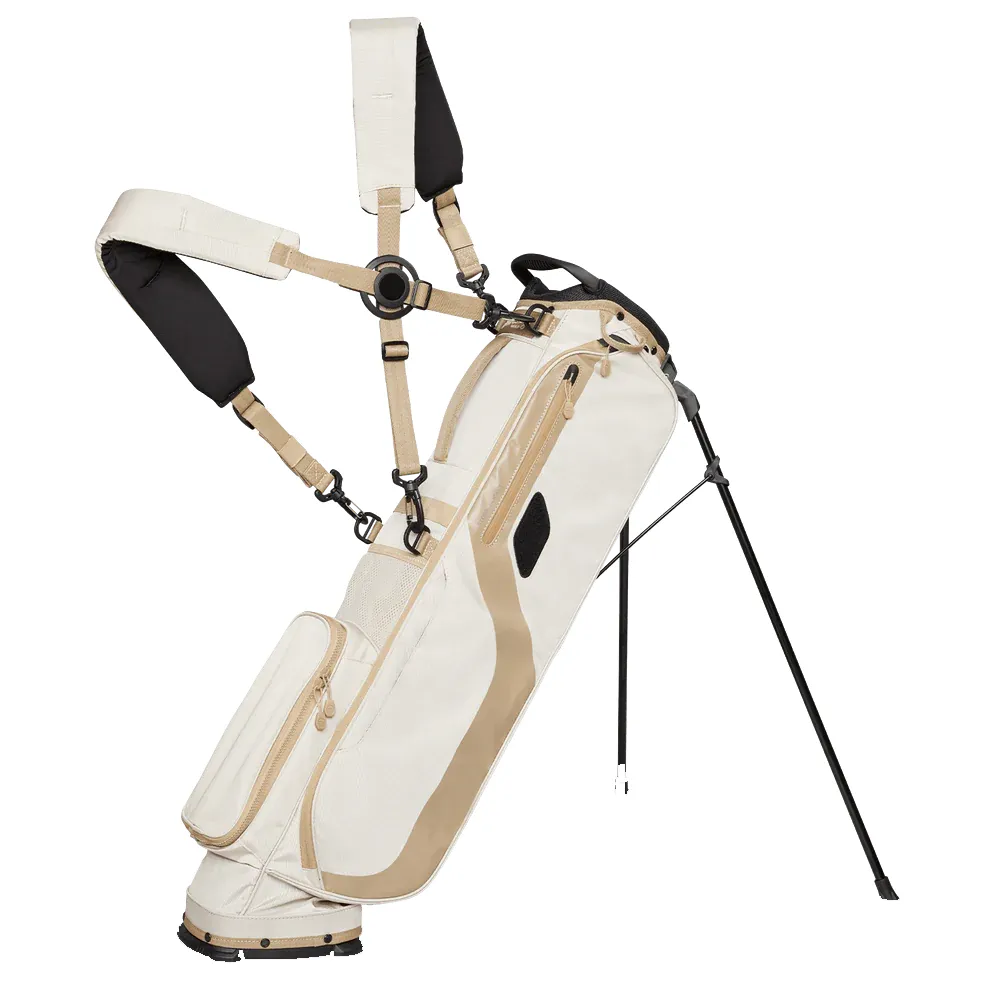
A custom golf stand bag price is not one number; it is the sum of material, labor, hardware, and overhead, each with its own lever. On a typical 600D polyester carry bag, the fabric and lining are the largest single share of material cost, followed by the stand mechanism and hinge block, the zippers, webbing and dual straps, the divider system, and the branding. Labor is the second big block, dominated by the sewing hours — and that is where a factory's sewing capacity and QC discipline show up in price quality.
Understanding the split matters because it tells you where to make cuts when the number comes in high. If you need to reduce cost, the fastest lever is fabric denier and finish, then hardware brand, then divider complexity, then branding detail. Slashing the sewing spec to save money usually backfires, because a stand bag that fails at the seams costs you warranty returns and brand damage that dwarf the saved production cost. Spend the engineering effort on the material and hardware, keep the sewing standard, and the total lands where it should.
At our affiliated plant the costing starts from a validated baseline: seven lines, 149 machines (126 sewing machines), 137 staff, and a monthly throughput of roughly 150,000 bags against a capacity of 200,000. That installed base is why we can hold tight cost on standard builds and price honest premiums on the complicated ones, rather than hiding the delta in a vague margin.
Why Material Is the Biggest Lever
Material is where the 15-20% swings live. A standard 600D polyester shell is inexpensive and easy to sew. The moment you move to a PU-coated or TPU waterproof fabric, three things change at once: the fabric itself costs more per meter, the lamination adds a production step, and the heat-sealed seams and zipper flaps require extra labor and a sealed-back room condition. The result is a genuine per-unit jump that no factory can fully absorb.
Denier is a second, subtler cost driver. A 400D nylon panel is lighter and cheaper, but it wears faster on the base and lower panel; a 600D or a 1680D ballistic weave costs more but survives course abrasion. The smart buyers choose denier by zone — heavier on the bottom wear plate, lighter on the top lid where weight matters. That zoning saves a few dollars a unit without sacrificing durability, and it is exactly the kind of cost engineering a good factory flags early.
Do not forget the finish and coating. A DWR water-repellent finish, a PU back-coating, and a scrim reinforcement each add a small step that accumulates. Lock the full material spec — base, lining, dividers, webbing, hardware finish — before you ask for a firm number. A quote built on "nylon or polyester" is a placeholder; a quote built on a written spec is a commitment.
Divider Systems: Cheap on Paper, Costly in Labor
Divider configuration is a classic hidden-cost area because the raw material is cheap but the labor is not. A 4-way or 6-way bag uses a simple horizontal separator, and the top assembly is quick. A full-length 14-way system means each of the fourteen tubes must be sewn vertically, aligned so a club handle does not snag, and matched to the divider texture so clubs slide cleanly. That alignment is hand-skill work, and it shows up in the sewing hours rather than in a line item you can see.
The pricing effect is real: a 14-way build typically costs more than a 6-way build even with identical fabric, because of the extra divider material, the additional top-lid pattern, and the QC time spent checking divider alignment on every unit. If your market genuinely needs 14-way protection, pay for it. If you are assuming 14-way because premium sounds better, test both in the sampling round and let the retail sell-through decide — many buyers land on a 6-way with a full-length option and save money with no sales penalty.
Ask your factory to quote the same material in 6-way and 14-way variants. The delta between those two quotes is the true price of the divider upgrade, and it is usually bigger than buyers expect. That single comparison will tell you whether the feature earns its keep on your shelf.
Hardware: Where the Premium Brands Earn Their Price
Hardware is the difference between a bag that feels premium and one that feels cheap, and the market prices it accordingly. The stand system is the centerpiece: the hinge block, the legs, and the deployment spring carry the most repetitive stress on the bag, so a reinforced hinge and a stable base geometry cost more but survive thousands of cycles. Zippers are the second visible driver — a smooth zipper with a robust slider and a water-tight flap on a waterproof build is a meaningful upgrade over a basic coil.
Webbing and straps matter more than they get credit for. A dual self-balancing strap with padded shoulder sections and an adjustable sternum strap adds webbing meters and hardware, but it decides whether the bag is comfortable to carry for nine holes. Buyers who comp on the straps to save two dollars often pay for it in poor sell-through reviews and higher returns. Keep the strap quality on the premium builds; it is where the "carry feel" is earned.
The rule for hardware is to spend where the user feels it — stand, zipper pull, strap, buckle — and save where they never touch it, like an internal stiffener that can be a lighter gauge without anyone noticing. A factory that advises you on exactly that split is adding real value, not just filling a quote.
The Quantity Curve: MOQ to 600 Pieces
Unit price is not flat; it steps down as quantity rises, and understanding the steps lets you buy at the right point. Around the 200-piece MOQ the setup is amortized and the material can be bought in near-full rolls. Between 200 and 600 pieces, hardware buying quantities improve and the sewing line runs without changeovers, pushing the per-unit number down a further step. Beyond roughly 600 to 1,000 pieces, full-roll material purchasing and a dedicated line time unlock the best price.
These breakpoints are not a marketing trick; they reflect real production economics. A factory quoting a flat per-unit price across all quantities is typically hiding the setup cost in the margin on the small orders and giving nothing back on the large ones. Ask for the price at three points — your pilot, your season order, and a hypothetical full container — and you will see the curve that lets you plan. Anchor your quantity to your sell-through forecast, not just to the cheapest tier, so you buy the step that matches real demand.
The table below lays out the practical quantity steps and what each unlocks, so you can target your first season realistically.
| Order Size | What It Unlocks | Planning Note |
|---|---|---|
| 100 pcs (test order) | Design, photography, logo validation | De-risk before committing; higher per-unit price. |
| 200 pcs (regular MOQ) | Setup amortized, cleaner color | Standard planning number for a first season. |
| 200-600 pcs | Better hardware buy quantities | Fewer line changeovers, next price step. |
| 600-1,000 pcs | Full-roll material, dedicated line | Best per-unit economics for a launch. |
| Multi-color spread | Per-colorway dye lots | Each color is its own minimum consideration. |
Branding Costs Without the Surprise
Branding is where hidden fees like to hide. A single-color logo on the chest is a modest add, typically 3-5% of unit cost, because the embroidery digitizing is a small one-time setup and the per-unit thread cost is low. Multi-color embroidery, a molded patch across two panels, or a heat-transfer wrap with gradient artwork pushes toward 6-8% because each color is a separate pass and every placement has its own registration and QC tolerance.
The costly mistake is to ask for a quote without specifying the logo method and placement, then get a number that balloons at sampling. Settle the artwork format early — vector AI or EPS, color-separated by Pantone — so there is no redesign charge at digitizing. And confirm whether the mold or digitizing setup fee is one-time or folded into the unit price; a one-time setup is usually cheaper than a hidden per-unit surcharge over a long season.
Because branding rides on the fabric and structure, brief it together with the architecture. A logo that sits on a waterproof panel needs a patch that does not pierce the sealed film; a logo on a high-flex zone like the stand hinge will delaminate. Tell your factory the placement and the panel together, and they will quote the correct method the first time instead of quoting a generic logo and fixing it after sampling.
Hidden Costs That Survive a First Quote
Even a line-item quote can miss a few costs if you do not ask. Sampling fees are the most common: a concept sample and a pre-production sample are real work, and they are quoted separately from bulk in most factories. Ask up front whether sampling is included, how many rounds are covered, and what a revision round costs. Mold fees for 3D patches and digitizing for embroidery are second. Accessories are third — a rain hood, a dual strap set, and a cooler pocket may be quoted as "standard included" or silently billed as add-ons depending on the buyer's assumption.
Colorway and dye-lot premiums are fourth. A small dye lot or a difficult color that requires an extra run carries a premium, and honestly only a factory that does a lab-dip chip can price it accurately. Finally, freight and Incoterms hide the biggest variable of all: the same carton can differ by a large percentage between a FOB price and a DDP price because the inland delivery, freight, duty, and clearance are all in one bundled figure on the DDP side.
The fix is to demand a written line-item breakdown and to normalize every quote to the same Incoterm before comparing suppliers. If you are still mapping the Incoterm trade-offs, our Incoterms guide for EXW/FOB/CIF/DDP walks through how the same price changes meaning as risk and freight move between buyer and seller.
What a Fair Quote Looks Like
A fair quote does not hide behind a range. It states the material spec it prices, the divider and hardware detail, the branding method and placement, the quantity tier, and the Incoterms and destination for the freight line. It separates one-time setup fees from per-unit cost, and it states the sampling scope and how many rounds are included. If a quote cannot answer those five questions, it is a placeholder, not a price.
At QUANZHOU JUNYUAN BAGS we quote against your written spec and keep the line items visible, because an honest unit number is the foundation of a repeatable program. We also flag the levers that would lower the price — a denier change here, a hardware simplification there — so you make the trade-off with your eyes open rather than discovering it in the PO revision.
Bring us your tech pack and target market, and we will return a line-item quote with the sampling plan inside 24 hours. If you are earlier in the process, the stand bag buying guide and the Factory & QC page cover the same ground from quality side, so you understand both sides of the cost equation before you commit.
Eight Cost-Control Levers to Pull First
When the quote comes in above budget, do not accept it and do not demand a round discount. Pull the levers in the order that protects the product. First, reduce colorways — every color is a dye-lot premium, and cutting from three colors to two removes a whole minimum plus a charge. Second, zone the denier: lighter on the top lid where weight matters, heavier only on the base and lower panel where wear happens. Third, simplify the divider to the minimum that satisfies the market, keeping a full-length option only if sell-through evidence demands it.
Fourth, standardize hardware: pick one zipper brand and one strap system across the line and buy them at quantity, rather than mixing two spec levels on different SKUs. Fifth, consolidate the accessory set into a single "base bag + hood" standard so you are not splitting the order into sub-minimums for optional variants. Sixth, trim the branding to single-color embroidery on the highest-visibility zone for the first season, and add multi-color or patches only after that zone proves out.
Seventh, plan the sampling rounds tightly so you approve the concept and the pre-production sample in the first pass, avoiding paid revision rounds that add to the total project cost even if they do not touch the unit price. Eighth, and most importantly, time the order against the factory calendar — buying at a non-peak month can move the line schedule in your favor at no material cost. These eight levers typically recover more than a flat negotiation would, and they do it without degrading a single stitch.
Budgeting the Total Landed Cost
A unit quote only tells you part of the story; the decision belongs on the total landed cost. Add the freight, the duty and clearance, the inland delivery to your warehouse, and the warehousing and markdown risk on anything you overorder. A "factory price" that looks low on a FOB basis can lose its advantage on a DDP basis once the small-carton freight is amortized, and vice versa. Build the full landed-cost model on both the pilot and the season quantities before you compare suppliers.
Inventory discipline is part of the total, too. Ordering the cheapest per-unit tier on a quantity your sell-through cannot support turns a low factory price into an expensive inventory you pay to store, insure, and eventually discount. The landed-cost number that matters is cost per unit sold, not cost per unit made. Anchor the quantity to a real forecast and let the price curve tell you whether the product justifies a bigger bet.
Our team will help you build that landed-cost sheet as part of any serious RFQ, because a repeatable program only works if the economics work on the shelf and in the warehouse, not just on the cutting table. That is the difference between picing a carton and pricing a brand.
Pricing Checklist for Your RFQ
Before you send the RFQ, gather the inputs that make a quote accurate instead of generic. Write down the bag type and divider spec, the material and finish for each panel zone, the full pocket list and access logic, the logo method, placement, and artwork format, the target quantity per colorway, and your Incoterms and destination decision. Attach a reference photo or a rough sketch, and state your desired season date so the factory can price the rush premium if any.
Then ask for the price at your pilot quantity and your season quantity, the one-time setup fees, the sampling scope, and the freight estimate for your destination. Cross-check the same variable set across two suppliers so you are comparing apples to apples. A buyer who normalizes the comparison gets prices that are actually comparable, and a buyer who does not is negotiating against their own blind spots.
Reach us at service@junyuanbags.com or +86 17750020688 with your spec, and we will support your evaluation sample while the quote is being built.
Recommended Internal Links
- Products (Stand Bag Architectures)
- OEM/ODM Service
- Factory & QC
- Golf Stand Bag Buying Guide
- How to Negotiate Prices with a Stand Bag Factory
- Golf Stand Bag Factory MOQ Guide
FAQ
What is the biggest cost driver in a custom golf stand bag?
Material specification is the largest driver. Moving from standard 600D polyester to waterproof TPU laminates can shift unit cost by roughly 15-20%, because the fabric, lamination, and heat-seal steps all change.
How much does a typical custom golf stand bag cost?
Unit cost scales with material, divider complexity, hardware, and branding, and it drops as quantity rises toward the 200-piece MOQ and beyond. Send your spec for a line-item quote rather than relying on a generic range.
Why does the unit price drop above a certain order quantity?
Above roughly 200-600 pieces the factory buys materials in full rolls and hardware at better buying quantities, and the fixed setup cost spreads across more units, so every additional bag gets cheaper.
Does adding branding increase the price much?
A single-color logo typically adds 3-5% to unit cost, while multi-color embroidery or a molded patch can add 6-8%. Method, color count, and placement are the three branding cost levers.
How do I get an accurate price for my unique stand bag spec?
Send a short spec: bag type, material direction, divider, pocket list, logo method, target quantity per colorway, and target market. That lets us quote the true material and labor cost instead of a placeholder.
Are 14-way dividers and waterproof panels much more expensive?
Yes, both raise cost. Full-length 14-way dividers add divider tube material and alignment labor, and TPU waterproof panels add lamination and heat-seal steps; combined they can push a premium build up noticeably.
What costs are hidden in a stand bag quote?
Watch for sampling fees, mold or artwork digitizing fees, colorway dye-lot premiums, accessories that are quoted separately, and freight differences between Incoterms. A line-item breakdown surfaces all of them.
Request a B2B quote for golf stand bags
Send your target market, expected MOQ, and reference photos. We respond within 24 hours with a sampling plan.