For a versatile two-in-one build, review our hybrid golf bags — Practice golfers can also browse our range and simulator golf bags — For B2B buyers, the decision between a pure golf stand bag and a hybrid cart/stand bag comes down to one number: the split between walking and cart rounds — the cart pass-through channel and reinforced base on a hybrid typically add 0.5-1.0 lb over an equal-capacity pure walker, which raises unit cost by roughly 8-12%. This comparison walks through weight, divider architecture, pocket layout, stand-leg geometry, and the factory cost drivers behind each line, so you can position the right SKU for your retail market without overbuilding. We make both architectures at QUANZHOU JUNYUAN BAGS, an SGS-verified Quanzhou plant (4,950 sqm, 7 lines, 149 machines, 137 staff), and we share the trade-offs we see confirmed in bulk orders and early returns.
Key Takeaways for Buyers
- Weight delta of 0.5-1.0 lb between pure walker and hybrid at equal capacity — decide your walk/cart split before locking a weight target.
- Hybrid unit cost runs about 8-12% higher due to the cart channel, foot tooling, and reinforced base.
- Hybrid bags win when more than ~40-50% of rounds are cart-based; pure stand bags win for walking-first players.
- Dividers, pockets, and stand legs all change between the two — do not reuse a pure-walker tech pack for a hybrid line.
- Offer both as separate SKUs with a 200-piece MOQ per colorway, or validate the hybrid with a 100-piece test order.
What "Stand Bag" and "Hybrid Bag" Actually Mean in Production
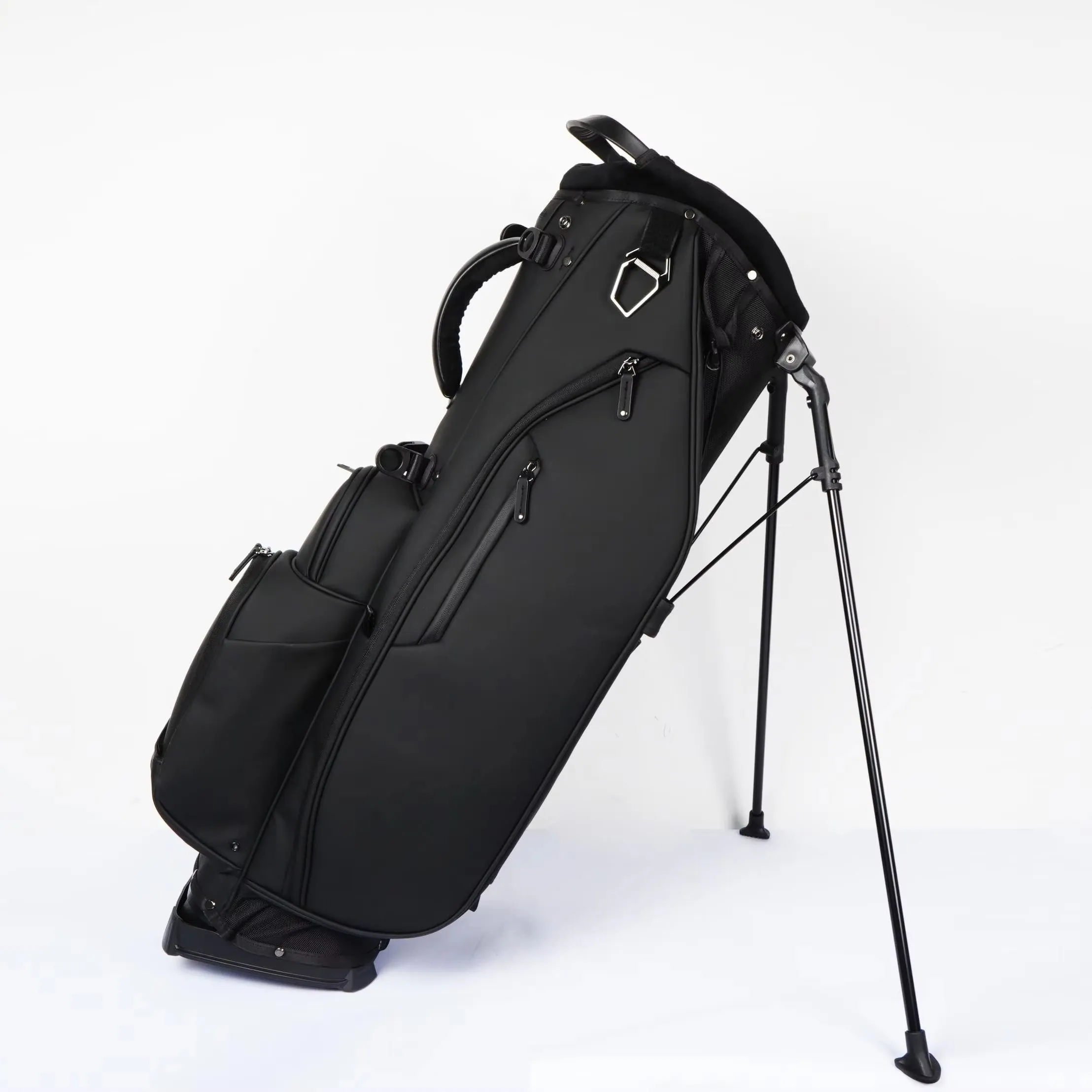
In the factory, neither term is a marketing label; each describes a specific build intent. A pure stand bag is engineered around walking: the dual straps are set for shoulder balance, the stand hinge block is positioned to stay out of the way while carrying, and every panel is chosen to shave grams because the buyer carries the bag for four or five hours. A hybrid cart/stand bag keeps the deployable legs but adds a reinforced cart-pass-through channel — a protected sleeve that slides over a cart's bag rest and top strap — a deeper foot plate, and forward-facing pockets so a player can reach gear while the bag rides on the cart.
That one structural addition changes everything downstream. The cart channel is not decorative: it is usually backed with a stiffer platform and extra bartacking so the strap load does not distort the bag, which is exactly why a hybrid gains weight and cost. When you brief a factory, do not assume a hybrid is "a stand bag with a bigger pocket." It is a different base architecture, and locking that at the start prevents an expensive mid-program redesign.
Weight: The Walk/Cart Trade-Off
Weight is the single most visible difference between the two types, and it is also the most frequently mismanaged spec. A lightweight pure stand bag targets roughly 3.0-3.8 lb; a standard walking stand bag sits around 4.2-5.0 lb; a hybrid cart/stand bag with the same divider and pocket package typically lands at 5.0-6.2 lb. On an equal-volume build, the cart channel, the larger foot, and the base reinforcement are where the 0.5-1.0 lb delta comes from.
The buyer mistake we see is setting a single "target weight" for both SKUs in the catalog. If you ask a factory to hold 4.0 lb on a hybrid, you force it to strip the reinforcement that protects the bag on a cart — and the first wave of returns tells you why. Decide the walk/cart ratio for your target player first, then set the weight. A country-club line with mostly cart play should optimize the base and forgive half a pound; a walking-centric retail brand should do the reverse. Put a tolerance on the weight target, typically ±0.2 lb on the confirmed sample, and re-verify after the first dyelot changes fabric weight.
Head-to-Head: Stand Bag vs. Hybrid Bag Spec Comparison
| Parameter | Pure Stand Bag | Hybrid Cart/Stand Bag | Buyer / Factory Note |
|---|---|---|---|
| Target weight | 3.0-5.0 lb | 5.0-6.2 lb | Set by walk/cart ratio; ±0.2 lb tolerance. |
| Stand legs | Compact, low-profile hinge | Wider leg spread, deeper foot | Hybrid needs stability on cart undulations. |
| Cart channel | None | Reinforced pass-through sleeve | The core cost driver of the hybrid. |
| Pocket orientation | Walk-friendly, side access | Forward-facing cart pockets | Pockets mirror how the bag is used. |
| Dividers | 4/5/6-way typical | 4/5/6-way, 14-way option | 14-way adds weight and cost on both. |
| Cart compatibility | Limited; straps can clamp hinge | Optimized for cart straps | Hybrid protects the stand from cart pinch. |
| Unit cost delta | Baseline | +8-12% | Channel, foot, base reinforcement. |
| MOQ per colorway | 200 pcs (test 100) | 200 pcs (test 100) | Tooling for hybrid foot may add a one-time cost. |
| Best-fit buyer | Walking-first, travel, June/junior lines | Cart-first or mixed-use markets | Position by retailer selling channel. |
Divider Architecture Differs More Than You Think
Many buyers copy the divider layout from a pure stand bag onto a hybrid and call it done. That is a mistake. Because a hybrid rides higher on a cart and tilts rearward, the club shafts sit at a different angle, so the top divider ring and the internal full-length tubes should be tuned to that tilt to stop clubs from rattling and crossing shafts. On a walking stand bag, the divider works best when the bag hangs nearly vertical on your back, which is a different geometry from the slight recline of a mounted cart bag.
In production this shows up as a divider alignment check in final inspection: the top ring, the mid spacer, and the base tube spacing must line up. Keep the divider spec explicit — 4/5/6-way versus 14-way, and whether the tubes are full-length. Full-length dividers prevent shafts from catching on pocket edges, but they add weight and stitching, which pushes cost up on both types. Our recommendation is to match the divider to how the clubs are carried: walking players tolerate a 6-way; cart-first players often prefer a 14-way because the bag is not on their shoulder, so the weight cost is acceptable.
Pockets: Walk-Access vs. Cart-Access Log
Pocket layout is where the two lines visually diverge and where returns happen if you get it wrong. A pure stand bag puts the valuables, rangefinder, and ball pockets on the side that faces your back while walking, keeping the front clean so the bag does not press into your spine. A hybrid flips the logic: pockets face forward so a player on a cart can reach them without twisting, and the top pockets sit higher to clear the cart's top strap.
From a cost standpoint, pocket count and lining drive labor. A magnetic rangefinder pocket, a removable cooler pocket with insulation and a drain, and a large apparel pocket all add sewing time and QC variability on either build. The practical rule is to design the pocket list around the dominant usage: put your two or three highest-value pockets where the hand naturally goes for that usage mode, and keep the rest simple. Complex pockets add real cost — roughly 3-5% for a full pocket package upgrade — so align pocket ambition with the retail price point you are targeting.
The Stand System: Hinge Block, Legs, and Foot
The stand is the part most likely to generate returns, and it is built differently on a hybrid. A pure stand bag uses a low-profile hinge block to keep the legs out of the way while carrying; leg collapse is driven by a tension strap or slider. A hybrid needs more leg spread and a deeper foot because the bag sits on an uneven surface more often — a cart path edge, a rough slope — and it must stay upright while the player walks around it. The deeper foot costs more material and tooling.
Our QC holds a stand deployment cycle target (deploy and collapse repeatedly) and a base stability check that measures leg spread and slipping resistance on a standard slope. These two tests catch the two most common field failures: hinges that drift out of tolerance and legs that wobble after repeated cart compression. If a buyer plans heavy cart use, specify a reinforced hinge block and a foot rated for the heavier hybrid base — it prevents the "wobbly bag in year two" complaint that drives warranty costs.
Cart Compatibility: Why the Channel Matters
The most underrated difference is how each bag survives a cart. A cart straps a bag in place across the top and around the foot; when it cinches a pure stand bag too tight, the compression concentrates on the hinge block and can distort the legs over time. The hybrid's reinforced pass-through channel is designed exactly to prevent that: it spreads the strap load across a stiffer platform instead of pinching the stand mechanism.
That is why we tell buyers to think about the retailer's selling channel, not just the end player. If your distribution is pro shops and resort courses where carts dominate, a hybrid line reduces warranty claims and photographs better on a cart. If your line sells through walking-focused specialty stores and travel retailers, the pure stand bag is the honest choice. A catalog can carry both, but each needs its own tech pack and its own base geometry.
Cost and MOQ: What Changes When You Add the Hybrid
Adding a hybrid SKU is not just one more bag; it is one more base tooling line. The cart channel, the deeper foot plate, and the reinforced base either reuse existing bending and stitching tooling or require new dies. Expect the hybrid to cost about 8-12% more per unit than an equal pure stand bag. Our regular MOQ is 200 pieces per colorway for both, and we offer a 100-piece test order so you can validate the architecture, the divider behavior on a cart, and the stand stability before committing to a full bulk order.
Lead time follows factory capacity: sampling runs 10-20 days and bulk production 45-60 days, which is standard for both architectures because the sewing and QC steps are the same. The real schedule risk on a hybrid is the foot and channel tooling, so lock the base drawing early. If you are comparing vendors, ask specifically how many stand deployment cycles and how many dyelot matches they guarantee on the hybrid — the answers reveal how well they actually build the cart channel.
Test Plan and Failure Modes Specific to Hybrids
- Cart strap compression test — verify the channel protects the hinge block from pinch distortion.
- Stand deployment cycle test and base stability check on both flat and sloped surfaces.
- Weight verification against the ±0.2 lb tolerance after each dyelot change.
- Divider alignment and shaft-rattle inspection on the cart-tilted geometry.
- Carton drop test and cart-channel abrasion check on the contact edges.
The failures that hit return rates most on hybrid lines are cart-channel tearing at the strap contact, stand wobble from a foot that is undersized for the extra weight, and divider shafts tangling because the top ring was copied from a pure walker. Put a dedicated hybrid QC checklist in place and inspect the cart channel at the sewing line, not just at final random sampling.
Decision Guide: Walk/Cart Ratio and SKU Positioning
There is no correct answer for everyone, but there is a correct answer for each target player. Use this rule of thumb: if your buyer plays more than half of rounds on a cart, the hybrid's cart-pocket access and protection outweigh the extra pound; if they mostly walk, the pure stand bag is the honest, lower-cost choice. Position the pure stand bag as the lightweight walking and travel SKU, the hybrid as the all-rounder for distributors who sell to a mixed audience, and a 14-way hybrid as the premium organizer for cart-first club players.
For a distributor catalog, we recommend a three-SKU stack: a 3.5 lb pure walker, a 5.5 lb hybrid, and a 14-way hybrid for the premium tier. That covers the high-intent search demand without bloating your inventory, and each SKU has a clear retail story. Keep the same brand file and trim family across all three so the line reads as one collection.
Plan after-sales before you ship the first bulk order. Stand bags in either build can have the legs or straps re-fastened, so carry a small spares kit — hinge pins, tension straps, and foot tips — and define a simple warranty window, typically 12 months on the stand mechanism and zippers. A buyer who knows the spare part list and the turnaround for a replacement leg trusts the line more, and that translates into cleaner reorders instead of chargebacks. When you are ready to source, email service@junyuanbags.com or message us on WhatsApp at +86 17750020688 with your target market and MOQ.
Material Choices That Shift the Weight and Cost Balance
Material is where a hybrid can be made to feel far lighter than its structure suggests, or where a pure stand bag silently gets heavier. Most walking stand bags use nylon in 400D or 600D, or a polyester shell, because both are light, strong, and take embroidery well. A hybrid that carries more hardware benefits from a partly reinforced build: a 600D or 840D stress-panel around the cart channel and foot, with lighter panels elsewhere, so the reinforcement goes exactly where the load is instead of adding weight to the whole bag.
The picks that really change the number are the foam in the straps and base, the divider tube lining, and the hardware. A dense but thin EVA strap padding keeps comfort without the bulk; a fluted or honeycomb foot saves grams versus a solid plate; and standard zipper/hook hardware can add up quickly if you specify every part at the premium level. In the factory we often quote a hybrid two ways — one at a value material set and one at a premium set — so you can see where the 8-12% cost delta actually lives and decide what to keep.
Colorways, Branding, and Line Consistency
It is tempting to run a hybrid only in the two or three colors you already buy for the pure stand bag, but colorway planning matters more on a hybrid because the larger base and cart channel add more visible panels that can shift tone. Set a dyelot and tonal tolerance on each colorway, approve a lab-dip or physical chip, and specify the Pantone reference so the hybrid matches your stand bag colors in the same catalog photo. Branding behaves the same way on both — embroidery, heat transfer, or molded patches — but the cart channel is a poor placement zone because it flexes and abrades under the cart strap; keep the hero logo on the front panel and the lid.
Keeping the same brand file, hardware finish, and trim family across the pure stand bag and hybrid makes the line read as one collection and lets you reorder both from the same QC master. Our OEM/ODM service supports branding and structure together, and we will flag placement conflicts before sampling so you do not pay twice.
Sampling and the Roadmap to Bulk
Before bulk, run at least one pre-production sample on the exact production fabric, with the approved stand hardware and a physical color chip. For a hybrid, also test the bag strapped to the actual cart strap geometry your retailers use, because the channel is the single most likely source of a late-stage design change. Lock the weight, the divider, the pocket list, and the stand cycle target in the tech pack, then confirm with a 100-piece test order before the full run.
Related reading to plan your line: see stand bag vs staff bag differences if you are also considering a caddie bag, and the stand bag vs cart bag comparison for the no-leg option. Browse the stand bag architectures we build, review our factory and QC process, and read the golf stand bag buying guide before you send an RFQ. Our OEM/ODM service covers both pure walkers and hybrids.
FAQ
What is the difference between a hybrid golf bag and a stand bag?
A pure stand bag is optimized for walking: its stand system and straps assume the bag is carried, and it is kept as light as possible. A hybrid cart/stand bag pairs the legs with a reinforced cart-pass-through channel, a bigger foot, and forward-facing pockets so it performs on a cart without giving up the ability to stand on the course. The hybrid typically runs 0.5-1.0 lb heavier at equal capacity.
Is a hybrid golf bag better than a stand bag?
It depends on how the player splits walking and cart rounds. If more than roughly 40-50% of rounds are cart-based, a hybrid protects the bag and gives better cart pocket access. If the player almost always walks, a pure lightweight stand bag saves weight and balances better.
How much heavier is a hybrid cart/stand bag?
At equal capacity and material, a hybrid typically adds 0.5-1.0 lb because of the cart channel, larger foot plate, and reinforced base that absorbs cart vibration. On a 4.5 lb walker that can mean a 10-20% weight increase, which is why buyers must decide the walk/cart ratio before locking a target weight.
Can a hybrid bag stand up on the course?
Yes. A hybrid retains deployable legs, but the stand legs are often set slightly wider and the base uses a deeper foot to stay stable on cart undulations. The trade-off is that the heavier cart-channel base sits higher, so the bag can be slightly less balanced on your shoulder when walking uphill.
What is the minimum order quantity for a hybrid golf stand bag?
At QUANZHOU JUNYUAN BAGS our regular MOQ is 200 pieces per colorway, with a 100-piece test order available to validate the architecture before committing to bulk. Hybrid programs add the cart channel and foot tooling, so quote them as a separate SKU line.
Do cart straps damage a standard stand bag?
A cart that cinches too tight can compress a stand bag across the hinge block and distort the legs over time. That is the main reason frequent cart users buy a hybrid or cart bag: the reinforced channel spreads the strap load instead of pinching the stand mechanism.
Request a B2B quote for golf stand bags
Send your target market, expected MOQ, and reference photos. We respond within 24 hours with a sampling plan.