Practice golfers can also browse our range and simulator golf bags — For B2B buyers the sharpest contrast is weight and "who carries it": a stand bag is engineered for the player to walk with at roughly 4.2-5.5 lb, while a tour-style staff bag has no stand legs and runs 6.5-9 lb or more because it is designed to ride a cart or be handled by a caddie. This guide compares the two bag types across weight, divider capacity, pocket architecture, stand legs, and the factory cost and MOQ implications, so you can pick the right SKU for a retail line, a tournament program, or a corporate gifting order. We produce both at QUANZHOU JUNYUAN BAGS, an SGS-verified Quanzhou plant (4,950 sqm, 7 lines, 149 machines, 137 staff), and we flag the engineering differences that catch first-time buyers off guard.
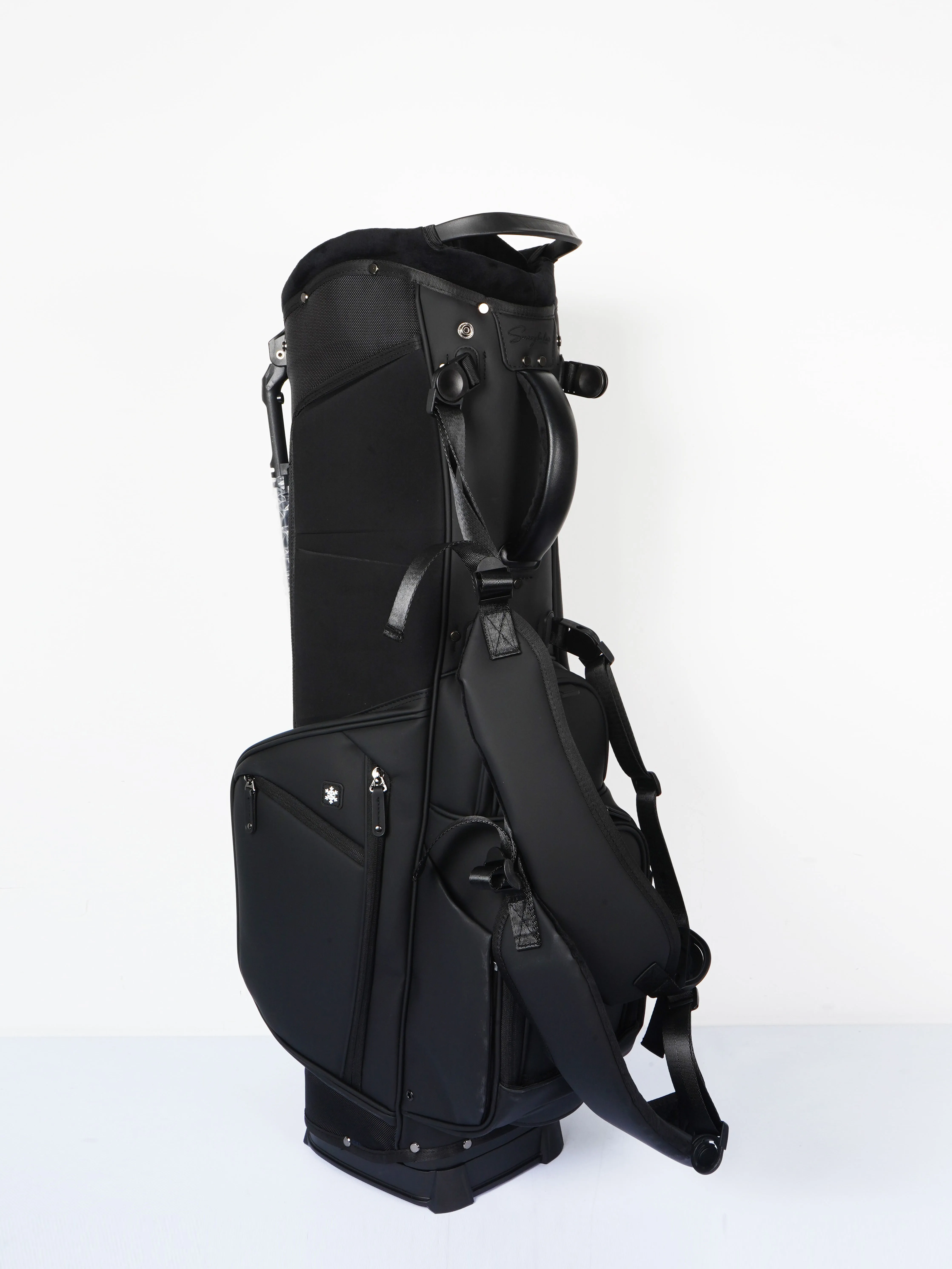
Key Takeaways for Buyers
- A stand bag is a walking bag with legs (4.2-5.5 lb); a staff bag is a cart/caddie bag without legs (6.5-9+ lb).
- Staff bags carry more pockets and a heavier top collar, so their fabric, freight, and unit cost run higher than a stand bag.
- Choose the bag by the end user: walking players, juniors, and travelers need a stand bag; pro shops, caddie service, and brand display benefit from a staff bag.
- Both customize well, but a staff bag's large front panel allows a bigger hero logo than a stand bag.
- Plan 200-piece MOQ per colorway (100-piece test available) and higher freight volume for the staff bag line.
Defining the Two Bag Types in the Factory
In manufacturing terms, a stand bag is defined by its deployable leg system and a structure tuned for shoulder carrying: the dual straps, the hinge block placement, and every panel gram are optimized so the bag balances on a back for hours. A staff bag is a materially different object. It is purpose-built to sit on a cart or be carried by a caddie, so it has no stand legs, a much larger top collar, a wider body, and deep, high-capacity pockets. The names are sometimes used loosely at retail, but the build recipes are not interchangeable.
That structural difference cascades through every spec. The stand bag's divider must cope with vertical hang on your back; the staff bag's divider faces the rearward tilt of a cart and the shoulder height of a caddie hauling it over a shoulder. Dollars and weight both follow: a staff bag simply contains more material, more pocket lining, and a heavier collar, which is why it costs more and weighs more before you add a single feature.
Weight: Walking Load vs. Cart/Caddie Load
Weight is the clearest line between the two. A standard golf stand bag sits around 4.2-5.5 lb, and a lightweight walking model can drop to 3.0-3.8 lb. A tour-style staff bag typically runs 6.5-9 lb, and a premium leather-trimmed model can exceed 10 lb. That gap is deliberate: a staff bag never has to sit on a player's shoulder, so there is no reason to strip grams, and the extra mass buys a more stable, authoritative silhouette in a pro shop.
For a buyer this means you must not treat the two as weight rivals — they are different carrying models. If a catalog lists both, set a weight tolerance on each independently and re-verify after any dyelot or hardware change. Asking a factory to cut a staff bag down to stand-bag weight would force it to shrink the collar, thin the pockets, and remove the very features that make a staff bag appealing. And remember the weight you print is the empty weight; a fully loaded staff bag with a full set plus rain gear is heavy in the hand, which is exactly why caddies and cart bookings handle it rather than the player's shoulders.
Head-to-Head: Stand Bag vs. Staff Bag Comparison Table
| Parameter | Golf Stand Bag | Staff (Caddie) Bag | Buyer / Factory Note |
|---|---|---|---|
| Stand legs | Yes, deployable | No | Staff bag relies on a cart or caddie. |
| Typical weight | 3.0-5.5 lb | 6.5-9+ lb | Set per-bag tolerance; do not cross-match. |
| Divider capacity | 4/5/6-way common | 5/6-way or 14-way, roomier | 14-way adds weight and cost on both. |
| Pocket count | Moderate, walk-friendly | High, deep cart pockets | Staff bag pockets drive labor and cost. |
| Top collar | Lightweight collar | Heavier, larger collar | The collar is a big staff-bag cost driver. |
| Carrying mode | Player carries on back | Cart or caddie carries | Defines straps, handles, and balance. |
| Branding space | Front panel + lid | Large front panel + collar | Staff bag allows a bigger hero logo. |
| Best-fit buyer | Walking players, juniors, travelers | Pro shops, tour programs, caddie service | Position by sales channel and usage. |
| MOQ per colorway | 200 pcs (test 100) | 200 pcs (test 100) | Staff bag material/freight per unit is higher. |
Divider and Club-Capacity Differences
Both bags protect clubs, but they do it for different carrying physics. A stand bag's divider benefits from full-length or near-full-length dividers so shafts do not catch while the bag swings on your back, and the top ring is sized for a lightweight silhouette. A staff bag has more room to work with: a taller collar allows a bigger ring, more tube sections, and even a full 14-way layout without the weight penalty mattering, because nobody carries the staff bag on a shoulder all day.
In production the divider is where we see alignment issues on both types: the top ring, mid spacer, and base spacing must line up to prevent shafts from crossing or rattling. A 14-way divider adds meaningful cost on both because it requires more tube material and more sewing at the collar. For a staff bag, a 14-way is often the expected premium feature; for a stand bag it competes against your weight budget, so match the divider to the carrying mode and the price point.
Pockets and the Caddie's Workflow
Pocket architecture is where a staff bag earns its size. The classic staff bag carries a valuables pocket, a rangefinder pocket, a large apparel pocket, a water bottle pocket, sometimes an insulated cooler pocket, and deep ball pockets — all sized so a caddie can access them quickly without sorting. The stand bag keeps a tighter walk-friendly pocket set on the side that faces your back while walking, preserving a clean front panel for balance and branding.
From a cost standpoint, every added pocket layer, zipper, lining, and magnetic closure adds labor and QC variability. A heavily pocketed staff bag can cost meaningfully more than a same-capacity stand bag purely because of the pocket package. The practical guidance: for a staff bag, give the caddie the deep, quick-access pockets that justify the form factor; for a stand bag, keep the highest-value pockets near the natural hand position and resist over-stuffing that pushes weight up.
Straps and Handles: One Carries on the Back, One on the Shoulder
The carrying hardware differs by design. A stand bag uses a comfortable dual-strap system with padded, self-balancing shoulder straps, because the player carries it. A staff bag is moved differently: it often has a single large shoulder strap plus robust carry handles on top, because a caddie typically hauls it over one shoulder and then sets it down, or it rides on a cart using the top strap.
That means staff bags need heavier strap anchor reinforcement and larger, grippier top handles to survive daily caddie use, while a stand bag needs its dual-strap anchors reinforced for the repetitive on-off motion of walking. Both benefit from a static-load test on the strap anchors. The staff bag's top handles are a frequent failure point in heavy team use, so specify bar-tacked handles and inspect them at the sewing line.
Branding Space, Aesthetics, and Retail Positioning
One of the strongest reasons to spec a staff bag is shelf presence. The large front panel and oversized collar give you a bigger hero logo canvas than any stand bag, which is why tour van programs, golf schools, and corporate gifting favor staff bags for maximum brand visibility. Embroidery, molded patches, heat transfer, and even sublimation all work, and the generous body lets a logo sit larger without cluttering the silhouette.
Position the two lines honestly in your catalog. A stand bag sells to the walking player, the junior, the traveler, and the weekend walker. A staff bag sells to the pro-shop-display buyer, the tournament sponsor, the resort and caddie service, and the corporate team that wants a showpiece. They rarely cannibalize each other because they serve different carrying models, but keeping a shared brand file and trim family across both makes the mixed line read as one premium collection.
Cost Drivers and MOQ for a Staff Bag Line
A staff bag costs more per unit than a stand bag for concrete reasons: more fabric, a heavier collar, deeper pocket linings, more hardware, and greater freight volume because of the larger carton. Expect the material and labor delta to be meaningful — typically the staff bag lands at a higher price bracket in the same construction quality. At QUANZHOU JUNYUAN BAGS our regular MOQ is 200 pieces per colorway for both, with a 100-piece test order to validate structure, divider, and branding before bulk. Lead time is the same window: sampling 10-20 days, bulk 45-60 days.
Watch the carton cube when quoting freight: a staff bag's box is bigger than a stand bag's, and if your target market brings in full containers that cube directly raises landed cost. For a mixed order, we often pack stand bags and staff bags separately or on different sales so sizing and marketing stay clean, and reorders are smoother.
Branding interacts with cost on both, but the staff bag gives you more options for your money because there is more surface. A large front-panel embroidery or molded patch costs more to produce than a small one, yet on a staff bag that bigger logo is exactly what buyers pay for, so the branding spend translates directly into retail price. Set the logo method and placement up front and lock the Pantone references so a mixed run of stand and staff bags matches in color. For a compact note on keeping color and trim consistent across a full program, our buying guide covers the QC loop end to end.
Materials and Construction Differences
Both bag types can be built in nylon, polyester, PU synthetic leather, or a mix, but a staff bag uses more of it. Because the staff bag needs a heavier collar that will hold its tubed shape, the collar is usually backed with more structure — a PE board or stiffened lining — and the shell often uses a denser nylon or a PU front panel for that premium sheen. A stand bag keeps lighter, more flexible panels so the legs sit close to the body and the whole bag folds and flexes during carry.
For buyers comparing material deltas, the practical number is yield: a staff bag consumes noticeably more fabric per unit than a stand bag, which is one reason its material cost runs higher before any feature. Water-resistance matters on both, but they are waterproofed differently. A stand bag often relies on a DWR-coated shell or a selective TPU-sealed section; a staff bag that lives on a cart is more exposed to rain slashing across its broad pockets, so buyers who serve wet regional climates often spec a fuller waterproof package on the staff bag, which raises cost further. Lock the material finish and waterproof scope per bag type, not once for the whole catalog.
Use Cases: Build the Right Bag for the Right Player
The deciding factor is never "which is better" in isolation — it is who carries the bag and in what setting. The stand bag answers the walking player: the weekend walker, the junior building the habit, the traveler who wants a bag that folds into a car, and the player with back concerns who needs a light, well-balanced carry. The staff bag answers a different set: the tournament pro whose caddie carries, the resort and golf school with caddie or bell service, the club captain wanting a showpiece in the pro shop, and the corporate gifting buyer who wants maximum brand surface on a premium object.
When you plan a catalog, map each SKU to a concrete buyer and usage. A retailer who only stocks stand bags misses the premium end-cap customer; a line of only staff bags ignores the walking mainstream. Most balanced brand portfolios carry a lightweight stand bag, a standard stand bag, and one staff bag as a flagship. That three-way stack covers high-intent demand without bloat, and each SKU earns its shelf space with a clear story.
Packing, Freight, and Logistics Considerations
Logistics is where a staff bag line surprises first-time buyers. A staff bag is larger than a stand bag, so per-unit carton volume is higher and the packed carton drop-tests differently. Full containers fill fast with staff bags, and if your landed-cost model assumes stand-bag volume, the freight line will come in higher than expected. We recommend quoting freight on the actual packed carton cube, not on an assumption, and testing the box with the real packing density before you commit a container.
Packaging also differs: a staff bag's heavy top collar needs firmer internal blocking so it does not deform in transit, while a stand bag's legs should be folded and the hinge block protected. Labeling and retail tags are the same across both, but the inner carton fit matters more on the staff bag because its broad body is more prone to scuffing in a loose box. Budget a small packaging-development step for the staff bag in your sampling phase.
Test Plan and Failure Modes for Stand vs Staff
- Stand deployment cycle test and base stability check (stand bag only).
- Top-handle and strap-anchor static-load test (critical on staff bags in team use).
- Zipper smoothness and cycle test on the deeper staff-bag pockets.
- Divider alignment and shaft-catch check on each divider config.
- Carton drop test sized for the staff bag's larger packed volume.
The failures that drive returns differ too. On a stand bag it is often the leg hinge drifting out of tolerance; on a staff bag it is usually top-handle tear, zipper jam on a deep pocket, or collar deformation in transit because the box is large and under-packed. Put the right inspection emphasis on each line and test the staff bag's boxed drop with the actual packing density you ship. A clear AQL and a written functional test list for each bag type keeps inspectors honest and makes reorders repeatable, which protects your brand equity over multiple seasons.
Which One Should a Brand Build First?
If you are launching a line, start with the market and selling channel. A retail brand focused on walking and travel should lead with the stand bag and add a staff bag as a showpiece. A resort, golf school, or tournament program may lead with the staff bag for visibility and caddie use, then add a lightweight stand bag for retail walking SKUs. Because the two share stitching, zipper, and branding processes, our affiliated plant can produce both on the same lines, which keeps MOQs practical.
Two closing tips for a first program. First, order a small run-down of each — even 20-30 units — to photograph the real lockup for your retailers and confirm weight and balance before a container. Second, keep the same brand file and QC master across both bag types so a reorder of either matches the original. Whether you need a walking stand bag or a tour staff bag, start with your target market and MOQ and reach us at service@junyuanbags.com or +86 17750020688; we will schedule an evaluation sample within our sampling window.
For deeper context read the supporting guides: the stand bag weight guide to target the right walking weight, the stand bag vs cart bag comparison if carts dominate your market, and the stand vs hybrid comparison for the middle-ground option. Then browse the bag architectures and our factory QC process before you send an RFQ through the buying guide or our OEM/ODM service.
FAQ
What is the main difference between a stand bag and a staff bag?
A stand bag has deployable legs and is designed to be carried by the player, usually weighing 4.2-5.5 lb. A staff bag is a large cart or caddie bag with no stand legs, typically 6.5-9 lb or more, carried by a caddie or shuttled on a cart, and built around maximum pocket capacity and a premium tour look.
Is a staff bag better than a stand bag?
It depends on who carries it and how often. A staff bag is better for cart golf, caddie service, and brand visibility in shops, but the added weight and lack of legs make it impractical for a walking player to carry. A stand bag is the better walking choice.
How much does a staff bag weigh compared to a stand bag?
A typical stand bag weighs about 4.2-5.5 lb, while a full-size staff bag runs roughly 6.5-9 lb or more due to the oversized body, heavy top collar, and deep pockets. A premium leather-trimmed staff bag can exceed 10 lb, which is why they are almost never carried by the player.
Do staff bags have stands?
No. Staff bags are deliberately built without stand legs because they are designed to sit on a cart or in the hands of a caddie. Adding legs to such a large, heavy bag would compromise stability and is rarely requested in production.
Can you customize a staff bag with a logo?
Yes. Staff bags are popular branding canvases precisely because the large front panel and top collar give generous space for embroidery, molded patches, or sublimation. The full-size body means a hero logo can be larger than on a stand bag, though placement should avoid the handle straps and wear zones.
What is the MOQ for custom staff bags?
At QUANZHOU JUNYUAN BAGS, regular MOQ for both stand and staff bags is 200 pieces per colorway, with a 100-piece test order available to validate structure and branding first. Staff bags use more fabric and a heavier collar, so their unit cost and freight volume run higher.
Request a B2B quote for golf stand bags
Send your target market, expected MOQ, and reference photos. We respond within 24 hours with a sampling plan.