For a versatile two-in-one build, review our hybrid golf bags — For a featherweight minimal carry, explore our Sunday bags — For a beginner, the features that actually matter are a carry weight of 4.2-5.2 lbs, a simple 4/5/6-way divider, a reinforced stand hinge tested to at least 2,000 deployments, and a dual padded strap — everything else is secondary to getting a player on the course without fatigue. This guide is written for B2B buyers planning a beginner stand bag line: it filters out the marketing noise, gives you the measurable specs our affiliated Quanzhou factory (SGS-verified, 4,950 sqm, 7 lines, 149 machines, 137 staff) locks at sampling, and explains which features drive cost so you spend your budget on what a new golfer actually feels.
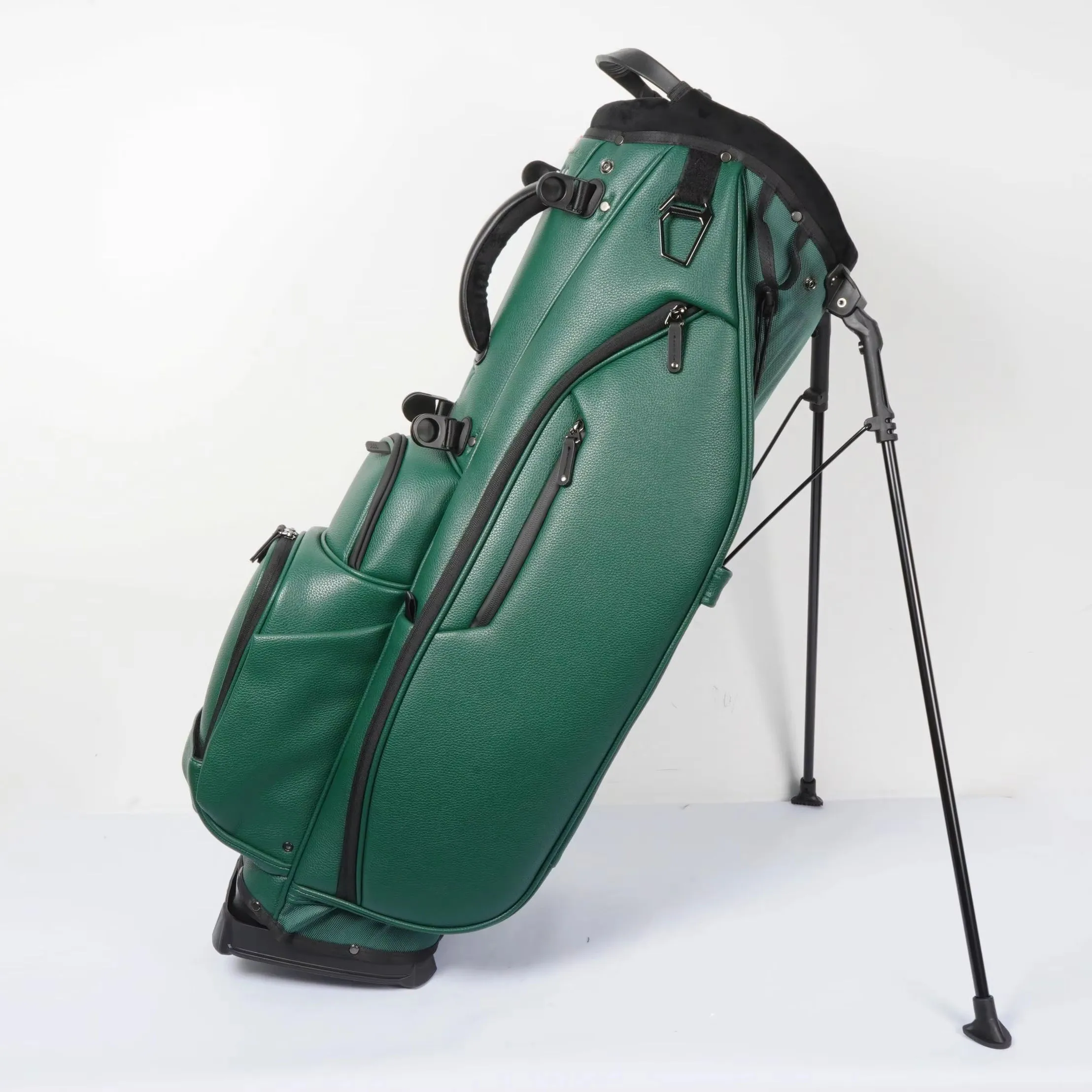
From a factory build standpoint, our dedicated ultralight stand bags page walks through the materials, hardware, and quality checks in detail.
Key Takeaways
- A 4.2-5.2 lb carry weight and 4/5/6-way top are the two highest-priority specs for a first-time golfer.
- The stand hinge block, not the shell fabric, is the most failure-prone part and must pass a 2,000-cycle deployment test.
- A dual 10-14 mm padded self-balancing strap keeps a new walker comfortable and reduces fatigue complaints in the first season.
- Locking a 600D water-repellent shell, a secure valuables pocket, and a reinforced wear panel covers beginner needs without paying for unnecessary TPU lamination.
Why beginners need a different spec than the average golfer
A beginner plays differently: they walk more hesitantly, load clubs unevenly, drop the bag mid-round, and rarely want to reorganize 14 dividers while learning a swing. That means the design priorities flip. Where an experienced walker might trade weight for a full organizing system, a new golfer wants the bag to disappear into the background — light enough to carry, simple enough to load, and tough enough to survive being set down carelessly on gravel, cart paths, and driving-range mats.
Demographically this matters for sales planning. Golf participation data consistently shows that new and returning players skew toward weekend, casual play, and shorter rounds — often nine holes with a push cart or a summer carry loop. For those rounds, the biggest performance variable is fatigue. A bag that sits comfortably on the shoulders keeps a beginner playing the back nine; a bag that digs in or shifts around becomes the reason a new player skips the second round. That is the commercial argument for spending money on straps and weight control before you spend it on zippers or branding.
There is also an equipment-education gap. Most first-timers inherit a hand-me-down cart bag or a battered carry bag and have no reference for what a good stand bag feels like. When you build for a beginner line, you are often the first quality impression of the sport they remember. Our affiliated factory treats the beginner segment as a durability-proving ground: a bag that survives its first 30 rounds without a hinge failure or a blown seam becomes an entry point to your mid-tier line in season two.
The weight target: where the beginner budget should go first
Weight is the single attribute a new golfer can verify without a spec sheet — carry it for fifteen minutes and the difference between 4.6 lb and 5.8 lb is obvious. For a beginner walk belt we set a target of 4.2-5.2 lbs empty. The floor is set by what the stand mechanism and the shell realistically weigh with modern materials; the ceiling is the point where shoulder fatigue starts to dominate the round. Intermediate carry bags that weigh 5.8-6.5 lbs are fine for seasoned link-strollers but are the wrong entry for most beginners.
Weight is also where manufacturing discipline shows. In production, the bag's final weight is a function of fabric denier, lining weight, foam density in the straps, hardware gauge, and how much webbing and zipper tape gets used. A careless run can drift 5-8% heavier just from an inconsistent fabric lot or an over-padded lining. That is why we weigh a mid-production sample and bind the weight target with a tolerance in the tech pack, then verify on inline inspection rather than trusting the first sample. For the buyer this means specifying "4.8 lbs +/- 0.2" instead of just "lightweight" — the delta between those two briefs is the difference between a consistent SKU and a seasonal weight lottery.
Weight reduction options, in order of cost-effectiveness, are: choosing a lighter 400D shell on non-wear panels, trimming unnecessary interior lining, using a lighter-but-reinforced hinge, and replacing heavy integrated coolers with a collapsible thermal pocket. Because most manufacturers quote weight from the first sample, ask to see the line-build weight record across two lots before committing to a claimed number.
Divider layout: simple tops beat organizing flex
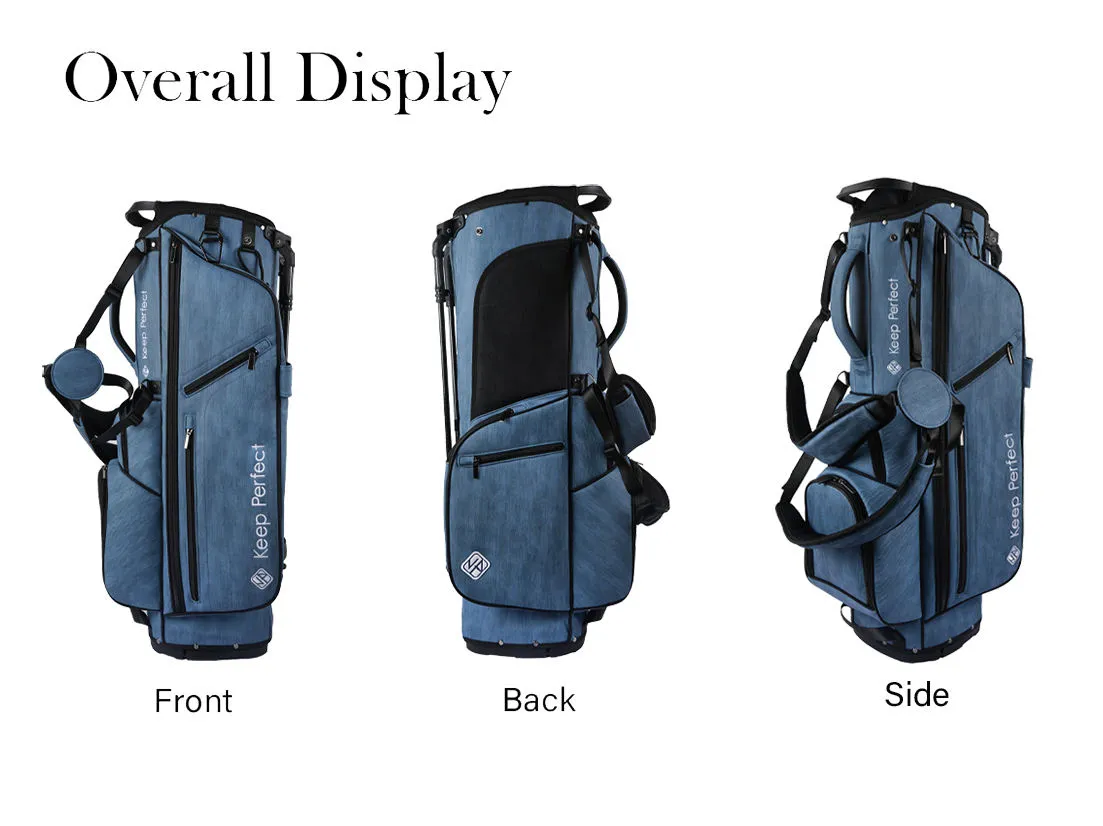
The divider is the second feature a beginner touches after the straps, because it is the interface between the golfer and their clubs. A 4/5/6-way top is the right entry point. It separates woods from irons and gives wedges and putter a clean home, without the complexity, weight, and swing-cut compromise of a 14-way organizer. New players load clubs tip-first and carelessly; a too-restrictive top frustrates them, while a loose 4-way lets them just drop clubs in and go.
The technical decision that separates a beginner top from a pro top is whether dividers are full-length. Full-length tubes run all the way to the bottom, preventing club-head clatter and shaft tangling. For a beginner who is still learning to pull and replace clubs mid-round, full-length dividers dramatically reduce the annoying "grabbing two clubs at once" problem. The trade-off is roughly 0.3-0.5 lb of added weight and a slightly higher seam count. Our recommendation for beginners who walk: offer a 5-way full-length top as the hero configuration, and a less expensive 4-way non-full-length for the entry SKU. That gives the buyer two price points with cleanly separated costs.
In production, divider spec is where we most often catch silent substitutions. A factory might quote "full-length dividers" and ship partial-length tubes to save fabric. Lock this in writing, specify tube length as a percentage of bag depth (we hold 90%+ for true full-length), and verify on the first article by measuring the tube on an actual production unit, not on a diagram.
The stand system: why the hinge decides the bag's lifespan
A beginner sets the bag down constantly — after every club, between holes, at the edge of a bunker, on concrete cart paths. The stand mechanism is thus the highest-stress subsystem on the entire bag, and the hinge block is its weak point. When a beginner bag fails, it is almost always the hinge cracking, the legs loosening, or the spring losing tension so the legs drag instead of deploying. All three come back to hinge material, leg geometry, and how the spring is seated into the block.
We recommend you require a reinforced hinge block — typically glass-filled nylon or an aluminum-reinforced composite — rather than a soft ABS block. The deployment spring should be captured so it cannot pop out during normal use, and the legs should be aluminum with a steel pivot pin rather than all-plastic, which is a category of failure-corner in budget bags. The measurable gate is a cycle test: 2,000 full open-close deployments with no cracking, no loosening, and no legs that refuse to lock. Some pro-tier programs require 3,000+; for a beginner line 2,000 is a defensible, honest floor that separates a real stand from a decoration.
Stability matters too. A first-time golfer rarely aims the bag at a perfect angle, so the legs must grip on a 15-degree incline and in soft rough without sinking or tipping. That is a base-geometry factor: wider leg spread, a low center of gravity from the shell, and rubber foot pads that bite into grass. Locking the deployment angle and the leg-spread width as named specs in the tech pack is how you prevent a beautiful-looking bag that falls over every time it is left alone.
Straps and carry comfort: spending where the shoulder lives
Comfort is carried in the straps, and it is the feature a new walker evaluates the most over a round. A single cross strap was acceptable decades ago; a modern beginner bag needs a dual, self-balancing strap system. Self-balancing means the strap weight-shares across both shoulders automatically as the bag shifts, distributing the load instead of dragging on one side. It is a genuine ergonomic advantage for someone unused to carrying weight.
The technical comfort levers are foam thickness, foam density, and breathability. Budget 10-14 mm of contoured EVA or PU foam in the shoulder zones, with a channel or mesh on the contact face so the strap does not trap heat on a summer carry. The strap should also be removable and washable, and the adjuster hardware should be a locking cam that holds through the round rather than slipping. Strap anchors are a QC-critical seam: they must pass a static load test (typically 20-30 kg) with no stitch failure, because a torn anchor mid-round ruins the bag and the brand's reputation.
For the buyer's plan, offering two strap tiers is a common pattern: a standard dual strap on the entry SKU and a quick-adjust, extra-padded strap on the mid SKU. That creates a clean value ladder without engineering two entirely different bags, and it lets beginners trade up to comfort without changing the shell.
Materials: durability first, waterproofing only where needed
Beginners are harder on materials than experienced golfers because they drop bag and clubs and brace the bag against rough surfaces while learning. The shell therefore prioritizes abrasion resistance and water repellency over outright waterproofing. A 600D nylon or polyester shell with a durable water-repellent (DWR) or PU coating is the sweet spot: tough enough for cart-path abuse, light enough for the weight target, and cheap enough to keep the entry price healthy.
Where you do want reinforcement is the bottom wear panel, the stand hinge surround, and the contact corners. A scuff-resistant bottom panel or a lightweight wear plating doubles the visible life of the bag at a tiny cost and prevents the most common "worn out in a season" complaint. A full TPU waterproof laminate is a premium upgrade, but for the true beginner it usually adds 8-12% to cost and 0.3-0.6 lb of weight for protection a weekend player rarely needs. Keep waterproofing as an optional upgrade or reserve it for the mid-tier, and let the entry bag win on weight and price.
Inside, the lining should be light but snag-free, and the divider tubes should be smooth so club grips do not catch. A beginner does not care about a fancy interior pattern; they care that clubs slide in and out cleanly. That is a lining-finish choice as much as a material choice, and it is worth writing into the spec as a snag-resistance requirement.
Pockets that match a beginner's round
Pocket strategy should follow how a new golfer actually carries things, which is simpler than the pro build-out. The essentials are: a secure valuables pocket (ideally lined and quietly closed on the back panel so it is not in the swing path), one roomy apparel pocket, a ball/tee pocket, and a water-bottle sleeve. A cooler pocket, a magnetic rangefinder pocket, and a full glove organizer are nice on a mid-tier but are load-bearing cost items a beginner line can defer.
The one premium pocket worth including early is a secure valuables pocket with a fleece or soft lining and a YKK-style zipper that does not scratch a phone or wallet. New golfers worry about their phone and keys more than experienced ones, and that pocket is a comfort feature as much as a utility one. Access logic matters: the valuables pocket belongs on the side/back away from the stand hinge, accessible without rotating the bag, and the water sleeve should be reachable while carrying.
For B2B planning, capping the beginner line at 5-6 pockets is a deliberate cost and SKU decision — every pocket is a seam, a zipper, and a QC point. A clean pocket count also keeps the bag lighter and the interior less crowded, which reinforces the beginner-friendly message. You can always layer more pockets onto the mid-tier build using the same shell architecture.
Build a beginner spec that survives QC
The gap between a beginner bag that cheapens the sport and one that rewards it is QC discipline, not raw materials. For a beginner line, the acceptance gates should cover the failures beginners actually cause: hinge cycles, strap anchor load, zipper smoothness, stand stability on inclines, and dropped-unit carton integrity. Writing these as named tests with clear pass/fail numbers prevents a supplier from shipping a bag that looks great in a photo but fails in week two.
At our affiliated plant we run the following baseline tests on any beginner line: a 2,000-cycle stand deployment test, a 20-30 kg strap anchor static load, a zipper cycle and jam-rate check on every pocket, a 15-degree incline stability check, and a packed drop test covering corner/edge/face to the buyer's carton spec. We also hold the weight target to a documented tolerance and check dividers for true full-length on the first article of each run. These are the checkpoints that keep a beginner line from becoming a returns problem.
Partnering with a factory that already holds this standard matters, because beginner buyers absorb complaints that pro buyers diagnose themselves. Lock the QC list before sampling and confirm the factory will do inline inspection on the stand and strap subassemblies, not just a final visual check. That is the difference between catching a hinge issue in production and catching it in warranty.
Audience spec reference table
The table below summarizes the beginner targets we recommend locking at sampling, usable directly as a buyer's internal reference sheet.
| Feature Block | Beginner Target | Why It Matters for This Audience |
|---|---|---|
| Carry weight | 4.2-5.2 lbs (tolerance +/-0.2) | Directly controls shoulder fatigue on 9-hole carry rounds. |
| Divider top | 4/5/6-way; full-length tubes on hero SKU | Simpler loading for learners; full-length prevents club clatter. |
| Stand hinge | Reinforced block, 2,000-cycle test | Most failure-prone part; sets the bag's season-one lifespan. |
| Strap system | Dual self-balancing, 10-14 mm foam | Comfort is the attribute a new walker verifies first. |
| Shell material | 600D nylon/polyester, DWR/PU coat | Durable where dropped, light enough for carry, cost-efficient. |
| Pocket payload | 5-6: valuables, apparel, ball/tee, bottle, glove | Covers the round without the weight and cost of pro build-out. |
| Waterproofing | Optional mid-tier upgrade | Full TPU adds cost/weight a weekend beginner rarely needs. |
| MOQ / lead time | 200 pcs (100 pcs test); sample 10-20d, bulk 45-60d | Lets smaller buyers validate a beginner SKU before scale. |
How to brief the factory for a beginner line
A clear beginner-line brief cuts the sampling loop roughly in half. The buyers who move fastest send a one-page sheet stating the target player (age, gender split, walk vs cart), the carry weight with a tolerance, the divider config, the stand cycle and stability test, the strap spec, the pocket list, the material direction, and the MOQ and launch date. Because the beginner spec is largely defined by weight and durability targets, putting those numbers on paper first removes most guesswork and lets the factory propose cost levers instead of asking you to re-decide.
Tell the factory whether you need OEM (branding on a proven beginner architecture) or ODM (co-developing a new silhouette, materials, and strap system). At QUANZHOU JUNYUAN BAGS we support both from our affiliated Quanzhou plant, and we will flag a weight or durability conflict before sampling so you do not pay for a redesign. Include your target market and expected MOQ with the RFQ, and reach us at service@junyuanbags.com or +86 17750020688.
One practical note from the production floor: order a small run (even 100-200 units) of the beginner SKU before a full container, photograph the real bag on an actual golfer, and confirm the weight and strap comfort on the production build. A beginner line lives and dies on how it feels in hand — a spec you validate on real units is worth more than a beautiful concept render.
Common mistakes in beginner stand bag programs
The most common failure in launched beginner lines is spec creep: a buyer starts with a light, simple bag and ends up approving a 14-way waterproof organizer that weighs 6.2 lbs and costs as much as a mid-tier bag. New-golfer products compete on accessibility, and every added feature is a small tax on both weight and price. Keep the beginner silhouette honest by naming a hard weight ceiling and a hard pocket count before anyone starts adding features, and treat any addition as a measured trade against those two numbers.
The second failure is over-engineering the stand. A beginner does not need a lightweight carbon-leg stand or a featherweight titanium hinge; they need a hinge that simply works two thousand times. Spending the premium on exotic stand materials is wasted budget on an audience that prioritizes reliability. Better to put that money into a thicker strap pad, a tougher bottom wear panel, and a smoother zipper, which are the features a beginner feels every single round.
The third and most costly mistake is shorting the QC list because the product is low-ticket. A beginner bag sold at a low price point still fails at the same rate per part as an expensive one, but the beginner buyer is far more likely to abandon the brand, complain publicly, or return the product. The disciplined approach is to test the beginner line to the same hinge, strap, and drop standards as the mid-tier, so the savings come from simpler spec, not from weaker claims. That is the manufacturing principle we apply across every beginner program at QUANZHOU JUNYUAN BAGS.
Merchandising and color direction for the beginner market
Color and trim are where a beginner line earns shelf appeal, but they must not fight the weight target. A bright, single-colorway shell with an accent trim tends to read playful and accessible, which suits the beginner audience, while a heavy multi-panel pattern costs you nothing in fabric but can complicate color-matching across production lots. The practical merchandising advice is to offer two to three colorways per SKU rather than eight: each colorway is a dye-lot, a QC point, and a potential shade-mismatch risk, and beginners buy on clarity, not on a bewildering menu.
Color governance matters at bulk. Approval of a lab-dip or a physical color chip per colorway, and a Pantone reference in the tech pack, is what keeps the "ocean blue" shell from drifting into teal across two lots. The accent trim — the zipper pulls, the piping, the strap overlay — should be color-banded so it does not clash when a second lot arrives. For a beginner line sold to a retail chain, tonal consistency across shipments is what converts a one-time tester into a repeat stockist.
Finally, think about how the bag photographs. A beginner bag is usually the hero image in a starter-set spotlight or a window display, and the front lower panel is the zone the thumbnail shows. Placing the brand mark or a clean accent there — away from the hinge and strap anchors — keeps the bag looking intentional in retail photo, and pictures of the actual production build for your retailers carry more weight than a render. It all ties back to the same discipline: lock the spec, verify it on a real sample, and let the beginner market see a bag that is simple, light, and dependable.
FAQ
How heavy should a beginner golf stand bag be?
A carry-focused beginner bag should land around 4.2-5.2 lbs empty. Anything above 5.5 lbs adds noticeable fatigue for a player walking nine holes, and a new golfer still experimenting with club loading benefits from a lighter, simpler bridge to carrying.
What divider setup is best for a first-time stand bag?
A 4/5/6-way top is the practical entry point because it separates woods, irons, and wedges without the weight and swing compromise of a full 14-way organizer. Full-length dividers are worth adding early if the buyer plans to walk often.
What is the minimum stand deployment quality I should accept?
Spec a reinforced hinge block and require a deployment cycle test of at least 2,000 opens before failure. The legs must lock fully open and the bag must sit stable on a 15-degree incline, which is the typical test angle used in factory QC.
Should a beginner bag have a waterproof shell?
Not as a mandatory feature. A water-repellent 600D nylon or polyester shell is enough for most starters; full TPU waterproof lamination adds cost and weight that a first-time golfer rarely needs. The right priority is a secure valuables pocket and a reinforced wear panel instead.
How much padding do beginner stand bag straps need?
A dual self-balancing strap with 10-14 mm of breathable foam padding on the shoulder zones is the comfort baseline. The strap anchors must also pass a static load test so the seams do not tear when the bag is carried fully loaded.
Why does stand hinge quality matter more than the fabric on a beginner bag?
The hinge block takes the most repeated load as the legs deploy on every shot. A cheap hinge cracks or loosens within a season, and it is hard to repair after assembly. Locking hinge material and geometry in the tech pack protects the whole program.
What MOQ should I plan for a beginner stand bag line?
At our affiliated Quanzhou plant, a conventional order starts at 200 pieces, with 100-piece test orders available to validate a new silhouette before scale. Sampling runs 10-20 days and bulk production 45-60 days, so plan the calendar around those gates.
Related reading
- Browse stand bag architectures for every segment
- OEM/ODM Service overview
- Factory & QC standards
- Golf Stand Bag Buying Guide
- Simple functional designs for casual golfers
Two final checks for a buyer launching a beginner line. First, target the weight and the stand hinge before you design the colorway — those are the two things a beginner verifies by feel, and they are also the two easiest to get wrong in production. Second, treat the beginner SKU as the front door to your brand: if it carries cleanly and stands reliably through 30 rounds, that eater of a golfer upgrades to your mid-tier next season, which is exactly how a single entry bag becomes a multi-year relationship.
Request a B2B quote for golf stand bags
Send your target market, expected MOQ, and reference photos. We respond within 24 hours with a sampling plan.