The right golf stand bag is the one matched to how the player actually uses it: a committed walker needs a 4.0-5.5 lb carry bag with a stable stand, a split walk/ride buyer needs a hybrid, and an organization-first player needs a 5-way or 14-way layout they can reach into instantly — and your starter order can be as low as 100 units to test before committing to a 200-unit production run. This guide walks a B2B buyer through matching bag architecture to buyer intent, then locking the weight, divider, material, and QC specs that make the match repeatable across seasons. It draws on the production practice of an SGS-verified Quanzhou facility (4,950 sqm, 7 lines, 149 machines, 137 staff). For the wider golf bag category — cart bags, staff bags and more — our affiliated golf bag factory is the one-stop reference.
Key Takeaways
Hold these five rules before reading the detail. First, the dominant use case decides the architecture: walker, walk/ride split, or organization-first. Second, weight segmentation gives you a clean catalog — entry 4.0-5.5 lb, mid-tier 3.0-4.2 lb, premium and all-weather heavier. Third, divider choice is a trade between speed and protection, so state whether 4/5/6-way or 14-way fits your buyer. Fourth, the material direction has to be named in the brief before sampling, along with the pocket list. Fifth, a small test order around 100 units de-risks a first season before you commit to a regular 200-unit run.
- Match the bag to the buyer's dominant use case first
- Segment weight targets to cover walk, split, and organizer buyers
- Name the divider layout and material in the same brief
- Set QC targets for stand cycles, zippers, and strap anchors
- Test the market on a small order before a full production run
Define the Dominant Use Case First
Every useful stand bag decision starts from the answer to one question: how does this player carry the bag? A committed walker who carries all 18 holes values light weight, balanced straps, and a stand that deploys reliably on the course. A buyer who walks some weekends and rides a cart others needs a hybrid architecture that sits stably on a cart yet still carries well. An organization-first player cares most about reaching the right club fast, which pushes toward a 14-way or carefully laid-out divider top. Write the dominant use case into the brief before any other field.
The mistake we see most in sourcing is choosing a bag by its photograph instead of by its use case, then discovering a mismatch in the field. A premium heavy bag looks great on a shelf but disappoints a walker; a feather-light carry bag frustrates an organizer. When you define the use case first, the rest of the spec — weight, divider, pocket list, material — follows logically, and your factory can quote the architecture that already solves that use case rather than improvising one.
Segment by Weight to Build a Clean Catalog
Weight is the single most intuitive signal a buyer scans, and it is the cleanest way to segment a catalog. A value walking line targets roughly 4.0-5.5 lb with simple pocket logic and a durable base. A mid-tier walking line aims for 3.0-4.2 lb by switching to lighter nylon and tighter tolerances. Premium organizers and all-weather bags run heavier because extra dividers, waterproof packages, or refined trims add material. State a target weight and a tolerance; then confirm the real number on the sample, because printed weights drift in production.
Think of weight as a promise you make at the shelf and keep in the box. In our factory we weigh each inspected unit and flag any that fall outside the locked tolerance, so the spec you quote is the weight your customer feels. Segmenting by weight also stops catalog creep: if you know exactly which band each SKU must hit, you reject an off-spec idea before it costs a sample. This keeps every SKU around a clear buyer and a clear price.
Choose the Carry Architecture: Walk, Hybrid, or Organizer
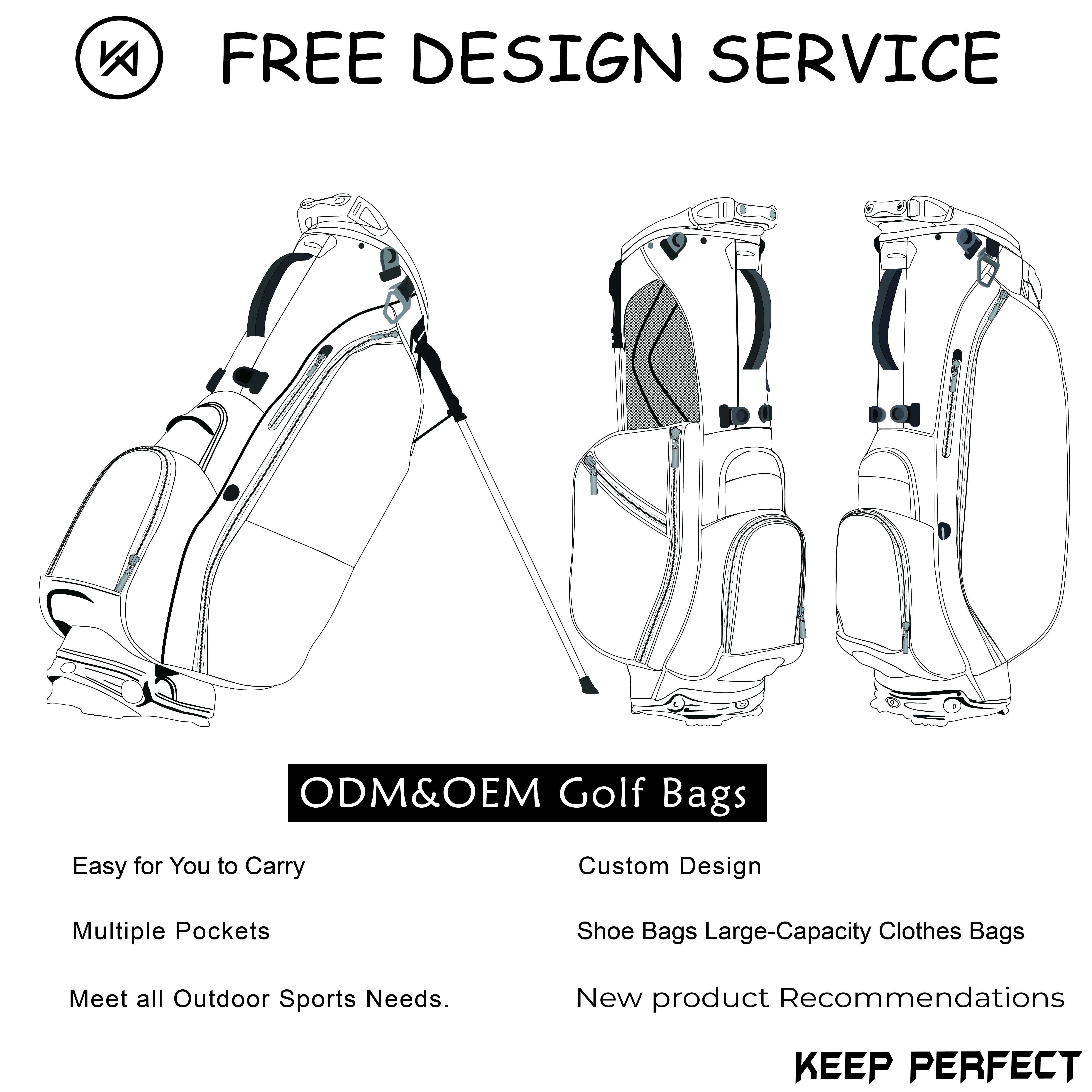
A pure stand bag is built for the walker, with balanced dual straps, a self-balancing carry system, and a stand that deploys from the folded position under load. A hybrid cart/stand bag adds a cart-friendly base and sometimes a longer profile, giving one SKU that serves both the walker and the rider. An organizer-heavy bag prioritizes the divider top and pocket layout over absolute lightness. None is universally better; each fits a different buyer. Decide which buyer you serve, then pick the architecture that serves them best.
For retailers, the hybrid is a smart inventory move because one SKU covers two use cases, but it is usually a compromise on both. For a committed walker, nothing beats a dedicated lightweight carry bag. The disciplined approach is to offer a walker SKU and an organizer SKU as your core pair, then add a hybrid only when the walk/ride split in your market justifies it. Matching architecture to buyer intent is what turns a catalog from a shelf of options into a set of answers.
| Buyer Profile | Best Architecture | Typical Weight | Divider Direction |
|---|---|---|---|
| Committed walker | Lightweight carry stand bag | 4.0-5.5 lb | 4/5/6-way |
| Walk/ride split | Hybrid cart/stand bag | Varies by priority | 5/6-way or hybrid top |
| Organization-first | 14-way organiser stand bag | Heavier | 14-way with optional full-length |
| All-weather buyer | Waterproof stand bag | Heavier | 5-way or 14-way |
Divider Configuration: Speed Versus Protection
The divider top sets how fast a player can grab a club and how well clubs are protected. A 4/5/6-way top groups clubs into broader sections, which is lighter, faster to reach, and cheaper; a 14-way organiser gives every club its own slot, preventing tangling and clubhead chatter but adding weight and construction complexity. Full-length divider tubes, whether on a 5-way or 14-way, extend that protection down the shaft and genuinely reduce grip wear, making them a strong premium feature.
For mid-tier and premium lines we recommend confirming whether full-length dividers are required, because they change cost and material in a meaningful way. In the brief, state the divider config and the full-length requirement explicitly so the factory quotes the actual construction and not a generic "organizer" estimate. Match the divider to the buyer: speed-first players prefer a 5-way, protection-and-organization players want their slots, and every extra slot has a weight and price consequence you should see up front.
Pocket Architecture and Carry Comfort
The pocket list and its access logic decide how the bag feels in real use. A well-built walking bag usually carries an apparel pocket, a valuables or rangefinder pocket near the top, a ball pocket that does not fight the straps, and on some models a cooler pocket. Name the pocket list and how each opens relative to the course view before sampling. A bag whose valuables pocket is awkward to reach while standing will draw the most negative reviews from a buyer who lives on the course.
Carry comfort is more than padding: it is strap geometry, balance, and where the weight sits on the shoulders. Define the padding thickness, adjust range, and whether you want removable straps. In our QC checklist we run a strap anchor load test and confirm strap alignment so the bag sits balanced for a full round. Locking pocket logic and carry comfort in the brief is what makes a good architecture feel premium in the hands of your end customer.
Materials and Waterproof Level
Material choice determines weight, feel, cost, and durability, and it has to be named before sampling. For lightweight walking lines, 400D to 600D nylon or polyester balances weight and abrasion. For premium lines, PU synthetic leather panels with upgraded trims raise perceived value. For rainy markets, TPU-coated or laminated waterproof fabric protects the contents but adds weight and seams to manage. Specify shell, lining, denier, finish, and where you want reinforcement on the same physical brief.
The waterproof level is a spectrum, and you should define the scope explicitly: standard fabric may be splash-resistant, a coated fabric sheds light rain, and a fully sealed waterproof package with taped seams and water-resistant zippers protects contents in a downpour. Because waterproofing adds real cost and construction difficulty, confirm how much your buyer actually needs before you lock the package. Matching the material and waterproof level to the use case prevents paying for features nobody feels and missing the ones they do.
The Stand System: Set the Acceptance Bar
The stand mechanism is the defining function of a stand bag, and its reliability decides returns. Set pass criteria in the brief: how many deployment cycles the stand must survive, the stability angle on firm grass, leg spread consistency, and the hinge feel. A reasonable starting target is 3,000 to 10,000 cycles with no cracking and no serious wobble, tightened for premium lines. These numbers belong in writing so both sampling and bulk read the same acceptance bar.
We test stand deployment to the cycle target, inspect every hinge block, and measure base stability and leg alignment on inspected units. Because a wobbly stand is a top warranty trigger, we treat the stand system as a core QC field, not a cosmetic check. When the acceptance bar is written down, the sample proves the standard, and bulk production holds it — which is exactly what keeps a reorder as good as your founding batch.
Set QC Targets and Inspection Standards
A custom bag needs measurable acceptance targets, not just adjectives. Define the functional tests and their pass/fail criteria in the brief: fabric abrasion (20,000-50,000 cycles by a defined method), stand deployment cycles, zipper smoothness and cycle count, strap anchor static load, and seam strength at stress points. Also state the sampling method and accepted quality level (AQL) you will inspect to, so both sides share the same defect bar.
We capture these fields on a standardized inspection record: PO, model, colorway and material batch, sample size and method, and the functional checks for the stand, zippers, straps, and divider alignment. This record makes reorders consistent and gives you an audit trail for retailer disputes. On complex programs we encourage an inline inspection during bulk so a defect is caught early, at a fraction of the cost of fixing it at the container.
Test the Market With a Small, Smart First Order
There is a safe path into a new or first-season stand bag: place a small test order before a full run. A test order around 100 units lets you photograph the real lockup for retailers, confirm placement on the production silhouette, and put the bag in players' hands for field feedback. That feedback is worth more than another design meeting, and it catches the small issues that never appear in photography — a strap that sits wrong, a pocket that is hard to reach, a stand that feels stiff.
Our test-order MOQ structure supports this path at around 100 units, with a regular production order at 200 units per colorway. Sampling runs 10-20 days and bulk production about 45-60 days, so a first-season plan fits a real launch calendar. Field data from the test order tells you which features to push, which to cut, and which segment to serve next — converting a first batch from a gamble into a roadmap.
Positioning and Pricing Your Segments
Positioning is where the use case, weight, and features turn into a price. A value entry bag competes on weight and a clean pocket logic; a mid-tier competes on walking comfort and stand stability; a premium competes on refined trims, hardware branding, and a balanced carry; an all-weather competes on genuine protection. Write your intended retail price next to each segment and let it guide the material and divider choices, so the shelf price and the build quality stay honest to each other.
An overbuilt bag at a value price is a margin drain, and an underbuilt bag at a premium price is a returns engine. The discipline is to state the price band first and let the spec fit it, cutting features customers feel least before cutting the stand or reinforcement that drive returns. When price and spec line up this way, every SKU in the catalog has a clear buyer, a clear price, and a clear job to do, which is what makes a product line profitable and repeatable.
Match Hardware and Trims to the Segment
Hardware and trims are the bridge between a quoted architecture and a perceived grade. The same shell can read value or premium based on the zippers, pulls, buckles, D-rings, and logo plates bolted onto it. For an entry bag, standard durable zippers keep cost down; for a mid-tier, smoother pulls and a color-matched trim lift the feel cheaply; for a premium line, metal or upgraded hardware branding is exactly where buyers see the price. Because trims are one of the least expensive swaps, they are a fast lever for segmenting a catalog.
Consistency is the trap. If trims drift across colorways or batches, the same bag can look like two products on a shelf. Set a hardware and trim standard in the brief, color-band the hardware against the shell, and confirm the finish on the sample. In our QC we check that trims are seated tight, pulls run smooth, and hardware matches the approved finish. Getting trims consistent across every inspected unit is what makes a premium price defensible and a value line still feel finished.
Branding and Placement on Your Architecture
Your logo has to survive the specific architecture you chose. On a lightweight carry bag, the panels are thinner and hold embroidery differently than a heavier 14-way shell. On a 14-way bag, the top flexes across divider rails, so lid embroidery must bridge without puckering. State the logo method, placement zones, and thread or film color in the brief, and test the logo on the actual production fabric before bulk. Embroidery and molded patches are the most durable; heat transfer is fastest but wears fastest on high-flex zones like the stand hinge.
Plan placement for how the bag is photographed. The front lower panel is the highest-visibility zone in a thumbnail; the lid shows second; a small tonal mark on the valuables pocket adds detail. Keep the placement diagram with measurements in the tech pack so every unit in the run carries the mark in the same spot. Our factory runs logo sampling in 10-20 days and keeps a sealed master so a reorder matches the original lockup, which protects your brand equity season after season.
Plan the Sampling Rounds and the Budget
Sampling is where a first-season plan is validated or sunk. Budget for the right number of sample rounds: one to validate the look and one to lock the technical file on a complex or first-time ODM structure. The pre-production sample must be made on the exact production fabric, with the approved thread and placement, so what you approve is what ships. Confirm the cost of each sample round and who owns revisions before you start, so there are no surprises on the invoice.
Because the sample is the contract for the whole run, treat it as an approval gate, not a prompt to renegotiate. Include the sample in the QC record, keep a sealed master, and use the test order to confirm sell-through before bulk. With sampling at 10-20 days and bulk at 45-60 days, a realistic plan spaces the two so field feedback from the test order lands before you lock the full production quantity.
Procurement Checklist for Your RFQ
- Dominant use case: walker, split, or organization-first
- Target market/country and stated price positioning
- Bag architecture and target weight with tolerance
- Divider config and full-length requirement
- Material direction and waterproof scope
- Pocket list and access logic
- QC targets, AQL level, and sampling method
- Test-order quantity, lead time, and inspection standard
Related Product Architectures
Move from the article intent to a concrete model path. Use these as landing points, then submit an inquiry with your targets.
Lightweight Carry
Recommended Internal Links
- Products (Stand Bag Architectures)
- OEM/ODM Service
- Factory & QC
- Golf Stand Bag Buying Guide
- Golf Stand Bag Size Guide
- Comfortable Straps Guide
FAQ
What is the difference between a 5-way and a 14-way divider?
A 5-way top groups clubs into five sections for faster access and a lighter bag; a 14-way organizer gives every club its own slot to prevent shaft tangling and clubhead chatter. Choose by whether you value speed-and-weight or protection.
How much should a golf stand bag weigh?
It depends on segment. An entry walking bag typically runs 4.0-5.5 lb, a mid-tier around 3.0-4.2 lb, and a premium organizer or all-weather bag can run heavier. Set your target weight and tolerance in the brief.
When should I choose a hybrid cart/stand bag over a pure stand bag?
Choose a hybrid when your buyer walks sometimes and rides a cart other times, or when you want one SKU to cover both. A pure stand bag is best for a committed walker; a cart bag suits riders. Match the bag to the dominant use case.
Are premium stand bags always the best choice for a retailer?
No. Premium bags cost more, weigh more, and serve a narrower buyer. A retailer often profits more from a well-executed entry or mid-tier walking bag that turns over faster than a heavy premium SKU.
What are the most important specs to define first?
Start with bag type, target weight, divider configuration, material direction, and the key pocket requirements. Then lock branding methods and QC checkpoints before sampling.
Do you support OEM/ODM for golf stand bags?
Yes. We support OEM (branding on proven architectures) and ODM (co-develop structure, pockets, materials, and hardware). Provide your target market and quantity to start.
Request a B2B quote for golf stand bags
Send your target market, expected MOQ, and reference photos. We respond within 24 hours with a sampling plan.