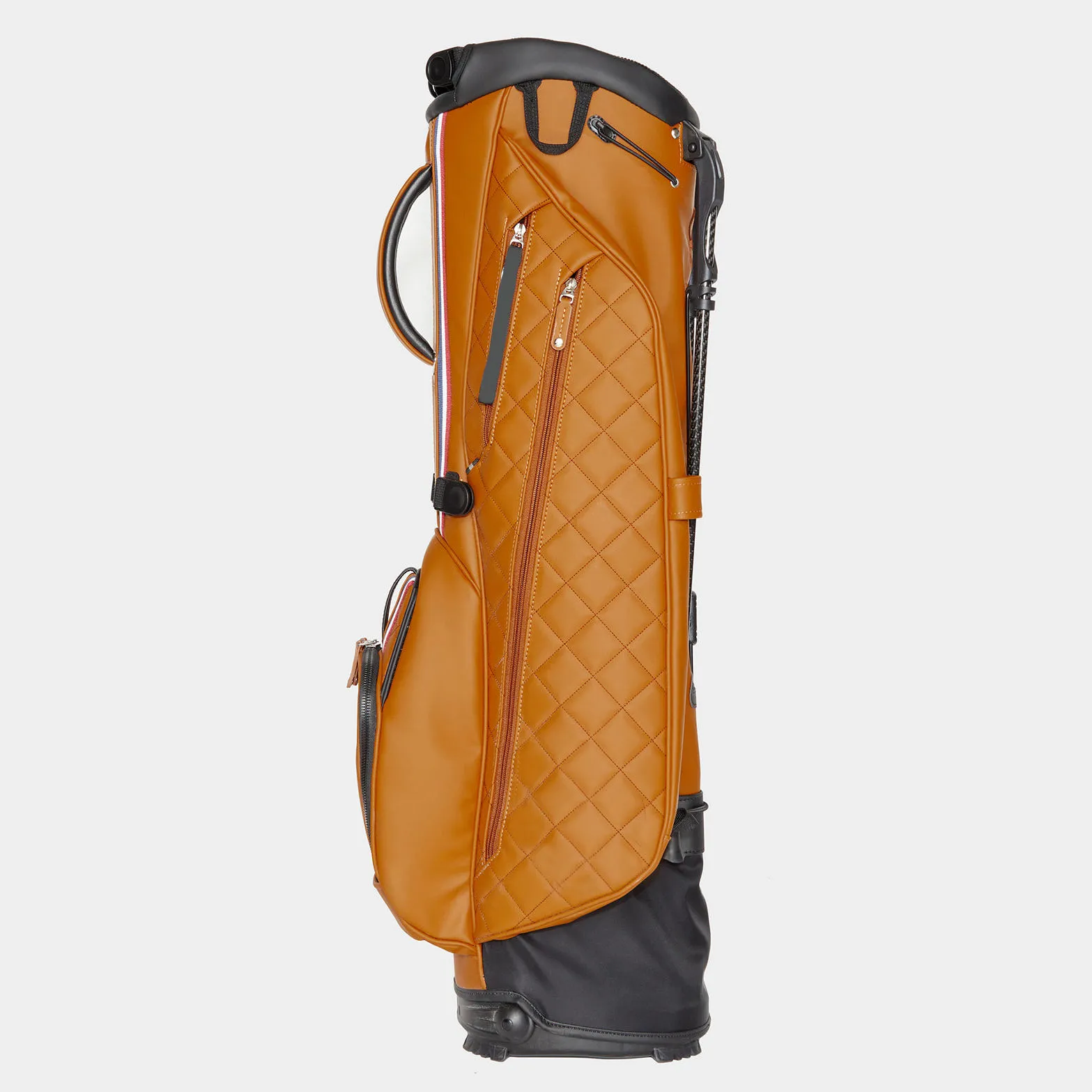
You can judge a golf stand bag's stitching quality without any lab equipment: a high-quality bag shows even, dense seams at 8-10 stitches per 3cm, locked bartacks at every strap and zipper terminal, and clean, balanced lockstitch with no skipped stitches or puckering — and these visual cues are backed by a seam-strength number a factory like QUANZHOU JUNYUAN BAGS can supply on the sample. Identifying good stitching is the fastest, cheapest way to screen a supplier, because a factory that sews well usually builds well everywhere. For a broader look across cart bags, staff bags and the full golf bag category from one source, our affiliated golf bag factory runs the complete line.
Key Takeaways
- Even, dense stitching (8-10 per 3cm on stress seams) with no skips is the visual mark of a quality join.
- Locked bartacks and reinforcement at straps, handles, and zipper ends prevent the classic unravel failure.
- Balanced tension means interlocked threads sit centered, with no loops, baring, waviness, or puckering.
- Confirm the seam with a pull test or seam-strength number, not just a visual review, at our QC-checked site.
Specification Table (Whitepaper View)
Use this table to inspect a sample or a delivered bag. Each row is a checkable detail a buyer can confirm in minutes at a factory visit or under the light of a retail review.
| Detail | Quality Signal | Red Flag |
|---|---|---|
| Stitch density | Even 8-10 per 3cm on stress seams | Loose 5-6 per 3cm or uneven spacing |
| Tension balance | Lockstitch centered, no loops or baring | Top thread baring, bottom looping, wavy line |
| Skipped stitches | None across the seam | Any skip or gap in the stitch line |
| Stress-point terminals | Bartack at straps, zipper, handle ends | Open-ended seam with no lock |
| Seam finish | Bound or folded edges, clean interior | Raw fraying edges, unfinished interior |
| Straightness | Straight, even seam line | Puckered or wavy seam along the fabric |
Start with the stitch count and its evenness
The first thing to check is the stitch density and, just as important, its evenness. Take the main seam and count the stitches over 3cm at three or four points; a high-quality bag shows a consistent count — ideally 8-10 per 3cm on the stress seams — with even spacing, while a loose or variable count signals a rushed or drifting line. A consistent, dense count means the load at that seam is spread across many thread passes, so it holds under the heavy pull of straps and dividers rather than tearing at a weak gap.
Evenness matters more than the raw number. A seam that is 9 stitches then 6 stitches then 8 is a machine that is not holding its feed, and the thin spots become the failure points. Run your finger along the stitches and watch the spacing; the eye and the hand catch irregularity a single count misses. If the density and evenness are both good at the main seam, it is a strong first signal the whole bag was sewn to a real standard, because a factory rarely upgrades only one seam.
Check the tension balance on the lockstitch
Hold a seam up to the light and examine the thread interlock. In a balanced lockstitch, the two threads interlock in the center of the fabric, so neither shows visibly on the opposite face; when tension is unbalanced, the top thread bares or the bottom thread loops, weakening the seam and making it likely to pull apart under load. A balanced, centered interlock is the signature of a tuned machine, and it is visible in seconds to anyone who knows what to look for.
Unbalanced tension is both a strength and an appearance defect — a seam that bares or loops looks sloppy in the hand and retail photo, and it fails earlier under stress. Look across several seams, not just one, because a single balanced seam can hide a machine that drifted. A bag whose seams are all evenly balanced is sewn by a disciplined line; one that shows loops or baring is a factory cutting corners on setup, no matter how it feels to the touch.
Look for skipped stitches and their pattern
Skipped stitches are the clearest strike against a seam, and they concentrate where they do the most damage. A skipped stitch is a gap where the loop failed to form, and under load that gap becomes a stress point; a run of skips on a long panel seam is a served look at a machine mis-tuned or a needle on its way out. Check the long seams and the curved seams where needle tension changes, because skips are most likely where the machine is pushed hardest.
The pattern matters. An occasional skip is a fixable machine hiccup; skips concentrated at the ends, the curves, or every few stitches indicate a systemic problem that will recur across the batch. Ask the factory how they prevent and catch skips — inline or with a continuity check — because a line that checks for skips is managing the defect, while one that hopes they did not happen will ship them. Skipped stitches are the defect that a photo cannot show and an honest density figure will not reveal.
Verify the bartacks and stress-point finals
Inspect where seams end. High-stress seams should terminate in a bartack — a tight, dense reinforcement stitch at the end — so the seam cannot unravel past the terminal, and the strap, handle, and zipper ends are exactly where this matters. A seam that simply runs off the edge with an unsecured end is waiting to unravel under load; a bartacked end locks the thread and prevents the classic "the strap pulled out" failure on a well-made bag.
Check that every strap anchor, handle point, and zipper terminal carries its bartack, because these are the points where a whole bag's weight concentrates during a carry. We note the bartack placement on the tech pack and confirm it on the sample, so a buyer can screenshot the map and compare it to the delivered bag. The presence and placement of the bartacks is a fast audit of whether the factory reinforced for real loads or just sewed an outline.
Seam straightness and the finished edge
Run your eye down the seam line from edge to edge. A quality seam runs straight and parallel to the edge or pattern with even margin, while a puckered or wavy seam indicates tension or feed problems that also weaken the join. Puckering is common on thin or coated fabrics when tension is too high, and it both looks cheap and reduces seam life. A straight seam with an even margin signals seam allowance was held and the machine was set up for that fabric.
Check the seam finish on the inside too. A high-quality bag binds or folds its edges so the raw fabric does not fray, wick moisture, or stand out as an unfinished interior; a cheap bag leaves raw edges that fray into weakness and look unfinished when the pocket is opened. The interior finish is where a buyer sees the part of the budget the factory actually spent, and it correlates closely with the seam strength you cannot see from the outside.
Confirm the seam with a test, not just a look
Visual inspection is the screen, but a real seam-strength number closes the deal. Ask for a seam-strength or pull test on the stress seams or, if the bag is a sample, do a controlled pull at the strap anchor and divider seam to feel that the stitch and the bartack hold before the fabric yields. A factory that supplies a seam-strength result on the sample is verifying the seam rather than asserting it, and it is the same number a reorder should reproduce per batch.
The discipline to demand is a measured, recorded standard: the stitch count per 3cm, the seam-strength result, and the bartack placement on the QC sheet. At our affiliated plant, seam integrity is checked inline with a continuity pass and verified on the first article, so the visual quality you approve is the structural quality that ships. A buyer who screens with the eye and confirms with the number gets a bag that sews as well as it looks.
Final note on identifying high-quality stitching
High-quality stitching is discoverable in a minutes-long inspection: dense and even counts, balanced tension, no skips, locked bartacks at the stress points, straight seams, and finished edges — confirmed by a seam-strength number. Because a factory that sews well usually does everything well, sewing quality is the cheapest and most reliable screen for a supplier. Use this checklist and the spec table at a visit or on a sample, and lock the confirmed standard on the tech pack so every batch holds it. Reach us at service@junyuanbags.com or +86 17750020688.
Inspect the sewing floor, not just the bag
A factory visit converts a one-off bag inspection into a read on the whole production. Watch how the sewing lines are set up: a quality floor has machines tuned and registered per fabric, fitters who check tension as a routine, and operators who inspect their own panels between runs. A floor that rushes or lets operators self-regulate without a check produces the same defects as a cheap line — skips, drift, puckering — no matter what the showroom sample looks like.
Ask to see the QC checkpoints mid-line, not only at the end. A factory that inline-checks the stress seams and records the check is managing seam quality as a process; one that only final-inspects is finding problems after they are baked in. The sewing floor is the honest sign of whether the quality you see on the sample is reproducible at volume — so a factory visit is worth more than ten photos when you are choosing where your hundreds or thousands of units are made.
Check the divider, base, and stand seams
Beyond the straps, the seams that join the dividers, the base plate, and the stand mechanism are structural and worth a close look. The divider-attach seams carry the clubs and hold the top together under a loaded set; the base seam meets the stiff plate and the turf; the stand-panel seam transfers the hinge action into the shell. Each should show the dense, reinforced stitching with a bartack and a clean finish. A failure here is not cosmetic — it is the bag coming apart where it is loaded.
At these structural seams, the reinforcement is more important than the surface stitch. Confirm the divider and stand seams carry an internal load or a pad-back and a double pass, not just a single line of stitching over a heavy-zone fabric. We map these structural seams on the tech pack so the inspection covers the places that actually hold the bag together. The buyer who opens the divider area and the stand panel and checks the stitching there sees the difference between a constructed bag and a printed outline.
Piping, binding, and edge-stitch details
The fine details — piping, binding, and edge stitching — are the strongest screen of a factory's pride, because they are the first place a corner-cutting line skips. Piping should be sewn with a consistent cord and an even margin; binding should lie flat at the corners without bunching or gaps; edge stitching should run parallel and at a consistent distance from the seam. These details are where most of the labor cost is hidden, and they are the fastest way to tell a bag that was finished with care from one sewn to a price.
Run your thumb along the edges and the piping seams. A quality finish is smooth to the touch, with no raw edges, no loose ends, no visible gaps at the turns. These are the details that photograph well and that a customer notices when the bag is new — and they telegraph the seam strength you cannot see. A buyer inspecting a range of suppliers will find that the factory which gets the piping and binding right is almost always the one whose structural seams hold, because finishing discipline tracks building discipline.
Read the pocket stitching and zipper tape
The pockets are sewn at the interface of fabric, zipper tape, and hardware, so their stitching reveals how the line handles transitions. Check that each pocket mouth is sewn through the zipper tape cleanly, that the pocket corners are reinforced and bartacked, and that the seams around a pocket do not pucker or drift at the turn. Cheap bags cut the labor at the pockets, which is why a pocket seam is a common early-failure point; a quality bag treats the pocket seam as a structural join, not an afterthought.
Check a function pocket like the cooler or valuables pocket under load. The stitching around a loaded pocket takes tension it does not get empty, so inspect the reinforcements there too. An inspector who opens every pocket and follows the seam to the zipper end sees the true finish quality. Pocket stitching is where a factory either spends the minutes that make a bag last or saves them and ships a seam that will give way after a season of use.
Tie sewing quality to warranty and records
Good sewing quality has a financial consequence: it is what a warranty can honestly support. A factory that supplies measured seam standards, per-batch stitching records, and a seam-strength result can back a longer warranty, because the failure data justifies it. A bag whose seam quality is verified has a lower expected defect rate, and that lower rate is worth real money across a large order — fewer returns, fewer claims, fewer reputation hits. Choose the supplier partly on the seam data, not only the price.
Ask for the per-batch seam records so the visual quality you inspect is confirmed in writing on every production run, not just the showroom sample. With the density and test results on file, a reorder reproduces the same seam standard instead of drifting. The thread, density, and test records turn "it looks sewn well" into an auditable and repeatable claim, which is exactly the kind of evidence a long-term buyer wants before committing a bulk order to one factory.
Spot-audit a delivered batch
The inspection does not end at the sample. Spot-audit a delivered batch with the same checklist — density, tension, skips, bartacks, straightness, finish — because production can drift between the approved first article and the shipped container. A structured spot audit of 10-20 bags from across the batch catches a drift that a showroom sample never did. It also sets the standard that the factory will hold on the next order, because a buyer who audits is a buyer who cannot be served a declining standard.
Keep the audit results beside the sample records so any drift is quantified, not just noticed. At our affiliated plant we expect and welcome batch audits, and we keep the density and seam-strength records ready for them, because a durable seam is a program, not a one-time sample. A buyer who inspects the seam at the sample, on the floor, and in the delivered container gets a consistent quality story across every stage of the purchase.
Final reinforcing note
High-quality stitching is purchased by inspection and locked by records. Add the structural seams and clear box: dividers, base, stand panel, pockets, piping, zipper tape — to the visual checklist, confirm the seam with a test number, and then require the density and test result on every batch. Combine the minutes-long visual screen with the measured record and a delivered-batch spot audit, and you have turned "good sewing" into a reproducible, auditable spec. Reach us at service@junyuanbags.com or +86 17750020688.
Using a stitch inspection as a supplier screen
When you are shortlisting suppliers, a focused stitch inspection is one of the most efficient screens available. Take the same bag from two suppliers, lay them side by side, and run the full checklist: density and evenness, tension balance, skips, bartacks, straightness, finish, and a seam pull. The differences are usually stark and immediate, because sewing discipline is hard to fake on demand. The supplier whose bag passes the seam screen is the one most likely to build the whole product to a real standard.
Combine the seam screen with the factory-floor visit and the batch records for a complete read. A shortlist decision made at least partly on seam quality rarely regrets it, because the seam is the most honest proxy for the rest of the build. Save the two inspection checklists — the visual one and the test-and-records one — and run them every time you evaluate a candidate, so the comparison is apples to apples across suppliers and seasons.
Remember that a quality seam inspection takes only a few minutes but is one of the highest-signal checks you can run, so build it into every factory visit, sample review, and delivered-batch audit rather than relying on a general impressions of the bag.
Recommended Internal Links
FAQ
How do I check stitch quality quickly?
Count stitches per 3cm (look for even 8-10 on stress seams), check the lockstitch tension is balanced, scan for skipped stitches, and confirm bartacks at straps and zipper ends.
What does a high-quality stitch count look like?
High-quality stitching is consistent and dense at 8-10 stitches per 3cm on stress seams, with even spacing and no skip. Loose or variable counts signal a rushed line.
Why do bartacks matter on a golf bag?
Bartacks lock the end of high-stress seams so they cannot unravel under load. Their placement at straps, handles, and zipper ends is a fast audit of real reinforcement.
Is visual inspection enough to judge stitching?
Visual checks are a good screen, but confirm with a seam-strength or pull test on the stress seams so the structure is verified with a number, not just a look.
What are the signs of bad stitching?
Skipped or wavy stitches, unbalanced tension (loops or baring), loose variable density, unsecured seam ends, and raw fraying edges are all signs of low sewing quality.
Does seam finish matter?
Yes. Bound or folded edges resist fraying and wicking and signal secured construction; raw unfinished edges weaken the seam and look cheap inside the bag.
Request a B2B quote for golf stand bags
Send your target market, expected MOQ, and reference photos. We respond within 24 hours with a sampling plan.