Nine out of ten broken golf stand bag stands fail at one of two points — the hinge block that anchors the legs to the base, or the activation cable that springs the legs outward — and most can be brought back to working order with a hinge-pin swap, a replacement cable, or a leg-foot replacement that costs far less than a new bag. This guide walks you through diagnosing each failure mode, the exact tools and tension settings to use, and when a repair stops making sense, using the deployment-cycle standards our affiliated plant in Quanzhou pressure-tests its stand mechanisms against before a single unit ships. For the wider golf bag category — cart bags, staff bags and more — our affiliated golf bag factory is the one-stop reference.
Key Takeaways
- The stand mechanism is a small system: legs, hinge block, activation cable, spring, and feet — diagnose before you buy parts
- Loose legs and sagging usually mean a stretched cable or a worn hinge pin, both cheap to fix
- A snapped leg or cracked hinge block needs a part swap; a torn shell around the mount usually means replacement
- Factory-targeted stand life is 3,000-5,000 open-close cycles, so premature failure is usually fixable
- Reinforced hinge blocks and all-metal anchors prevent most failures before they start
Understanding the Stand Mechanism
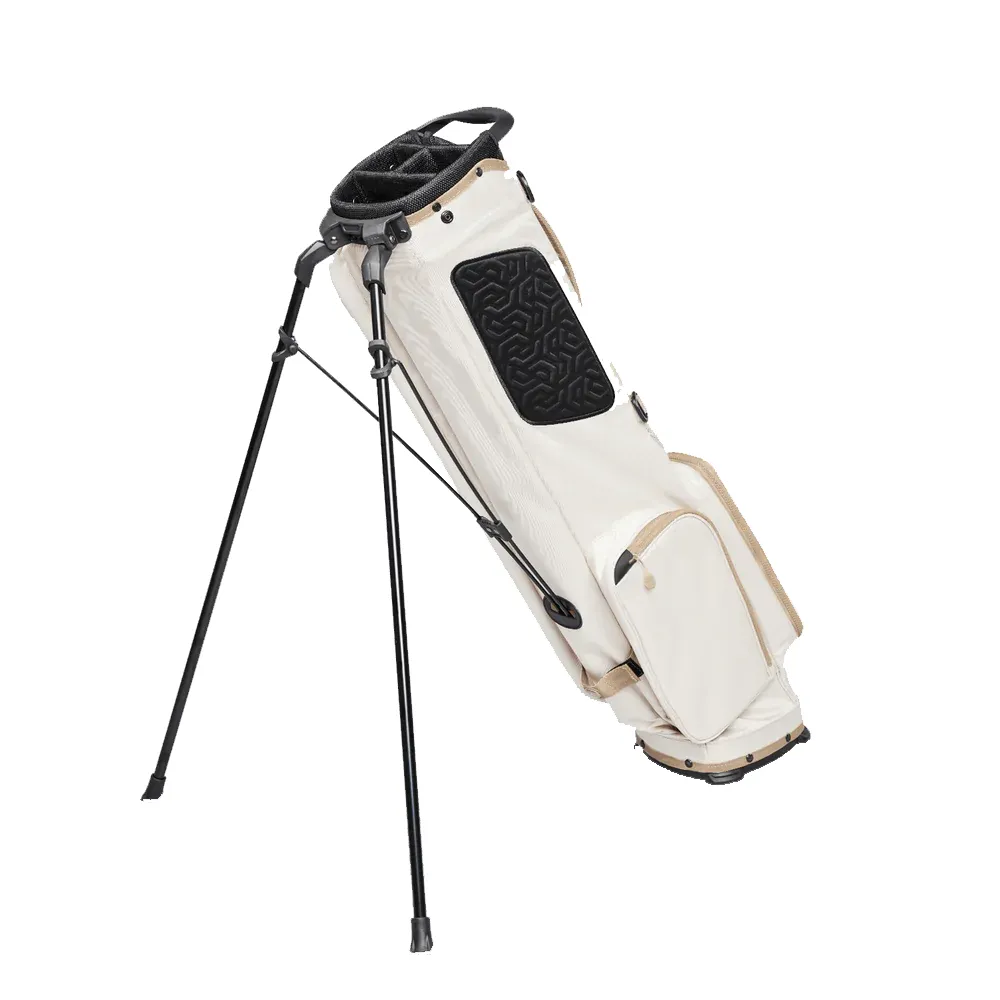
A stand bag's legs are not a single part; they are a small, coordinated mechanism fixed inside the base slot. Two aluminium or fibreglass legs pivot on a hinge block that rides in the rigid base. When you set the bag down, an activation lever — driven by a cable running up the bag to a spring-loaded trigger near the top or the hip pad — pushes the legs outward until they lock at their designed angle, usually about 60-65 degrees. Lifting the bag pulls the cable back and folds the legs flat. The mechanism depends on three things staying true: the hinge pivot stays tight, the cable returns cleanly, and the lock holds the open angle.
Because the whole system is compact and mostly hidden inside the base, most owners neither see nor maintain it until something stops working. The good news is that the failure modes are few and familiar. A bag that will not lock open, legs that wobble at the hinge, a stand that sags under load, or a leg that has snapped at the foot are the four problems you will actually meet, and each has a specific cause and a specific fix that this guide breaks down step by step.
Diagnosing the Failure Before You Buy Parts
Skip straight to ordering parts and you will often buy the wrong component, because two different faults produce the same symptom. A bag that will not lock open could be a stretched cable, a worn hinge-lock tooth, or a spring clip that has popped out — and each is fixed differently. Start with a clean diagnosis. Set the bag on level ground, open the stand fully, and watch where the slack or movement appears. Press down gently on the top of the bag to load the stand; if the whole leg assembly slides or sags, the cable or the hinge lock is the culprit. If only one leg wobbles at the pivot, the hinge pin on that side is the problem.
The second test is the fold-and-return. Pull the legs flat by lifting the bag, then set it down again. A smooth, springy return past several openings means the spring and cable are healthy. A lazy, loose return that leaves the legs half-open points to a stretched cable that no longer holds the lock. Listen and feel for grit too — a scraping resistance through the full motion usually means a bent leg or a debris-packed hinge, which you can clean before replacing anything. Writing down the exact symptom is what lets you order the right seal, pin, or cable on the first try.
Common Failure Points and Their Root Causes
Every mechanical failure has a predictable origin, and knowing them makes the repair safer and cheaper. The most frequent offender is the hinge block: constant open-close motion wears the pivot hole, the pin shears, or the block cracks under the repeated load of a heavy 14-way bag. The second most common is the activation cable, which stretches over hundreds of cycles until it can no longer pull the legs into the lock. Third is the leg foot — a rubber or plastic foot grinds flat or splits, which does not stop the bag opening but makes it lean and slide on hard ground. Less common but more serious are a snapped leg extrusion at the foot notch and a base plate that has cracked around the hinge mount, both of which usually call for a full base swap.
The fourth risk zone is the shell around the mount. When a stand fails on a heavy bag carried by the legs, the fabric can tear along the seam that surrounds the base slot — the same kind of seam failure covered in our tear-repair guide. If the shell has torn, no hinge repair will hold, because the anchor has lost its base. Repair the fabric or replace the base first, then attend to the mechanics. Diagnosing the order — mechanism first or shell first — is what separates a durable repair from one that fails two rounds later.
Repair Parameter Table
Use this table to confirm the tolerances and settings for a stand repair. The values reflect the standards our affiliated plant holds on its reinforced builds and the practical ranges a home workshop can return a mechanism to.
| Parameter | Recommended Setting | Repair Note |
|---|---|---|
| Open lock angle | 60-65 degrees | Set so the bag stands level with the legs spread fully. |
| Hinge pin diameter | 3-4 mm steel or aluminium | Match the hinge-block bore; replace if wallowed. |
| Activation cable | 1.5-2.0 mm wire with steel sleeves | Replace the sleeve when the wire shows rust or kinks. |
| Leg material | 6061 aluminium or fibreglass | Cheap repairs reuse the existing leg blank. |
| Spring tension target | Firm but returns smoothly | Over-tension stresses the hinge anchor. |
| Torque on anchor screws | Hand-tight + 1/4 turn | Do not over-torque into a resin or foam base. |
| Anchors | All-metal or reinforced composite | Confirm at spec for durability. |
Repairing a Loose or Worn Hinge Block
A loose hinge is the most common and the easiest stand repair. With the bag empty and resting on its side, remove the two anchor screws that hold the hinge block into the base slot, and pull the block free. Inspect the bore where the hinge pin sits; if it is oval or chipped, the block itself is worn and you should replace it as an assembly rather than just swapping the pin. If the bore is intact, drive out the old pin with a punch, slide in a new 3-4 mm steel pin, and reassemble. Re-seat the block level in the slot before tightening the anchors, and add a small bead of flexible sealant on a waterproof build to keep the slot sealed.
The second loose-hinge scenario is the anchor itself. On many bags the hinge-block shelf is held by two screws into a resin or foam reinforcement, and over time the screw threads strip or the shelf cracks. If only the threads are gone, re-drill with a slightly larger screw or fit a threaded insert. If the shelf is cracked, do not patch it with glue alone — fit a metal reinforcing plate on both sides of the cracked area, because a stand under a loaded bag puts real shear on that joint. Retest by opening the stand and pressing down; the legs should hold firm with no forward slide.
Replacing the Stand Legs and Feet
A snapped leg is a clear-cut replacement. The leg is a separate extrusion fixed to the hinge block by a pin or a clamp plate, so you do not need to replace the whole base. Source a matching leg blank of the same length and cross-section, or re-use the unbroken leg as a template so both sides finish at the same length and the bag stands level. Pull the hinge pin, remove the broken leg and its foot, fit the new leg, and re-crimp or re-pin it. Match the foot too — a worn replacement foot that is taller on one side makes the new bag list to one side.
If both hinges are intact but the bag slides on hard surfaces, the feet are the real problem. A foot that has ground flat or split should be removed with pliers and replaced with a fresh rubber or thermoplastic foot of the same socket size. Keep the two feet matched so the bag does not rock. On a home repair, a little soapy water eases a stubborn foot over a tight socket; do not force it with a blade, which can cut the leg. Once fitted, set the bag on concrete and load it — a good foot grips and the bag stays put during a swing.
Fixing the Activation Cable and Pulley System
When the stand returns slowly or stops locking, the activation cable is the prime suspect. The cable runs from the trigger mechanism up the bag to the legs, and it stretches or frays after hundreds of cycles. To replace it, open the base, release the cable from the leg-activation lever, and note the routing through any pulley or guide before pulling it out. Fit a new 1.5-2.0 mm wire with a fresh steel sleeve, route it through the same guides, and secure it with a new clamp or crimp so the length is identical. The fix restores the crisp, springy lock that keeps the bag from collapsing mid-swing.
The chapter of the mechanism people forget is the spring and its anchor. A weak spring returns the cable slowly and lets the legs sag, even with a healthy cable. Check the spring ends for spread or break, and confirm its anchor at the top web has not pulled loose. Re-seat or replace the spring, then set the cable so the legs lock at the designed angle with a little tension to spare. A quick test — ten rapid open-close cycles — confirms the return is smooth and the lock holds before you call the repair done.
Zipper and Strap Care That Protects the Mechanism
A surprising share of stand mechanisms fail because of the parts rubbing beside them. A stiff zipper or a twisted dual strap can catch on a leg during fold and yank the hinge out of alignment, while a loose valuables pocket flap can jam into the base slot. Before you touch the mechanism, free anything that sits between the legs and the shell. Apply a light silicone-free zipper lubricant to the pulls and run each one full-length twice, so a stiff zipper is not fighting the stand's return path.
Keep the dual-strap anchors tensioned and the straps clear of the leg wells, because an untwisted strap that wraps a leg is a frequent, invisible cause of a stand that will not close flat. If a strap anchor has loosened, reseat it before servicing the stand, otherwise the strap will torque the shell and reintroduce friction on the next use. These small chores take minutes and protect the most delicate part of the mechanism from the abuse that actually shortens its life.
When the Stand Is Not Worth Repairing
Some failures are better met with a new base or a whole new bag. If the base plate has cracked at the hinge mount, or the shell has torn all the way around the anchor, a patch will not hold a loaded stand and you risk a sudden collapse on the course. Likewise, if both legs are bent, the hinge block is shattered, and the cable guides are broken, you are effectively rebuilding the mechanism — at that point a replacement base assembly costs less than the parts and labour. Use this simple rule: if two or more of the four core components (hinge, cable, legs, base) are damaged, replace the assembly rather than repair it.
There is also an economic line for cheap, thin-shell bags. On an entry-price stand bag, buying a base assembly and new legs can approach the value of the bag itself, and the shell that surrounds the mount is likely to be the next casualty. For a premium or reinforced build, though, a stand repair genuinely extends the service life and is worth doing. Weigh the replacement price against one season of reliable play, and treat a single clean failure as repairable while reserving replacement for compound damage.
How to Buy a Stand That Needs Fewer Repairs
For buyers sourcing stand bags, the ideology is to prevent failures at the design stage rather than repair them in the field. Confirm three things in the spec: a reinforced hinge block with an all-metal or reinforced-composite anchor, a cable and pulley system with a steel sleeve and a service target of 3,000-5,000 cycles, and leg feet with a durable thermoplastic that grips without splitting. These choices add little to unit cost but remove the most common failure points, and they are the parameters QC should lock on the first article of every batch. Where you can, ask the supplier to run a stand deployment-cycle test on the pre-production sample so you see the real mechanism, not just a sample that opens once.
The build quality of the base also matters. A rigid, well-braced base holds the hinge geometry so the stand opens at the same angle every time; a soft base lets the mechanism flex and drift out of alignment. If your program targets golfers who walk most rounds, the stand is a daily-use component on a level with the straps, so it deserves the same specification discipline. The factory QC and material standards page lists the checks our affiliated plant applies, including the deployment-cycle test, so a buyer can write them into the contract before bulk production.
Tools and Materials Checklist
Before you start, assemble everything so the repair runs without interruption. Most stand repairs need nothing more than hand tools and a few small parts, so set up a clean, well-lit bench and check the list below.
- 3-4 mm hex key set and a small flat-head screwdriver for anchor screws
- Needle-nose pliers and a punch to drive hinge pins in and out
- Diagonal cutters for the activation cable and steel sleeves
- Replacement hinge pins, leg blank, leg feet, cable, and spring as diagnosed
- Cloth tape, flexible sealant for waterproof builds, and spare anchor screws
- A rivet gun only if the build uses rivets on the hinge mount
Test Plan & Acceptance Criteria
A repair is only finished when the mechanism passes a short functional test. Run the stand through ten full open-close cycles and check each of the following, stopping if any fails.
- Legs lock firmly at the designed 60-65 degree angle with no forward slide
- Both legs return smoothly and fold flat with no scraping or binding
- Hinge bolts and anchor screws hold without loosening over the pass count
- Bag stands level on hard ground with both feet gripping
- No zipper, strap, or pocket flap catches on the leg during fold
Recommended Internal Links
- Products (Stand Bag Architectures)
- Factory & QC
- How to Repair a Tear in Your Golf Stand Bag
- How to Extend the Lifespan of Your Golf Stand Bag
- Golf Stand Bag Buying Guide
FAQ
Why does my golf stand bag stand stop locking open?
A stand that collapses instead of locking is almost always a worn hinge or a stretched activation cable that no longer holds the legs at the open angle. A spring clip or hinge pin has usually worked loose or sheared; replacing the pin and re-setting the cable usually restores the lock.
Can I replace the legs on a golf stand bag if one snaps?
Yes, if the leg is a separate aluminium or fibreglass extrusion fixed to the hinge block. Source a matching leg blank and foot, pull the hinge pin, swap the leg, and re-crimp. If the hinge block itself is cracked, replace the whole block as an assembly.
What tools do I need to fix a golf stand bag stand?
A 3-4 mm hex key, a small flat-head screwdriver, needle-nose pliers, a punch for hinge pins, a diagonal cutter for cables, cloth tape, and a rivet gun if the build uses rivets. Most repairs need no power tools.
How many deployment cycles should a stand survive before it fails?
A well-built stand mechanism is target-tested to 3,000-5,000 open-close cycles in factory pressure testing. If your stand fails well before that range, the failure is usually a loose anchor or a manufacturing tolerance issue rather than normal wear.
Is it cheaper to repair the stand or replace the whole bag?
For a loose hinge, stretched cable, or snapped leg, repair typically costs a fraction of a replacement bag. If the base plate or the hinge-block pocket is cracked, or the bag shell is torn around the mount, replacement is usually more cost-effective.
How do I stop the stand from sagging when it is fully open?
Sag is a stretched cable or a worn hinge lock. Reset the cable tension so the legs lock at the designed about 60-65 degree angle, and tighten or replace the hinge pin. Check the leg feet too — a worn foot shifts the load and makes the bag lean.
How can I prevent my golf stand bag stand from breaking in the first place?
Avoid carrying a fully loaded bag by the stand legs, keep the bag from being crushed against a trunk edge, dry and store it upright. Reinforced hinge blocks and all-metal anchors last longest, so confirm these on a custom build at the factory stage.
Final Note — Fix the Mechanism, Keep the Bag
A broken stand is most often a fixable mechanism, not the end of a bag. With a clean diagnosis, a handful of cheap parts, and the right tension settings, a loose hinge, stretched cable, or snapped leg can be returned to reliable service in under an hour, and it protects the investment in a bag that still has years of play ahead. For buyers sourcing a line, the smarter route is to specify a reinforced hinge and a cycle-tested mechanism at the design stage so the stands you ship simply do not break. That starts with the specifications on the OEM/ODM service page, where material and hardware choices are reviewed before sampling. Whether you are repairing a single bag or designing a more durable program, the mechanism, not the cosmetics, is what earns the course-long trust.
Request a B2B quote for golf stand bags
Send your target market, expected MOQ, and reference photos. We respond within 24 hours with a sampling plan.