Working with a Chinese golf stand bag factory concentrates the value where it actually helps a brand: a machine-hour cost base, an integrated fabric-and-hardware supply chain, and flexible MOQs from roughly 200 pieces that let you scale from a 100-piece test run to thousands — usually at a 15-30% lower unit cost than Western alternatives on comparable models. The real strategic advantage, though, is speed to a certified, repeatable spec: sampling in 10-20 days and bulk in 45-60 days. This guide sets out the concrete advantages of a Chinese golf stand bag supplier, using our SGS-verified Quanzhou plant (4,950 sqm, 7 lines, 149 machines, 137 staff, monthly line capacity 200,000 units) as the reference for what an integrated factory offers. For a broader look across cart bags, staff bags and the full golf bag category from one source, our affiliated golf bag factory runs the complete line.

The Cost Base: Where a Chinese Factory Actually Saves You Money
The biggest misconception is that the Chinese advantage is cheap labor. It is not — effective. The real advantage sits in the machine-hour economics and the integrated supply chain. A mature stand bag factory buys common shell fabrics, zippers, stand hardware, and trims from suppliers in the same region, which removes the freight and lead time of importing components from separate countries. On a 200-piece or larger bulk order, that material integration is where the visible savings accumulate.
A factory running 7 lines with about 149 machines reaches a high monthly line capacity, driving the per-unit machine cost down as volume climbs. The combination of integrated materials, high line throughput, and an experienced sewing workforce lets a brand land a comparable stand bag at a per-unit cost meaningfully below what Western labor and separate component sourcing would support. When you build a landed-cost table, the manufacturing-line portion of a Chinese quote is typically the most favorable line.
The honest caveat is that freight, duty, and lead time still apply. A low per-unit factory price can be eroded by ocean freight on a bulky stand bag, so the smart comparison is always landed cost, not the quoted price. The advantage of a Chinese plant is that it gives you a bigger head start on the cost line; the savvy buyer then manages freight and duty on top rather than letting the two cancel out.
Capacity and Speed: Sampling in Weeks, Bulk in Two Months
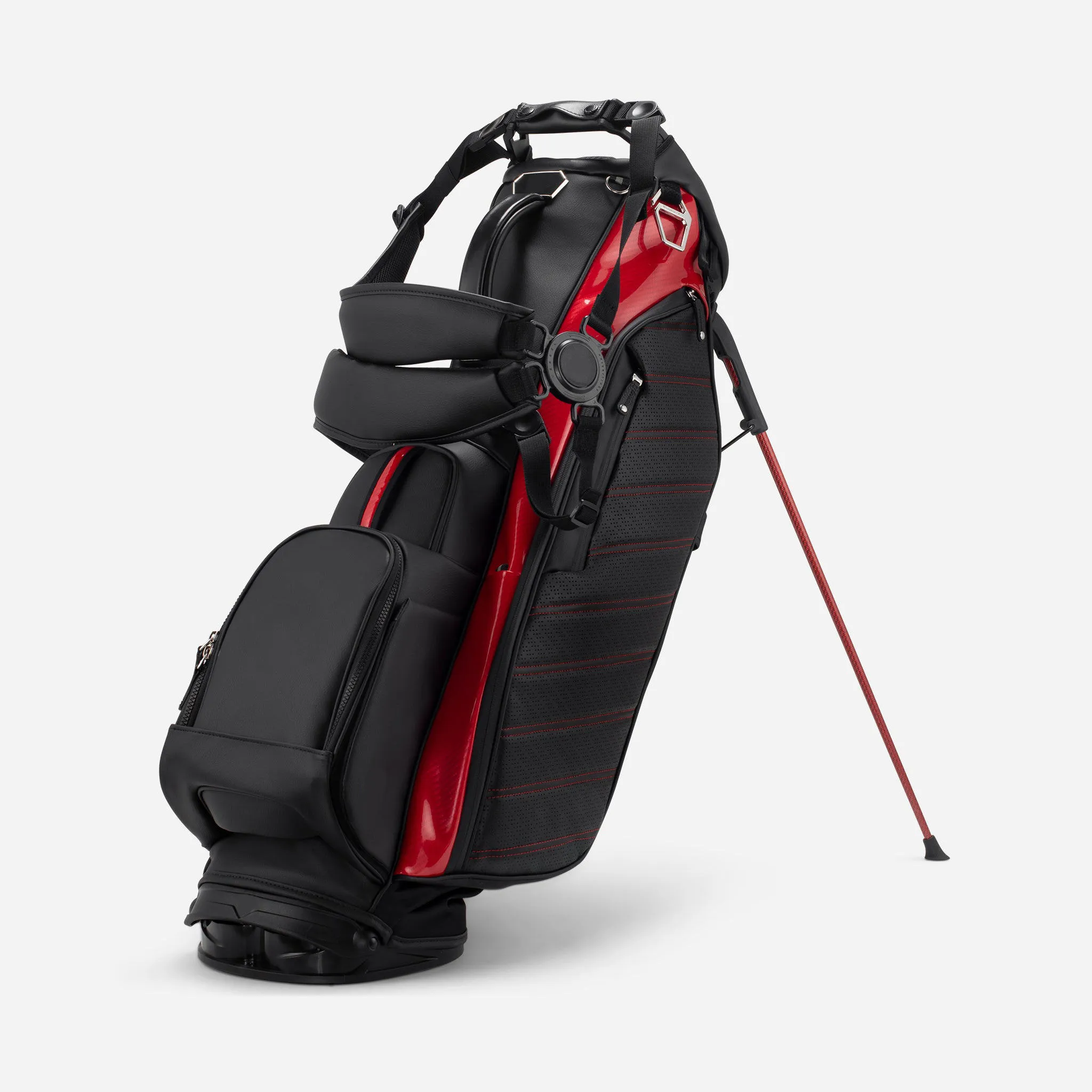
China's stand bag ecosystem is built for lead time. Because the fabric, hardware, and stand components are regionally available, a factory can often reserve materials and start sampling without waiting on imported components. With an established line, sampling runs about 10 to 20 days and bulk production about 45 to 60 days from sample approval — a cycle that lets a brand go from a validated sample to a container within roughly a season.
Capacity is the counterpart of speed. A standalone workshop with one line may produce a few hundred bags a month; an integrated plant with multiple lines can hold a far higher monthly output. For a brand that needs a seasonal spike of a few thousand units, the reserve capacity is a real advantage, because the factory can parallelize models across lines rather than making you wait for one line to clear. Ask what the plant's current monthly output is versus rated line capacity when you evaluate this.
Speed also protects your calendar. Because bulk runs 45-60 days, a brand targeting a spring or fall retail window can place its order with confidence if it starts early enough. The combination of regional materials and high-speed lines means the factory is usually running to a real schedule it can defend, rather than structurally over-promising. Confirm the timeline in writing at order time and you take most of the risk out of the calendar.
Integrated Supply: One Region for Fabric, Zipper, Stand, and Trim
The single most underappreciated advantage of sourcing in China is the density of the supplier cluster. Shell fabrics of multiple deniers, zippers and pulls, stand mechanisms and hinge blocks, foam padding, webbing, and hardware all sit within a short radius of the sewing plants. That proximity does two things: it cuts component lead time, and it lets the factory hold a small inventory of common materials so sampling and small runs move without a special purchase order.
For a brand, this means faster iteration. If you decide during sampling that you want a different zipper pull or a stiffer stand leg, the change can often be sourced and tested in days rather than weeks. The ability to make one change without restarting a whole import chain is a genuine engineering advantage that a more dispersed supply base cannot match. It is also why so many premium stand bag programs are born in this region.
The trade-off to manage is quality control across that speed. An integrated supply that is not disciplined can ship inconsistent hardware. The advantage converts to value only when the factory runs QC on the incoming components as well as the finished bag. Ask whether the plant inspects component lots before assembly and holds the same defect record for incoming materials as for the finished unit — that is the difference between a fast cluster and a fast, reliable one.
Flexible MOQ: Test at 100, Scale Beyond 200
A brand's first order does not have to commit to a container. In this market a regular bulk MOQ is about 200 pieces per model, while a first test order can often start around 100 pieces so new brands can validate the sample, photograph the real lockup, and confirm sell-through before scaling. That flexibility is a genuine advantage when you are testing a new line or entering a new market without a large capital commitment.
The reason the MOQ can be flexible is the same as the cost advantage: the integrated supply and multi-line capacity let a plant run smaller batches without stand-alone setup costs becoming prohibitive. Confirm the MOQ structure per model and per colorway before you design a SKU plan, and start with one architecture and a small set of colorways to keep complexity low on the first order. As volume grows, the per-unit cost drops and the factory holds capacity for your reorder.
From a strategy standpoint, the flexible MOQ means you can run a pilot with real production — not just a mock — test your pricing and your retailer reaction, and then reorder with confidence. That de-risks the biggest mistake new brands make: committing a large quantity to an untested model. The Chinese factory model accommodates the pilot-then-scale path because the line economics support it, and a trusted supplier will hold your spot through the evaluation period.
OEM and ODM Depth at One Partner
China's stand bag ecosystem supports both OEM and ODM, which lets you choose between branding a proven architecture or co-developing something new. For OEM, you put your branding on a tested structure and move fast. For ODM, the plant co-develops the structure, pockets, materials, and hardware with you — which is where the region's component density helps most, because a whole new idea can be assembled and sampled in weeks.
The advantage of doing both at one partner is continuity. When the same factory that designed your ODM structure also runs the bulk and the QC, there is no hand-off error between a designer, a maker, and a trader. The tech pack, the sample, and the master stay with the people who build it. For a brand building a long-term golf line, that continuity protects your design and your quality across seasons.
For a first program, most brands do best starting with OEM on a proven architecture, adding one or two meaningful differentiators, and shifting toward ODM once the relationship and the market both prove out. This keeps the first run low-risk and lets the ODM conversation happen with a partner who already knows your materials and your taste, rather than a new supplier learning you from scratch.
QC and Certification You Can Verify from a Distance
The doubt many buyers carry is quality control across an ocean. The answer is that a disciplined Chinese factory makes QC auditable: third-party audits such as SGS document the floor area, line count, machine count, and workforce; and a recorded AQL inspection with inline and final checkpoints gives you evidence at the dock. Our plant's SGS audit (verified March 2026, 4,950 sqm, 7 lines, 149 machines, 137 staff) is the kind of independent evidence that bridges the distance.
Build QC into the contract the same way you would with a domestic supplier: define the AQL level, the defect classes, and the functional tests (stand deployment cycles, zipper cycle, strap anchor load, base stability, packed drop test), request inline inspection during production, and keep a sealed master sample the line checks against. A recorded inspection per lot turns an import from a leap of faith into a documented process.
The advantage is that you do not have to be on site to be in control. The same records that prove the factory honest on one shipment are the ones that keep a reorder consistent. Distance stops being a risk when the evidence is standardized, and that is precisely what an audit-certified, inspection-recorded Chinese partner provides — control you can audit remotely.
Typical Cost and Lead-Time Reference
| Factor | Typical Chinese Factory Reference | Buyer Note |
|---|---|---|
| Unit cost vs Western option | ~15-30% lower on comparable models | Compare on landed cost, not quoted price |
| Sampling lead time | 10-20 days | Two rounds on a complex spec |
| Bulk lead time | 45-60 days from sample approval | Confirm calendar at order time |
| Regular bulk MOQ | ~200 pcs per model | First test order ~100 pcs possible |
| Production scale | Up to ~200,000 units monthly line capacity | Current output varies by load |
| QC / audit | AQL + third-party audit (e.g. SGS) | Request the latest audit certificate |
| OEM / ODM | Both supported | Start OEM, shift to ODM when ready |
When a Chinese Factory Is Not the Right Fit
The advantage is real but not universal. If your program is high-mix, high-brand-protection, and needs a domestic supplier for regulatory or storytelling reasons, a Chinese plant may be the wrong primary partner. Similarly, if you cannot tolerate the 45-60 day production window or the ocean freight cost of a bulky cargo, the trade is not automatically favorable. The decision should rest on your landed cost, your timeline, and your risk appetite, not on habit.
That said, for a B2B brand or distributor building a volume golf stand bag line, the combination of cost base, integrated supply, flexible MOQ, OEM/ODM depth, and auditable QC is why the region remains the center of stand bag manufacturing. The key is managing the two risks that genuinely exist — freight cost on a bulky item and quality control from a distance — with a landed-cost discipline and an inspection record, both of which a certified partner supports.
Explore the proven Stand Bag Architectures, our OEM/ODM Service, and the Factory & QC pages to see the capabilities, and contact the team at service@junyuanbags.com to start with a pilot MOQ.
Design Iteration Speed: The Engineering Advantage
One of the most practical advantages of the Chinese ecosystem is how fast a design idea can be turned into something you hold. Because the component suppliers are close, a change made during sampling — a different zipper pull, a stiffer hinge, a relocated pocket — can often be sourced and tested in days rather than weeks. That iteration speed shortens the distance between your brand brief and a physical bag you can photograph, which is where most stand bag programs actually get won.
For a brand that is still shaping its spec, this speed translates directly into lower development cost. Every design change that can be validated cheaply and quickly reduces the expensive back-and-forth that drags a project when suppliers are spread across countries and time zones. A factory that can show you a revised sample within the same week keeps your development momentum and protects your seasonal calendar.
The condition is the same one that governs quality: iteration is only valuable if the changes are captured in the tech pack and reflected in QC. The plant that moves fast must also lock the revision so bulk matches the final sample. Ask how a mid-sampling revision is logged and how the frozen master is updated, so the speed of the ecosystem serves consistency rather than undermining it.
Sea-Freight Advantage and the Bulky-Cargo Reality
China sits at the center of the world's ocean freight network, with major ports and regular sailings to virtually every golf market. That is a genuine advantage for a bulky, lightweight product like a stand bag: container capacity and vessel frequency are reliable year-round, and multiple port options mean a buyer can route through the port that best fits the destination. Access to frequent, competitive ocean freight keeps landed cost predictable across seasonal demand.
The bulky reality cuts the other way, and it deserves an honest paragraph. A stand bag is light but takes up container volume, so the freight line is driven by volume, not weight. That means the cost advantage from manufacturing can be partially recovered by freight economics unless the buyer packs smartly and compares landed cost. Ask about packing density and carton configuration during sourcing, because a factory that packs efficiently can materially reduce the freight per unit on a bulk order.
Use the freight access to your advantage in scheduling. With frequent sailings, you have more freedom to book a vessel that fits your timeline, and more room to negotiate the rate. Combine that with the regional supply chain and you get a faster, cheaper path from sample to shelf. The win is realized when you actively manage the freight line rather than accepting it as a fixed cost on top of the factory price.
How to Choose the Right Chinese Stand Bag Factory
Within China, factories differ as much as they share advantages, so selection still matters. A shortlist is built on the same evidence as any rigorous sourcing decision: third-party audit certificates, verified floor area and line and machine counts, export references and destinations, a documented AQL and inspection process, and the ability to show you in-progress work. A factory that can put audit and inspection records on the table is easier to trust at a distance than one with only brochures.
Match the factory to your process maturity. A new brand testing a line is usually best served by a supplier comfortable with small pilots and OEM branding; a distributor running volume wants multi-line capacity, strong reorder economics, and proven export history. Ask about the MOQ structure and test-order flexibility, and confirm the plant can grow with you rather than being either too small to scale or too large to care.
Finally, validate with a pilot before committing. Start with a test order of around 100 pieces, photograph the real bag, confirm sell-through, and then trigger a standard 200-piece bulk reorder. The Chinese factory advantage is best captured through this pilot-then-scale rhythm, where low initial risk converts into volume economics once the model proves out.
Recommended Internal Links
In short, the Chinese golf stand bag factory advantage is real and it is measurable: concentrated material supply, experienced multi-line production, and fast, low-cost prototyping combine to deliver a better bang-for-the-buck ratio than is available from most other producing regions.
- Products (Stand Bag Architectures)
- OEM/ODM Service
- Factory & QC
- Golf Stand Bag Buying Guide
- How to Visit a Stand Bag Factory
- Working with a Factory for Bulk Orders
FAQ
Why should I source golf stand bags from a Chinese factory?
China's sewing and hardware ecosystem combines proven stand-assembly capability, integrated material supply, flexible MOQs from around 200 pieces, and competitive machine-hour economics with year-round ocean freight, giving brands more design and cost control.
Are Chinese golf stand bag factories able to match premium quality?
Yes. A factory running on SGS-verified lines (for example 4,950 sqm, 7 lines, 149 machines, 137 staff) can hold the same QC discipline as premium suppliers, including AQL inspection and functional stand and zipper tests, at a lower unit cost.
What is the typical cost advantage of manufacturing in China?
The advantage comes mainly from the machine-hour rate and integrated material supply, not necessarily raw labor. Common fabrics, hardware, and zippers are sourced within the region, cutting material logistics cost on a 200-piece or larger bulk order.
Can I get a small test order before a bulk run?
Yes. A regular bulk MOQ is about 200 pieces, but a first test order of about 100 pieces is often accepted for a new brand so you can validate the sample and sell-through before scaling to a full container.
How long does production take at a Chinese factory?
Sampling typically runs 10-20 days and bulk production 45-60 days from sample approval, supported by an integrated supply chain that keeps material on hand. Confirm the calendar before ordering so the peak season is covered.
Is it hard to manage QC from afar when importing from China?
It is manageable if you define an AQL plan, request inline and final inspections, and keep a sealed master sample. Third-party audits like SGS and recorded inspection per lot give you evidence independent of the distance.
Do Chinese suppliers handle OEM and ODM for stand bags?
Yes. You can do OEM (branding on proven architectures) or ODM (co-developing structure, pockets, materials, and hardware). The ecosystem spans fabrics, zippers, stands, and hardware under one region, supporting both routes.
Request a B2B quote for golf stand bags
Send your target market, expected MOQ, and reference photos. We respond within 24 hours with a sampling plan.