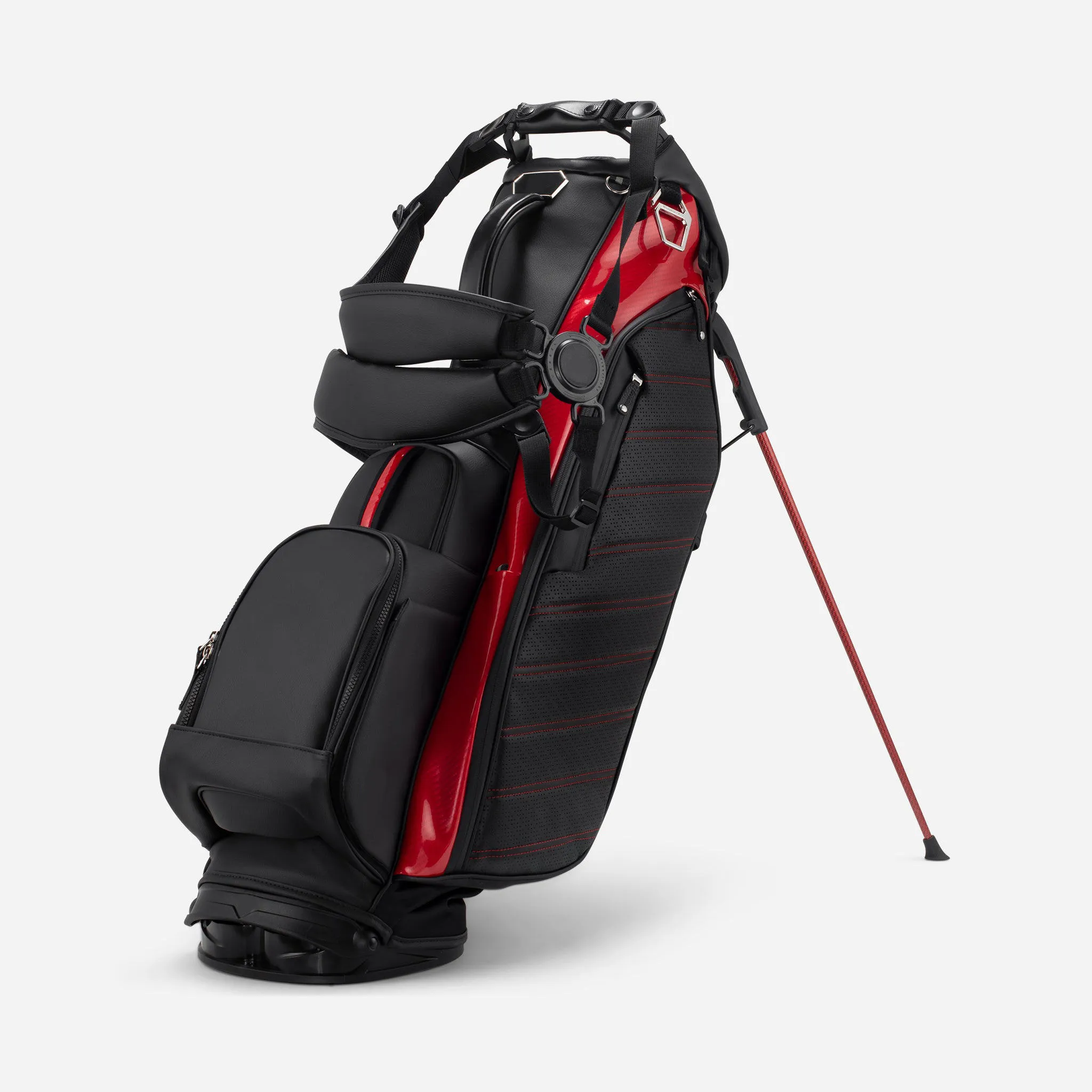
For a versatile two-in-one build, review our hybrid golf bags — For the most compact small carry, see our pencil bags — The most popular golf stand bag features in 2026 center on a reinforced aluminum or composite stand with a stability-focused base, 14-way full-length dividers, seam-taped waterproof packages, PU-leather and certified rPET panels, magnetic rangefinder and valuables pockets, and a dual self-balancing strap — a combination that typically holds a premium carry bag in the 3.0-3.5 kg weight band. This guide turns those popular features into production-ready specifications, using the SGS-verified March 2026 capacity of QUANZHOU JUNYUAN BAGS — 4,950 sqm, 7 lines, 149 machines, 137 staff — so your 2026 catalog leads with what buyers actually want.
Key Takeaways
Popularity in 2026 is not about piling on every idea; it is about investing in the features that drive the most daily use and the fewest returns. The features below recur across best-selling catalogs because each one solves a real problem — stability on the course, club organization, dry gear in rain, a premium look, and convenient mid-round access. For a B2B buyer, the value is in knowing which features earn their cost and which are gratuitous weight, so you can brief a lean, popular program.
- Reinforced aluminum/composite stands with hinge-block build are the #1 mechanical feature
- 14-way full-length dividers dominate the premium organization band
- Seam-taped waterproof packages have become a mainstream premium spec
- PU-leather accents plus certified rPET base panels is a leading 2026 material combo
- Magnetic and RFID pockets are the fastest-growing convenience features
- Dual self-balancing straps must pass a load test before they earn the premium
Feature 1: The stand system leads everything
The stand is the feature that defines the category, and in 2026 it is the most scrutinized mechanical part because it is used on virtually every hole. The popular specification pairs reinforced legs — often aluminum for the premium slide feel or a composite for weight savings — with a reinforced hinge block and a stability-focused base geometry. The hinge block matters more than the leg material, because most stand wobble and failure trace to hinge-tolerance drift and base wear rather than to the leg tube itself.
For a factory, the stand is validated by a deployment-cycle test with a defined target and by a base-stability check that covers deployment angle, slipping resistance, and leg-spread consistency. A popular bag that deploys smoothly, locks firmly, and does not sag after a season is the one that survives retail review and my-summer-of-play scrutiny. If you are sourcing, ask for the cycle target and the stability criterion in the RFQ so the sample is judged against a number, not a feeling. Our factory QC page documents the deployment and stability tests we run on every stand program.
One further point worth briefing is the leg-tip and base traction. A bag that slips on a slope or on wet grass annoys every player who picks it up, so the popular spec includes a non-slip base pad or traction lug and a leg-tip cap that grips without scuffing. These are small components, but they are the difference between a bag that "stands" and one that merely props, and they are cheap to specify correctly when they are in the tech pack from the beginning rather than added after a field complaint.
Feature 2: 14-way full-length organization
The organization feature that dominates premium catalogs in 2026 is the 14-way top with full-length dividers. Players who walk with a mixed set want clubs that do not tangle and grips that stay protected, and full-length tubes prevent the mid-bag clatter that a shallow 4-way or 6-way top allows. The cost drivers are the top assembly, the divider tubes, and the top-frame reinforcement, and the typical failure modes are top alignment and divider wear, which is why the divider sleeve width and tube material should be locked in the spec.
The arrangement of the 14 openings also matters for daily use: the popular layout groups woods and long clubs at the back, irons in the middle, and wedges and a putter well at the front, with a full-length putter well that holds the flat stick without it rattling. Getting this layout into the tech pack avoids a bag that technically has 14 ways but arranges them awkwardly for how players actually load clubs. A good divider map is a design feature buyers feel immediately, and it is one we confirm on the production sample before bulk.
The trend-conscious balance is to offer the 14-way on the organized premium band while keeping a 4/5/6-way option on the lightweight end, so buyers are never forced to carry a heavy bag just to get club separation. On a 14-way bag, the top must be checked for alignment in final inspection and the divider padding specified so grips stay protected without adding excessive weight.
Feature 3: Seam-taped waterproof packages
Waterproof construction is one of the fastest-growing popular features in 2026, rising with all-weather play in the UK, Scandinavia, and the Pacific Northwest as seam-taped TPU packages become affordable at scale. A genuinely waterproof bag depends on three coordinated elements: a waterproof or water-repellent fabric laminate, seam-taped or welded seams so water cannot pass through the stitch holes, and waterproof zippers at the openings. A bag that skips any one of these leaks at exactly the wrong moment.
The popular version of this feature pairs a water-repellent PU-laminate fabric with seam tape on the high-exposure seams and a magnet-assisted or waterproof coated zipper at the valuables opening. Because waterproof cannot be retrofitted cheaply, it must be in the tech pack from the start, with a hydrostatic-head target and a seam-integrity test on the production panels. A properly sealed 2026 waterproof bag commands a healthy premium and, done right, returns far less than a leaky half-measure.
Feature 4: The PU-leather + rPET material combo
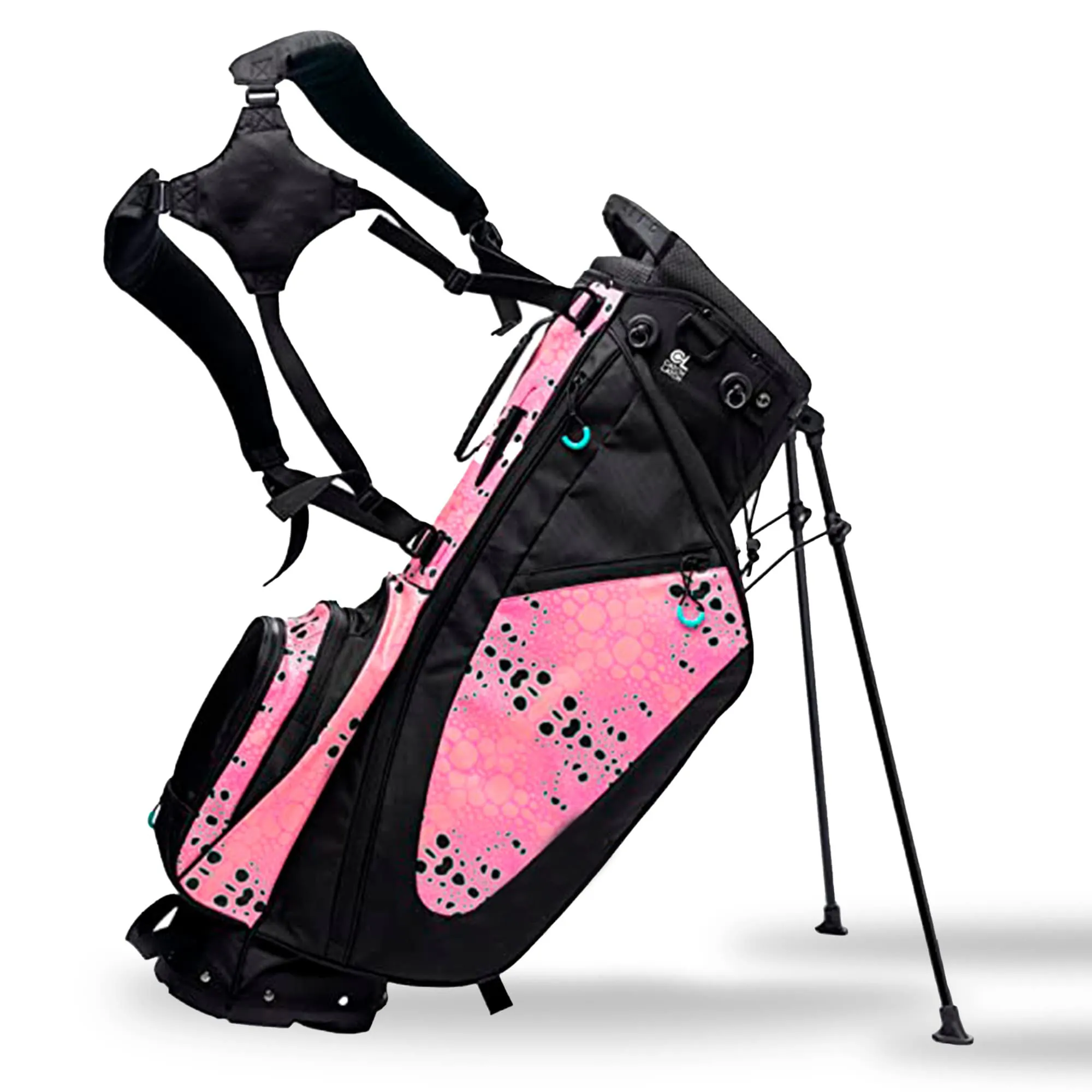
Material is the biggest driver of both price and perceived value, and the most popular 2026 combination is a premium PU synthetic leather accent — usually the top panel, valuables pocket, or brand patch — over a reinforced nylon or certified rPET base that carries the stand and strap anchors. PU leather delivers the high-end look and an easy wipe-down cleaning surface, but it is heavier and less flex-friendly than nylon, so keeping it to trimmed panels protects both weight and durability.
The base panels, meanwhile, take the real abuse — stand deployment, strap anchoring, and base wear — so they should be a 400D or 600D nylon (or certified rPET at equivalent denier) with reinforcement at stress points. This split lets a catalog sell premium aesthetics with lightweight performance and a defensible eco claim where rPET is used. The exact blend should be confirmed on the production sample, because PU grain and recycled yarn tone vary, and a color-chip-approval step prevents the classic "premium" shell that looks great in the art file but off-tone on the shelf.
A 2026 feature-by-feature specification table
Use this as your internal feature spec. Confirm each row on the pre-production sample and lock the values before bulk so the popular features ship consistently:
| Feature | 2026 Typical Spec | Key QC Point |
|---|---|---|
| Stand legs | Aluminum or composite, reinforced hinge block | Deployment-cycle + base-stability test |
| Top divider | 14-way with full-length tubes (or 4/5/6) | Top alignment + divider wear check |
| Waterproof package | PU/TPU laminate + seam tape + water zipper | Hydrostatic head + seam-integrity test |
| Shell material | PU accent over 400/600D nylon or rPET | Fabric abrasion + tear at stress seams |
| Pockets | Magnetic rangefinder + RFID valuables | Magnet retention + RFID shielding test |
| Strap system | Dual self-balancing, removable | Strap-anchor load + stitch-failure check |
| Hardware | Corrosion-resistant zippers, buckles | Salt-spray check if required |
This table is the working definition of "popular 2026 features" in a form a QC line can enforce. It is also the fastest way to cut a confusing catalog down to a hero that genuinely sells.
Feature 5: Magnetic rangefinder and RFID pockets
Convenience features round out the popular list, and two stand out in 2026. The magnetic rangefinder pocket offers one-handed mid-round access to a rangefinder or phone without wrestling a zipper, provided the magnet is placed to avoid interfering with the device or the divider system and the closure holds at a full swing. The RFID-lined valuables pocket protects cards and tags from skimming and reads as a premium signal in urban and travel markets, but the lining must keep its shielding after washing and flexing, which needs a dedicated test.
Both add a modest weight and cost and give a brand a genuine story to photograph. They are the "smart" features that survive real use, unlike battery-powered gadgets that add certification and after-sales burden. For a 2026 program, one magnetic pocket for the rangefinder and one RFID valuables pocket are the sweet spot — enough to signal convenience without pricing the bag out of its band.
Feature 6: Dual self-balancing straps that pass a load test
Comfort is a feature buyers feel before they even swing a club, and the dual self-balancing strap is the most popular carrying system of 2026. The value lives in the padding thickness, the adjust hardware, and the self-balancing geometry that spreads the load across both shoulders, and it is a genuine differentiator — but only if it survives wear. A strap that looks padded but tears at the anchor is a return waiting to happen.
The adjustment hardware is where many straps quietly fail. A low-grade slider or buckle can slip under load and dump the weight unevenly, which is uncomfortable and can even misbalance a bag mid-walk. The popular spec therefore calls out a positive-lock adjustment with a defined adjust range and a minimum retain strength, and it is validated in the strap-anchor load test together with the stitching. We also recommend checking that the two straps are symmetric in length and padding when the bag is empty, because an asymmetric pair creates an avoidable pressure point that players notice within a single round.
That is why the popular spec includes a strap-anchor load test with a stitch-failure criterion, plus padding-thickness and adjust-range values in the tech pack. When the strap is engineered to carry a fully loaded bag — clubs, rain wear, a rangefinder, and a water bottle — without straining the anchor, it earns the premium. A removable strap is a nice-to-have that helps airline travel and storage, so many 2026 catalogs offer it as an option.
Failure modes to test for and controls
A 2026 bag with these popular features introduces specific failure modes beyond a basic bag. Stand wobble, zipper jamming, and strap-anchor failure remain, but a waterproof or smart-equipped bag adds seam-leak risk, magnetic pop-open, and RFID-shielding loss. Control them with a QC plan built around each feature's test, and returns drop sharply.
| Failure Mode | Root Cause | Prevention / QC Control |
|---|---|---|
| Stand wobble | Hinge drift, leg fatigue, base wear | Cycle + stability test; inspect hinge and base |
| Waterproof seam leak | Tapeless seam, film delamination | Seam-tape integrity on production panels |
| Magnetic pocket pop-open | Weak magnet, wrong placement | Swing-retention test |
| RFID shielding loss | Lining wear after flex/wash | Shielding check after wash and flex |
| PU panel cracking | PU film fatigue on high-flex zone | Limit PU to accent panels; flex test |
| Dye-lot color drift | Recycled yarn lot variance | Color chip lock + trim-down sample |
Documenting these tests gives your sales team defensible claims and keeps the popular-feature program profitable instead of burying margin in returns.
Branding the popular features cleanly
A feature-rich premium bag needs a branding plan that does not fight its own construction. Because popular mats include a PU accent top panel and an rPET nylon base, the logo method should be matched to each surface: embroidery or a woven label sits cleanly on a 600D nylon panel, while a debossed or tonal patch works better on a PU accent where embroidery thread can stress a soft film. Heat transfer stays on stable panels away from the stand hinge and strap anchors, where it would peel first, and a small tonal logo on the magnetic or valuables pocket reads as premium without cluttering the design.
The colorway also has to live with the features. A waterproof seam-tape color, the PU panel grain, and the rPET base tone should all be briefed together so the bag reads as one designed object rather than assembled from unrelated parts. Lock a Pantone reference for any logo thread or film, approve a physical color chip, and request a trim-down sample before a large container — especially when recycled yarns are involved, because they can drift between dye lots. The custom logo approaches page walks through matching method to panel, which is exactly the discipline a feature-rich 2026 bag needs.
Putting it together: the procurement worksheet
To buy a 2026 bag with the popular features, capture them all in a one-page worksheet before the RFQ: the target market and weight ceiling, the divider configuration, the stand and strap standards, the material blend (PU accent plus base nylon or rPET with certificate), the pocket list, the waterproof scope if any, the logo method, and the AQL plus functional test requirements for stand, zippers, seam, magnet, and shielding. Locking these on paper forces product, sourcing, and sales to agree before a sample is cut.
Send that worksheet with your target market, expected MOQ, and reference photos to service@junyuanbags.com or +86 17750020688 and we return a concrete plan — a pre-production sample in 10-20 days and bulk in 45-60 days. The brands that win the 2026 season brief the popular features as measurable specs, lock them once, and repeat them reliably across the whole catalog.
Two practical closing notes for the buying team. First, order a small feature check run — even 20-30 units — before a full container, so you can photograph the real stand deployment, the waterproof seam, and the magnetic pocket on your production silhouette and confirm the features behave as promised for your retailers. Second, keep the same popular-feature spec across the bag line as you scale, because manufacturers quote and reorder more efficiently when the feature set and its test methods are already audited and reproducible. That consistency is what turns a season of popular features into a durable, defensible product line.
How popular features map to Price-to-market segments
The same set of popular 2026 features does not apply equally to every price band, and knowing where to spend and where to hold back is what keeps a catalog profitable. At the entry and volume end — resort rental fleets, junior and women's lines, and lightweight travel bags — the load-bearing features are a dependable stand, a comfortable dual strap, and a clean pocket layout; waterproof and smart add-ons are usually skipped to hold price and weight. In the mid band, a 4/5/6-way organized carry with a PU accent panel and one magnetic pocket offers the best value story. In the premium band, buyers expect the full popular set: 14-way full-length dividers, a seam-taped waterproof package, rPET with certificate, and both a magnetic rangefinder and an RFID valuables pocket.
Weight interacts with all of it. Because waterproof packages and 14-way dividers are the two heaviest adds, a premium bag that also seeks a low weight ceiling must make deliberate cuts — a lighter divider tube, a slimmer PU accent, or a water-repellent rather than fully waterproof package for dry-first markets. The smart buyer states a weight ceiling and a priority order for features in the RFQ, so the factory can model which combination lands in band. Our product architecture page shows how we separate the lightweight, 14-way, waterproof, and hybrid line-ups so you can mix features without confusing the frame or the price point.
Testing and sampling for a feature-rich hero
A 2026 hero carrying several popular features needs a sampling and QC plan that validates each one. Because the waterproof package, the magnetic pocket, the RFID lining, and the 14-way dividers each have a measured target, the pre-production sample (PPS) must be produced on the exact production fabric and components, and the buyer should budget a couple of sample rounds on a complex hero — one concept sample to confirm the look and one PPS to lock the technical file. Inline inspection during bulk beats a final random check for these packages, because seam-tape application, magnet placement, and divider alignment are all caught earlier at lower cost.
At QUANZHOU JUNYUAN BAGS, a feature-rich hero typically samples in 10-20 days, and we encourage a photo-documented inline report on the stand deployment, the seam-tape application, the magnet placement, and the top alignment. Locking the test plan at the same time as the colorway and the recycled certificate turns a list of popular features into a repeatable product line, and that repeatability is the quiet feature that protects your margin and your brand across seasons. If you plan an after-sales and spares program — replacement magnets, liners, divider pads, and seals from the same line — a travel or rental channel can repair quickly instead of replacing, which extends product life and closes a sustainable loop.
FAQ
What are the most popular golf stand bag features in 2026?
The most requested features are reinforced aluminum and composite stands, 14-way full-length dividers, seam-taped waterproof packages, PU-leather and recycled rPET panels, magnetic rangefinder and valuables pockets, and dual self-balancing straps.
Is PU synthetic leather durable enough for a stand bag?
Yes when specified well. PU leather offers a premium look and easy wipe-down cleaning, but it is heavier and less stretch-friendly than nylon, so it works best as accent and upper panels with reinforced nylon stress panels for the stand and strap anchors.
Which material is best for a 2026 stand bag?
It depends on positioning. Nylon and polyester suit lightweight lines, PU synthetic leather suits a premium look, and TPU-coated or laminated fabrics suit waterproof programs; many catalogs mix a premium PU accent with a reinforced nylon base.
How important is the stand system to a popular 2026 bag?
It is arguably the most important mechanical feature because it is used on every hole. A 2026 popular bag pairs aluminum or composite legs with a reinforced hinge block and a stability-focused base, validated by deployment-cycle testing.
Do popular 2026 bags include smart pockets?
Yes. Magnetic rangefinder pockets and RFID-lined valuables pockets are among the fastest-growing 2026 features, adding a modest weight and cost while giving a bag a real mid-round convenience story.
What is the fastest way to get an accurate quote for these features?
Send bag type, material direction, divider (4/5/6/14-way), pocket list, logo method, target MOQ, timeline, and reference photos or a tech pack.
Recommended Internal Links
Request a B2B quote for golf stand bags
Send your target market, expected MOQ, and reference photos. We respond within 24 hours with a sampling plan.