For a featherweight minimal carry, explore our Sunday bags — A stand bag can only carry a waterproof claim if the material system works as one package: a TPU-coated or laminated water-resistant fabric with a hydrostatic head of 5,000-10,000 mm (ISO 811), seam tape sealing the needle holes on critical seams, water-repellent zippers at the pockets, and protected openings — because a single unprotected seam or zipper turns an excellent fabric into a leaking bag. This guide explains the material and construction choices a B2B buyer must specify so the final bag genuinely resists rain, and it maps each choice to a test you can require on a sample. It is written for brand teams and distributors, not for retail shoppers, so the emphasis is on measurable targets you can lock before bulk production.
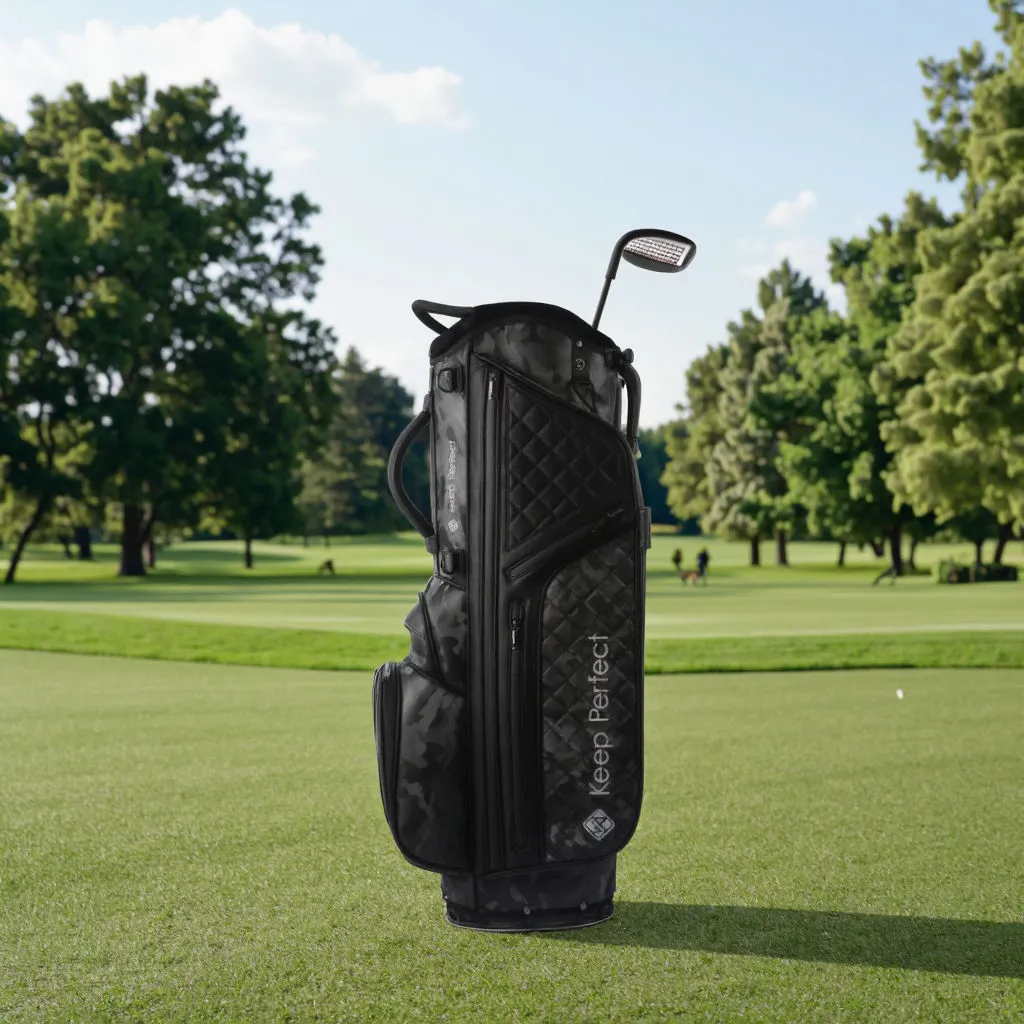
From a factory build standpoint, our dedicated waterproof stand bags page walks through the materials, hardware, and quality checks in detail.
Key takeaway: the material, the seam, and the zipper decide the claim
The phrase "water-resistant" means different things in different catalogs, and the difference is what destroys consumer trust. A material alone can be marketed as water-resistant while the assembled bag leaks at every seam and zipper. The whole point of this guide is to give the buyer the exact vocabulary and the exact test numbers needed so that a waterproof stand bag is judged on the assembly, not on a coating claim. Think of it as the material-layer view of the same package described in our waterproof stand bag guide, but focused on what happens at the fabric, seam, and zipper level.
Because weight is the biggest constraint on a walking bag, the material choice is never made in isolation. A heavier, tougher laminate buys abrasion resistance at the cost of carry weight; a light TPU coating protects the walking market but needs more care at the stress points. The right answer comes from matching the material system to the target player, then confirming each layer with a test. The sections below break the decision into fabric, seam, zipper, and opening choices, then show how to lock them in a spec table and a QC plan.
- TPU-coated nylon vs. laminated polyester vs. PU synthetic leather
- Hydrostatic head to ISO 811 and what the number really proves
- Why seam tape is the true guarantee of a dry bag
- The zipper and opening standards that close the leak paths
- Weight management and how to keep a walking line light
- How to brief the material system for OEM/ODM and test it
TPU-coated nylon vs. laminated polyester vs. PU synthetic leather
The material direction sets the weight, feel, and durability of the whole bag, and the waterproof claim is anchored in which construction you choose. TPU-coated nylon, typically in 200D-420D, is the most common waterproof choice for a walking line: it is light, softens the hand feel, and takes a clean coating that bonds well to seam tape. The trade-off is that the coating can be abraded on high-friction zones, so it is usually reinforced with heavier panels or a protective bottom plate at the stress points. Laminated polyester, by contrast, is stiffer and more abrasion-resistant than a coated nylon of the same weight, which makes it a strong option for a cart-allowed or tour-focused waterproof line where course toughness matters more than carrying a light bag.
PU synthetic leather is a third direction that looks premium in photographs but behaves differently under water. A PU shell is flexible and reads high-end, yet its water resistance lives in the PU film, and it must be paired with the same seam-taping and zipper protection as any other waterproof construction. The mistake to avoid is ordering a "premium" PU bag and assuming it is waterproof because the leather-like film sheds a sprinkle. Unless the spec names a hydrostatic head, seam-taping scope, and water-repellent zippers, the bag is only as waterproof as its weakest seam. Specify the exact denier, the coating or lamination, and the reinforcement panels, and confirm the feel on a physical swatch before you commit to a colorway.
Hydrostatic head: what the number proves about the fabric
The hydrostatic head is the water-column height in millimeters at which water pushes through the fabric, measured in the lab. A practical B2B target is 5,000-10,000 mm tested to ISO 811. The higher figure supports a heavy-rain or premium claim; the lower figure is a reasonable baseline for light-to-moderate rain. But the number proves only the fabric's resistance to water pressure on a flat sheet. It does not prove the assembled bag is dry, because a seam without tape, a standard zipper, or an unflapped pocket all leak regardless of how high the shell's hydrostatic head reads.
Treat the hydrostatic head as the qualification test for the material, and the assembly test as the qualification test for the claim. On the RFQ, name the method (ISO 811) and the acceptance level, because two suppliers can both print "10,000 mm" while their coating weight and denier behave differently in the field. The highest-value habit is to demand a laboratory report with the method and date attached, not a marketing bullet point, so every material lot is compared against the same standard.
Why seam tape is the true guarantee of a dry bag
Every stitch a sewing line runs through a waterproof fabric punches a needle hole straight through the coating, and water wicks into those holes. A fabric can be rated at 10,000 mm and still leak like a sieve along a seam with no tape. That is why seam tape is the single most important construction detail in a genuinely waterproof bag: it seals the needle holes on the critical seams so water cannot track inside. The critical seams are the main body seams, the pocket perimeters, and the shoulder-strap attachment zones, and the tape is typically a hot-melt or PU film applied at 18-25 mm width depending on the fabric and seam curvature.
The QC control is a peel-strength test plus a re-test after temperature cycling, because a tape that looks fine when new can lift after the bag is folded, packed, and carried in heat. Specify the tape type, the exact seam coverage list, and the re-test standard in the product spec, and verify the result on the waterproof sample before bulk. This detail, more than any single material, decides whether your "waterproof" bag earns the word in a downpour. It is also the layer most often under-specified in buyer briefs, which is exactly why it deserves the most attention at the sampling stage.

Zippers and openings: closing the last leak paths
Even a perfectly sealed shell is only as dry as the zippers and openings that let the user in. A standard zipper lets water pass through the teeth and the zipper tape, so a waterproof package uses water-repellent zippers on at least the critical pockets and the club compartment, and protects the highest-priority openings with a weather flap or a folded lip. The valuables pocket is the first place to prioritize, because phones, keys, and scorecards live there and a soaked valuables pocket is the fastest way to generate a return. Many programs specify a PVC-free water-repellent coating on the zipper and a fold-over flap on the valuables pocket as standard.
Water-repellent zippers are stiffer than standard ones, so the spec should include a zipper smoothness and cycle test to confirm the assembly does not jam after normal opening and closing. On a 14-way bag that is opened every round, a jamming waterproof zipper is a defect even though the bag stays dry. The opening test is a spray or rain simulation aimed directly at the pockets and zippers, checking that no water pools inside after repeated use. Lock the zipper standard, the flap construction, and the cycle target, and verify them on the sample so the openings do not become the one gap that sinks the whole claim.
Weight and the walking-line trade-off
The desire for a lightweight walking bag and the need for a waterproof package pull in opposite directions, and the buyer has to resolve the tension before the material is chosen. Waterproofing adds mass through the coating or lamination, the seam tape, and the heavier zippers, typically a 0.3-0.6 lb penalty over a non-waterproof carry bag of the same architecture. If the SKU is a true walking Sunday bag, the target often favors a lighter 200D TPU coating that clears the weight ceiling with a still-defensible hydrostatic head; if it is a cart-allowed or tour line, the buyer can afford the heavier, tougher laminate and the higher head.
The way to manage the trade-off is to set the weight ceiling first and choose the lightest material system that clears it, rather than letting the package drive an uncontrolled final weight. On the production sample, verify the weight tolerance alongside the waterproof tests, because a bag that is waterproof but mislabeled on weight fails a different trust test. A disciplined program sets one target that balances carry weight and dryness, and the SKU holds up under both the walk and the storm.
Specification table: what to lock on the RFQ
Use this table as the core of your waterproof material spec. Confirm each row on the pre-production sample and lock the values before bulk. The numbers reflect typical best practice for a waterproof stand bag program and the tolerances we hold at our SGS-verified Quanzhou plant (4,950 sqm, 7 lines, 149 machines, 137 staff).
| Parameter | Typical Spec | Buyer Notes |
|---|---|---|
| Target segment | Mid-tier / Premium | Define price positioning and target player. |
| Shell material | TPU-coated 200D/400D nylon or laminated 200D-420D polyester | Choose coated nylon for light walking weight, laminate for abrasion. |
| Hydrostatic head | ≥5,000-10,000 mm (ISO 811) | Name the method and acceptance on the RFQ. |
| Seam sealing scope | Critical seams taped, 18-25 mm tape | List body, pocket, and strap seams; define coverage. |
| Zippers | Water-repellent standard + protected openings | Add a zipper cycle test for bulk QC. |
| Target weight | 4.2-6.2 lbs | Set tolerance and confirm with samples. |
| Top divider | 4/5/6-way (optional full-length) | Confirm full-length tube requirement. |
| Abrasion target | ≥20,000 cycles (typical) | Match the segment; define the method. |
| Tear strength | Define min by fabric | Confirm for reinforcement panels. |
| Assembly test | No water ingress after deployment cycles | Spray/rain simulation + ingress check. |
How to brief the material system for OEM/ODM
The buyers that get a fast, accurate program send the material system as one coherent statement rather than a list of hopes. State the shell material and denier, the hydrostatic head target with method, the seam-taping scope, the zipper standard, the weight ceiling, the divider, and the accent materials for reinforcement panels and trims. At QUANZHOU JUNYUAN BAGS we run OEM (branding on proven waterproof architectures) and ODM (co-developing the shell, pockets, and hardware), and a clear material brief lets us quote and sample in the standard 10-20 days and move to bulk in 45-60 days.
Because waterproofing touches every seam and zipper, flag any functional customization early — a removable cooler sleeve, a rangefinder pocket, or a different weather-lip design — so the structure can be validated on the sealed shell before bulk. Adding a pocket after the seam-taping scope is locked can force a re-run of the waterproof tests. If you are also deciding between material families, the stand bag buying guide and the all-weather waterproofing article will help you weigh the trade-offs.
Test plan and acceptance criteria
Professional waterproof programs need test methods and pass/fail criteria, repeated at sample and bulk so the claim is reproducible run to run. Confirm these on the pre-production sample and lock them into the inspection plan. Around the waterproof core, add the mechanical tests that keep the bag functional through a season: stand deployment, base stability, zipper cycle, strap load, and a drop test on the packed carton.
- Hydrostatic head to ISO 811 against the locked target
- Seam tape adhesion / peel-strength check, re-tested after cycling
- Spray/rain simulation test for pockets and zippers, no ingress
- Water-ingress inspection after deployment cycles
- Zipper smoothness + cycle test (pull force and jam rate)
- Fabric abrasion and tear strength at reinforcement seams
- Stand deployment cycle and base stability check
These methods give a reorder or a new colorway a single auditable standard, preventing the drift that happens when a batch is approved by looks alone. The factory QC page shows how the checkpoints run on the line and at final inspection.
How the coating chemistry affects the material behavior
The coating is where waterproofing is actually won or lost at the material level, so the buyer should understand the two dominant approaches. A TPU (thermoplastic polyurethane) coating is applied as a film or a wet-applied layer that bonds tightly to the fabric, giving a soft hand, good flexibility, and strong seam-tape bonding. A PVC-based or PU coating, by contrast, can be heavier and stiffer, and PVC carries additional restricted-substance scrutiny in some markets. For a walking waterproof line, TPU is the usual baseline because it balances weight, flexibility, and bond quality; for a cart or tour line, a laminated film construction often adds abrasion resistance at the cost of some flexibility.
The buyer should specify the coating type, the coating weight in grams per square meter (gsm) or the laminated film, and the accept/reject criteria on the swatch before a colorway is locked. A common B2B starting target is a coating weight in the range that supports the hydrostatic-head goal without adding excessive stiffness — the exact gsm depends on the denier and the yarn construction. Confirm the hand feel, the flexibility at the seams, and the coating adhesion to seam tape on the physical sample, because a coating that looks waterproof on paper can crack at the bend lines or fail to bond the tape over a curved pocket, and neither failure shows up in a hydrostatic-head report alone.
There is also a color and finish interaction worth planning for. Matte and textured finishes tend to hide minor abrasion and fingerprinting better than a high-gloss shell, and a darker hero colorway reads as more premium while a light colorway shows soiling sooner in the course environment. If the market is a wet coastal region, a textured or anti-glare finish also helps the bag read well in bright, reflective light. Weigh the finish against the target player and the retail photography, because the finish is part of the material system and is specified just as deliberately as the coating.
Sample-run and bulk consistency for the material system
A material system that performs on one sample is worthless if it drifts between production lots. The three risk points are the coating batch, the fabric dye lot, and the seam-tape lot, and each should be confirmed on bulk before the container ships. For the coating, require a test certificate with the method and the lot number, and spot-check the hydrostatic head and the coating adhesion on the first bulk pieces. For the color, require a dye-lot approval against the sales sample so a new lot does not shift the shade mid-production. For the seam tape, confirm the peel strength on the actual bulk fabric, because a tape that bonds to one coating can lift on a different supplier's lot.
The discipline pays off in reorders. Once the material system is locked and the certificates are on file, a second colorway or a reorder is a repeatable build rather than a fresh negotiation, and the waterproof claim stays auditable run to run because every lot is measured against the same method. This is exactly how mature programs avoid the surprise of a batch that passed a visual check but failed in the field. Keep a swatch and the certificate set with each order, and the buyer always has the evidence to defend the claim and to manage the factory on the next lot.
Recommended reading and links
This article covers the material layer; for the full procurement framework and the seam-tape engineering detail, the related pieces below take you deeper into the same package.
- Waterproof Golf Stand Bag Guide
- How to Specify a Waterproof Package
- Tour Waterproof Products
- OEM/ODM Service
- Factory & QC
- Golf Stand Bag Buying Guide
Two practical notes for the B2B team. First, order a small run-down of the waterproof sample before a full container so you can photograph the real fabric hand, the sealed seams, and the weight on the production silhouette for your retailers. Second, keep the core material and testing spec identical across colorways and across the whole bag line, because manufacturers quote more efficiently and the waterproof claim stays auditable when the framework is repeatable. Reach us at service@junyuanbags.com or +86 17750020688 and we will confirm the material and seam package against your weight target.
FAQ
Is TPU-coated nylon or laminated polyester better for a waterproof stand bag?
TPU-coated nylon usually wins on low weight and a soft hand, while a laminated polyester shell is stiffer and more abrasion-resistant; the best choice depends on whether the priority is walking weight or course toughness.
What hydrostatic head makes a fabric genuinely waterproof?
Most B2B programs target 5,000-10,000 mm tested to ISO 811; the higher end suits heavy-rain claims, but the seams and zippers still decide whether the assembled bag actually stays dry.
Why do needle holes make even a waterproof fabric leak?
Every stitch punches a hole through the coating, and water wicks into those holes. Seam tape seals them, which is why critical seams are taped on a genuinely waterproof bag.
Do waterproof zippers perform exactly like standard ones?
Water-repellent zippers are stiffer and need a cycle test to confirm they do not jam after normal use; protected openings and weather lips add further defense.
Which material is best for golf stand bags overall?
It depends on positioning. Nylon and polyester are common for lightweight lines, PU synthetic leather is popular for premium look, and TPU-coated or laminated fabrics are used for waterproof programs.
What is the fastest way to get an accurate quote?
Send a short spec: bag type, material direction, divider (4/5/6/14-way), pocket list, logo method, target MOQ, timeline, and reference photos or a tech pack.
Request a B2B quote for golf stand bags
Send your target market, expected MOQ, and reference photos. We respond within 24 hours with a sampling plan.