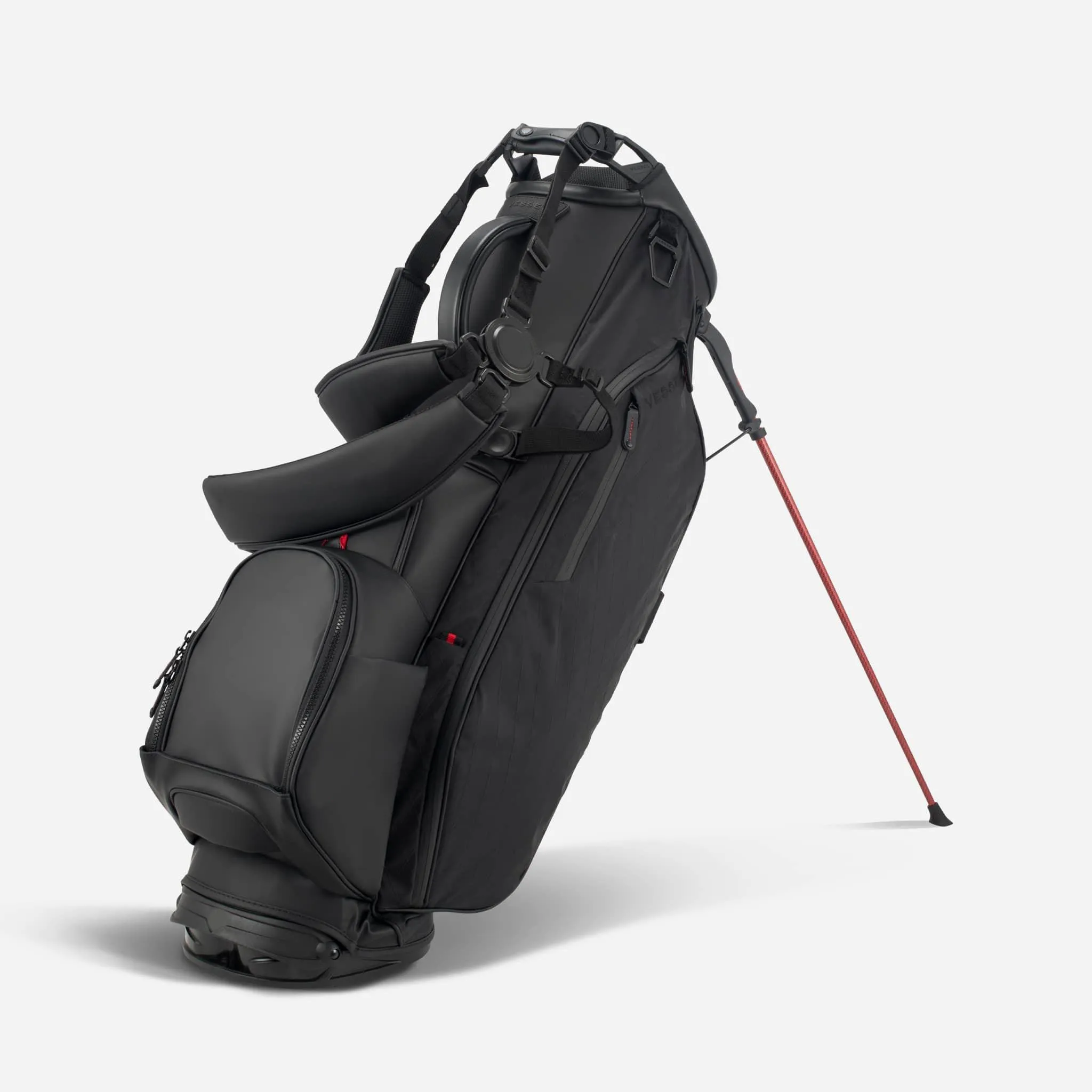
For a featherweight minimal carry, explore our Sunday bags — For a B2B buyer, the divider layout is the single biggest functional differentiator on a golf stand bag: a 14-way top gives every club its own full-length slot and cuts shaft tangling dramatically, but it adds roughly 0.5-0.8 lb and a small per-unit cost over a 6-way layout, while a conventional 6-way still separates the bag into six compartments at a lighter carry weight. This guide compares 14-way versus 6-way divider stand bags on the numbers that matter — divider count, tube thickness, stand angle, club access, weight, and COGS — so you can spec the right architecture for premium, mid-tier, and lightweight SKUs.
Key Takeaways before you brief the factory
Before you compare dividers, anchor on the three decisions that actually move the product: how many clubs you expect a player to carry at once, how much the total bag may weigh, and whether the buyer prioritizes organization or the lightest carry. A 14-way organizer serves the player who carries a full 14-club set and wants each club reachable without looking; a 6-way (or 4-way) serves the walker who wants a lighter, mechanically simpler bag. Write those two answers into the tech pack before the factory samples, because divider choice ripples into the top collar, the tube set, the stand hinge, and the weight target all at once.
The retail side matters too. In e-commerce photography, a 14-way slot layout reads as "premium" and justifies a higher price band, while a 6-way is the volume workhorse. But the manufacturing difference is not branding — it is real parts and real labor. Every added divider tube is a component to source, a seam to sew, and a QC point to hold, so the COGS gap between a 6-way and a 14-way is a repeatable, structural number rather than a marketing choice. Understanding that number is what keeps your margin while you decide which layout to feature in which SKU.
- 14-way: full club separation, premium positioning, +0.5-0.8 lb and small COGS increase
- 6-way: balanced separation and weight, the mid-tier workhorse
- 4-way: lightest and simplest, for walking-first lightweight SKUs
- Divider tube wall (1.5-2.5 mm) and full-length coverage decide durability
- Stand angle (roughly 10-18°) and leg spread interact with top weight
What the divider count actually controls
The divider count is not a cosmetic hole pattern on the top; it defines how the entire top assembly is engineered and sewn. A standard 4-way stands as the baseline: four full-length compartments that separate woods, long irons, mid irons, and wedges. It is the lightest layout, the simplest to sew, and the most cost-efficient, which is why value and lightweight Sunday bags default to it. A 6-way keeps six compartments with a similar full-length tube set, adding a dedicated putter or a better wood iron split while staying close to the 4-way in weight and cost. A 14-way delivers fully separated individual slots, usually fourteen, with each club sliding into its own tube so no two shafts touch on the way in or out.
The consequence of that count is felt in three places every time the bag is used: the ease of replacing a club without looking, the weight over the shoulder, and the number of parts the factory has to hold in tolerances. On the 14-way, a player can return any club to its slot one-handed with confidence because the dividers guide the shaft; on a 4-way, a full set shares four tubes so shafts rub and the player often has to glance to untangle grips. For a brand targeting serious players and staff-bag-grade organization, that access difference is the entire value story. For a brand targeting the lightweight walking market, the 4- or 6-way's lower top weight and simpler construction are the selling point. Neither is universally better; each serves a distinct buyer.
Divider tube wall thickness and full-length dividers
The material and construction of the dividers matter more to long-term durability than the hole count. Rigid full-length dividers are typically formed from PET or fiberglass rods with a fabric sleeve, and a common wall thickness runs about 1.5-2.5 mm depending on whether the tube is a load-bearing divider or a soft drop-in liner. Full-length dividers run the depth of the bag so a club shaft is guided from the top collar all the way down, which prevents the divider from collapsing toward the bottom where bags flex the most. Soft, partial dividers stop near the top, so the shaft can drift and tangle lower in the bag — a frequent source of the complaint "the divider is useless by season two."
When you brief the factory, specify divider material, wall thickness, and whether the separation is full-length. Ask the factory to confirm the tube stays rigid through a compression test at the base of the bag and through the packed drop test, because a thin or soft divider is the first component to deform under a full 14-club set carried on carts and stair-rails. In our experience across the lines, buyers who lock the divider spec in the tech pack avoid most mid-season durability returns, while buyers who leave it open get whatever the seam room had on hand. The divider is a five-minute conversation at sampling and a season-long quality commitment after.
Stand angle geometry and how the top weight interacts
The stand system is where the divider choice and the bag physics meet. A stand bag's legs deploy from a hinge block near the bottom and spread to stable positions, and the deployment angle — commonly in the range of roughly 10-18° from vertical, with leg spread tuned so the bag stays upright on uneven ground — is a function of base width, hinge build, and how the weight sits. A heavier 14-way top and a full club set shift the center of gravity higher, so the hinge block and base geometry must be engineered to keep the bag from tipping when the top-heavy organizer sits on a slope. A lighter 4- or 6-way bag carries its weight lower and needs less aggressive base tuning.
The practical test is a loaded stability check: place the bag with a full set and a push-pull on the handle at the top, then confirm it holds its angle without the legs folding or the bag rocking off-center. Buyers should ask for the stand deployment cycle target (often in the 3,000-10,000 range) and a defined failure criterion, plus a compatibility note that the stand is tested with the heaviest top in the range. If a 14-way top is planned, the factory should validate the hinge and base with that heavier configuration, not with a 4-way prototype. Spec-writing the stand with the divider layout together is what prevents the embarrassing retail failure of a premium 14-way bag that falls over on the practice green.
Club access: pull and return ergonomics in practice
Club access is the divider attribute players feel every single round, and it is measurable. Fully separated 14-way slots let a player pull any club and drop it back without brushing neighboring shafts, which removes the friction and grip-lock that dominate a 4- or 6-way layout. In a simple access test, a fully separated 14-way stays tangle-free across a full set because each slot is dedicated; a shared 4-way tube requires the player to arrange clubs or tug through partial tangling. That is the real advantage premium buyers pay for, and it is why staff bags and high-end stand bags consistently land on 14-way.
But access has a cost that walkers notice: a 14-way's larger collar and tube set can make the bag heavier and slightly bulkier at the top, and the individual slots can feel cramped for oversized grips or an unusual club mix. If your market is a wide range of grip sizes or a player who carries more than one putter, an elongated 14-way with a dedicated putter well is the standard fix. For the value-conscious walker, a well-chosen 6-way balances a comfortable opening and lighter weight while still separating the set into logical groups. The brand decision is whether your buyer would rather pull an exact club blindly (14-way) or carry a lighter, simpler bag (6-way).
Weight and materials trade-off between divider layouts
Weight is the other half of the divider decision, and the difference is structural, not marketing. A lightweight 4-way or 6-way top and tube set typically lands a total bag in the 4.2-5.0 lb range when paired with light fabrics and aluminum legs, which is what walking-first buyers want. Adding fourteen individual full-length tubes, a reinforced collar, the putter well, and the extra divider rails pushes the top assembly toward roughly 0.5-0.8 lb heavier, moving an otherwise-lightweight bag to the 5.0-5.8 lb range. If a 14-way is mandatory but a light target is also required, the factory must pull weight from elsewhere — thinner liner, single-wall pocket fabric, minimized hardware — and every one of those choices affects durability and cost.
Set a weight target with a tolerance in the tech pack, then confirm it on the production sample, because gram-level claims drift between prototype and bulk. Ask the factory to weigh the bag empty (without clubs) and with the target divider option, and to record the delta so you can compare layouts objectively. Materials follow: a 14-way needs stiffer, more expensive tube material to hold its shape, while a 6-way can use a lighter reel. This is the moment to balance the three constraints at once — access, weight, and durability — and the factory that can show you the same shell built two ways is proving it controls its process rather than quoting from a price list.
Divider layout comparison table
Use this table as your internal spec anchor when comparing divider architectures. Confirm each value on the pre-production sample before bulk.
| Parameter | 4-Way | 6-Way | 14-Way |
|---|---|---|---|
| Divider compartments | 4 full-length | 6 full-length | 14 individual slots (+ optional putter well) |
| Typical top weight add | Baseline (lightest) | +0.1-0.3 lb | +0.5-0.8 lb vs 4-way |
| Divider tube wall | 1.5-2.0 mm PET | 1.5-2.2 mm PET | 2.0-2.5 mm PET/fiberglass |
| Full-length coverage | Yes | Yes | Yes (required to stop tangling) |
| Club access | Shared tubes, some tangling | Logical groups, low tangling | Dedicated slots, tangle-free one-hand return |
| Stand interaction | Low top weight, simple base | Balanced, standard base | Higher CG, reinforced hinge/base tuning |
| COGS impact | Baseline | Low | Moderate (more tubes + labor) |
| Best-fit SKU | Lightweight value | Mid-tier workhorse | Premium organizer / team program |
A common way to read this table: the 6-way is the safest default for a brand that wants one strong mid-tier SKU, because it delivers meaningful separation and a reasonable weight and cost. Add a 14-way premium tier only if the retail price band and buyer profile justify the added weight and COGS. Keep a 4-way lightweight value entry if your catalog needs a lowest-price, walker-first option.
When 14-way wins: premium, team, and staff programs
The 14-way organizer shines for the buyer who values exact club protection and effortless access over every ounce. Collegiate teams, staff bags, and premium retail lines all lean on 14-way because the players and pro-shop staff constantly swap clubs, and a tangle-free, one-handed return saves seconds per change while protecting shafts. For these programs the added top weight is a non-issue; what matters is that the 14-way top holds its shape under heavy daily use and keeps every club in its own slot. A putter well, an elongated slot for longer irons, and reinforced divider tubes become the buying criteria rather than optional extras.
For a brand program, the 14-way also photographs better in a premium stance and gives the copywriter a concrete story — "each club has its own slot" is a headline a retailer can sell. On the manufacturing side, a 14-way program is where a factory's engineering depth shows, because it must source the right tube set, tune the collar, reinforce the collar-to-body seam, and validate the stand with a heavier top. If you are building a hero SKU, ask the factory for its 14-way divider QC gate: divider rigidity test, top collar seam strength, and a loaded stability check. A factory that can run these on a 14-way is signaling it understands the product beyond the catalog page.
When 6-way is the workhorse
The 6-way holds the broad middle of the market because it satisfies most players most of the time. It separates the set into six logical compartments — woods, long mid irons, short irons, wedges, a putter-ish slot, and a gear section — without the weight or cost premium of a 14-way. For a distributor building a three-SKU catalog, the 6-way is the dependable volume model that converts both walking players and occasional riders. Its lighter top also pairs naturally with the lightweight stand bags that dominate entry-and-mid-tier retail, and it keeps the stand system simple because the center of gravity stays lower.
From a sourcing standpoint, the 6-way is the easier program to hold in bulk: fewer tubes, a simpler collar, and a lighter sew time mean lower per-unit cost and fewer QC surprises across a container. It is also the most forgiving when a buyer is new to a market and not yet sure which divider detail will sell. If you outsource a mid-tier range, making the 6-way your cornerstone keeps your MOQ manageable (often near 200 pieces per style and colorway with a 100-piece test order) and your QC focus concentrated. You can then add a 14-way premium entry only when the retail data shows the buyer is ready to pay for the upgrade.
Factory construction: why divider spec is a QC gate
The divider is one of the most QC-sensitive components on a stand bag because it is hidden inside the bag and its failure is only discovered in use. Common failure modes include divider tube collapse near the base, a top collar seam tearing under the load of a full set, misaligned slots that jam a shaft, and tube wear that produces noise. Each maps to a concrete control: specify the wall thickness and full-length coverage, test the collar-to-body seam under load, run a club-insert-and-remove cycle, and inspect the divider alignment in the final goods. A factory that lists these as gates rather than as a shopping-room afterthought will deliver a divider that survives a season.
The QC message for buyers is to put the divider tests in the same contract as the shell tests. Instead of only a fabric and zipper standard, add a divider rigidity test, a collar-seam load test, a full-club-set access cycle, and a packed drop test that includes the divider layout you plan to ship. In the final inspection, walk the random sample with a ruler and confirm slot alignment and tube stand against the approved master. In our verified affiliated plant we hold these on the 6-way and 14-way programs alike, because the divider is where a "premium" claim either holds or collapses — literally. Locking it in writing is what turns a good sample into a reliable reorder.
COGS impact of divider choice
Cost follows the parts. A 4- or 6-way shares a lighter, cheaper tube set and a simpler collar, so the divider portion of COGS stays modest. Moving to 14-way adds more individual tubes, a reinforced collar plate, additional divider rails, a putter well, and extra sewing labor at the top — typically a small but real percentage added to unit cost, concentrated in the top-assembly step. For a price-sensitive retail band, that margin on every unit matters across a container, so the COGS table should be part of the negotiation, not discovered after sampling.
Compensate for the 14-way cost by specifying the exact top complexity you need: decide whether the putter well is required, whether all fourteen slots need full-length rigidity or only the woods do, and whether an oversized-grip slot is worth the tooling. Every simplification that players will not notice is margin you keep. Conversely, if you are building a premium 14-way, do not under-spec the tubes to save pennies, because a collapsing divider will be returned at a far higher cost than the saved material. The right COGS conversation is a trade, not a cut — spend on what the buyer feels, cut where they will not.
OEM and ODM options for both divider types
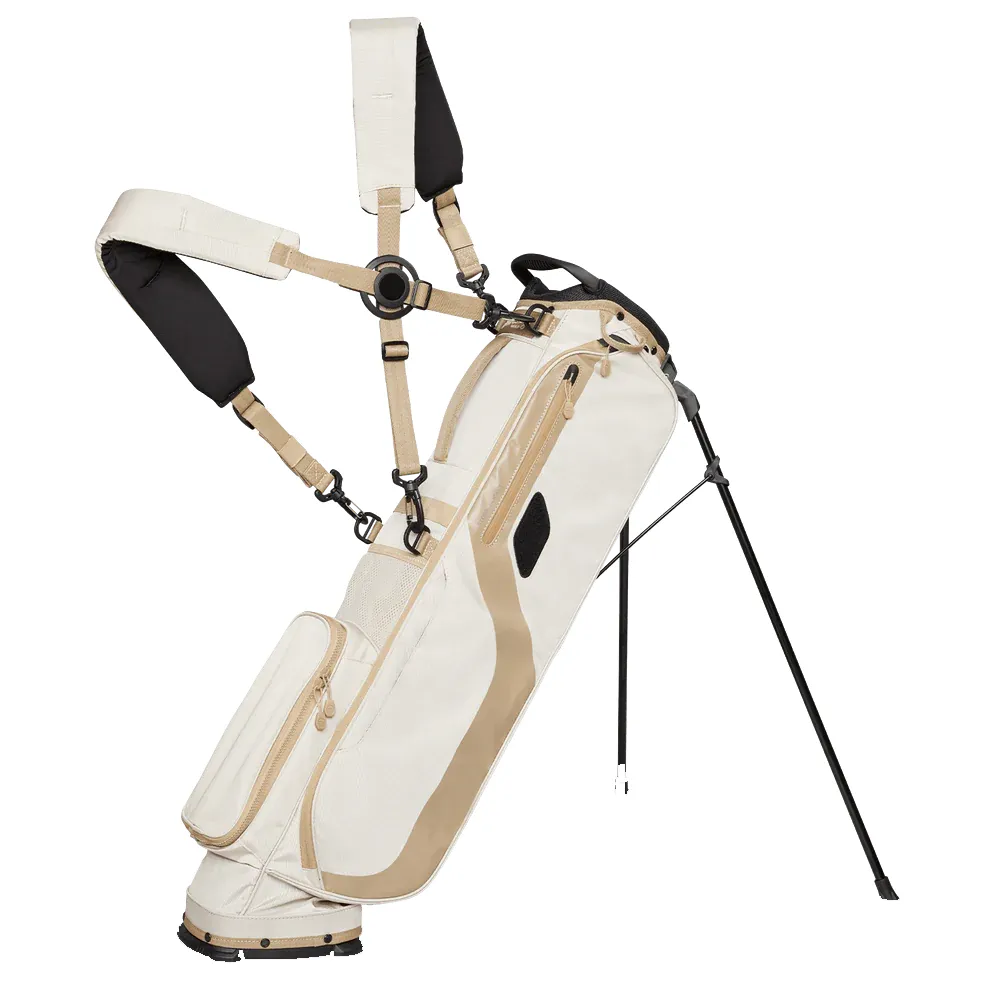
Both divider architectures are fully available in OEM and ODM programs. On the OEM side, we reproduce your branding on proven 6-way and 14-way architectures, so you get a reliable divider layout and its tested stand and pocket system without re-engineering the structure. This is the fast, lower-risk path for a retailer or new brand that wants a 6-way workhorse or a 14-way organizer with its own logo, colorway, and labeling, on a sensible MOQ and a shorter lead time.
On the ODM side, we co-develop the divider layout with you — the exact slot count, a custom putter well, a deeper or angled top collar, a specific divider material, and a stand tuned to the heavier top. ODM suits a brand that wants a differentiated access story, such as a widened main slot for mid-size grips or a reinforced 14-way that holds under team-cart abuse. Whichever route you choose, share your target market, expected MOQ, and a reference or a simple tech pack so the factory can quote the correct divider spec. Reach us at service@junyuanbags.com or +86 17750020688 with your market and quantity to start the sampling conversation.
Recommended Internal Links
- Products (Stand Bag Architectures)
- OEM/ODM Service
- Factory & QC
- Golf Stand Bag Buying Guide
- Stand Bag Materials Guide
- How to Choose a Golf Stand Bag
- 14-way stand bag
FAQ
Is a 14-way divider bag better than a 6-way divider bag?
A 14-way gives each club its own full-length slot so grips never tangle and you can pull or return any club one-handed. A 6-way separates the bag into six compartments at a lower top weight, making it the better carry choice for walkers. "Better" depends on whether you prioritize organization or the lightest carry.
How much weight does a 14-way top add compared to a 6-way?
A 14-way top and full-length tube assembly typically adds roughly 0.5-0.8 lb over an equivalent 6-way layout because of more individual tubes, a reinforced collar, and more divider rails. On a bag targeting 4.2-5.0 lb total, that margin is meaningful for walking-first buyers.
Do 14-way dividers really stop club shafts from tangling?
Yes, when the dividers are full-length and rigid. Fully separated 14-way slots reduce shaft-to-shaft friction and grip locking versus a 4- or 6-way layout. The benefit depends on divider material and full-length coverage, not just the hole count in the top.
What is the typical MOQ for a custom 14-way or 6-way stand bag?
A conventional order is around 200 pieces per style and colorway, with a test order of about 100 pieces to validate the divider layout and stand feel before committing. Divider complexity can raise the per-style MOQ, so confirm the exact number for the configuration you plan.
Which divider layout is cheapest to produce?
A 4-way or standard 6-way full-length layout is cheapest because it uses fewer tubes, a simpler collar, and less sewing at the top. A 14-way raises cost through more divider tubes, a reinforced collar, a putter well, and extra labor, typically adding a small percentage to unit cost.
Can I get both a 14-way top and a lightweight stand bag?
Yes, but there is a trade-off. To hold a 14-way top near a lightweight target you must cut weight elsewhere — thinner liner, single-wall pocket fabric, aluminum legs, and simplified hardware. Confirm the exact target weight and tolerance with the factory before sampling.
What divider material should a factory use for durability?
Rigid full-length dividers are typically PET or fiberglass rods of about 1.5-2.5 mm wall with a fabric sleeve, keeping their shape under repeated insertion and preventing tube collapse. Ask for the divider material, wall thickness, and full-length coverage in your tech pack.
Request a B2B quote for golf stand bags
Send your target market, expected MOQ, and reference photos. We respond within 24 hours with a sampling plan.