For a B2B buyer speccing a golf stand bag, weight is a position, not a fixed number: a walking stand bag comfortable for 18 holes typically lands around 4-5 lb, a premium ultra-light build can drop toward 3.5 lb, and a heavy-duty or 14-way organizer reaches 5-6.5 lb, with the deck built by dividers, pockets, and stress-point reinforcement. This guide breaks down where each gram goes, how to set a weight target and tolerance, and how to choose the lightweight or heavy-duty build that matches the load and the buyer, without under-building durability. We build both at QUANZHOU JUNYUAN BAGS, an SGS-verified affiliated plant in Quanzhou (4,950 sqm, 7 lines, 149 machines, 137 staff), and explain the engineering that keeps a light bag stable and a durable bag honest.
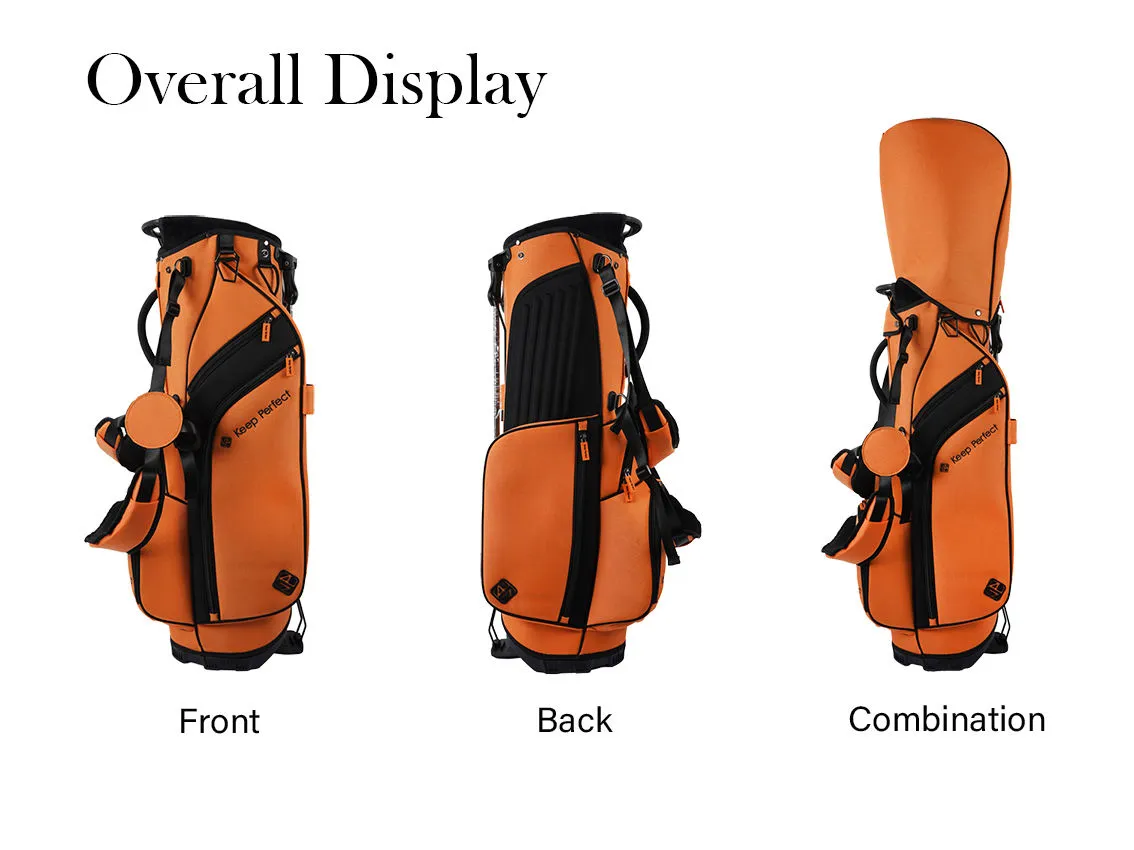
From a factory build standpoint, our dedicated ultralight stand bags page walks through the materials, hardware, and quality checks in detail.
Why Weight Is a Position, Not a Single Target
There is no universal "best" stand-bag weight because weight is a trade, not a goal. Every gram you add buys something: a stronger shell, a full-length divider, an extra pocket, a more stable base. And every gram you strip gives back something else: comfort on the shoulder but less pocket capacity, a lighter feel but a bag that tips more easily on uneven turf. The right weight is the one that matches the load the bag actually carries and the way the player uses it — a walker with fourteen clubs and a full pocket stack needs a different bag than a minimalist carrying half a set for nine holes.
The manufacturing discipline is to define weight by function: state the intended bag load, the round length, and the weather, then let those define the shell, the dividers, and the pockets. If you start from a raw number — "make it as light as possible" — you risk a bag that feels nice empty but sags or tips under a real load. If you start from the load, you arrive at a defensible weight that is light enough to carry and strong enough to last, which is what keeps warranty calls low and retailers happy.
The Weight Bands: Where Each Type Sits
In practice, stand bags sort into recognizable weight bands. An ultra-light walking bag is typically under 4 lb and approaches 3.5 lb with an open-weight shell, a 4-way top, minimal pockets, and a thin stand mechanism. A standard lightweight walking bag sits around 4-5 lb, which is the comfortable sweet spot for most walkers carrying a full set. A heavy-duty or 14-way organizer build runs 5-6.5 lb, trading lightness for full-length dividers, a bigger pocket stack, and heavier reinforcement at the hinge, base, and strap anchors.
That 1.5-2 lb spread between a 3.5 lb ultra-light and a 5.5 lb heavy-duty does not look like much on paper, but on the shoulder over eighteen holes it is the difference between an effortless round and a sore neck. The buyer's decision is which band the customer needs, and the SKU should be named honestly — "ultra-light walker," "standard walker," "heavy-duty organizer" — so the catalog positions each band clearly instead of blurring them into one blurry "light" claim.
Weight Band Comparison
| Band | Typical Weight | Divider / Pockets | Best-Fit Use | Key Trade-Off |
|---|---|---|---|---|
| Ultra-light walker | Under 4 lb (to ~3.5 lb) | 4-way top, minimal pockets | Walkers, minimalists, short rounds | Least capacity, most walkable |
| Standard lightweight | 4-5 lb | 5/6-way, moderate pockets | Most walkers with a full set | Balanced comfort and capacity |
| Heavy-duty / 14-way | 5-6.5 lb | 14-way full-length, full pockets | Organization-first, cart-assisted | Most durable and organized, heaviest |
Use this banding to brief the factory. If you say "lightweight," specify the band and the target; if you say "heavy-duty," confirm the divider system and pocket count. The banding also protects against scope drift — a buyer who asks for "lightweight" but then adds a 14-way top, a cooler pocket, and four accessory pockets ends up with a 6 lb bag that sits awkwardly between bands. Lock the band first, then the features within it.
Where the Weight Goes: The Anatomy of a Stand Bag
To control weight you have to know where it lives. On a typical stand bag the shell fabric (a 600D nylon or 400D polyester) is only part of the story; the stand mechanism — legs, hinge block, and base plate — can be a pound or more by itself because the hinge and base must survive thousands of deployment cycles. The dual carrying straps with foam padding and bar-tacked anchors add weight, and every pocket contributes shell area, lining, zippers, and pulls. A 14-way full-length divider system is notably heavier than a simple 4-way top because each tube and its lining add material.
The practical lever is to say where the weight is acceptable and where it is not. For a walker, the weight on the shoulders is what matters, so you keep the shell, straps, and top light; the stand mechanism is unavoidable but can be slimmed with an aluminum-leg design. For a heavy-duty bag, the weight is fine because a cart carries it, so you spend it on a 14-way system, a full pocket stack, and a heavily reinforced base. Direct the grams at the zones the buyer cares about, and both bands stay honest.
Lightweight Build: How to Trim Without Losing Stability
Building a lightweight stand bag is a discipline of subtraction done carefully. You pick a lighter shell — an open-weight 300D-400D nylon — and cut the lining back in low-stress areas. You use a 4-way or 5-way top instead of a full 14-way set. You trim the pocket stack to a valuables pocket, a ball pocket, and a rangefinder slot. And you spec a slim stand mechanism, often with aluminum legs and a lightweight hinge, so the bag still stands on the course without the weight of a heavy-duty base.
The trap is lightening the wrong thing. A bag that loses weight by starving the hinge, the base, or the strap anchors will tip on the fairway or fail at the anchor long before its light shell gives out. So the rule for a light build is to spend the saved grams on the zones that take load — reinforce the hinge block, the base plate, and the strap anchors — and strip weight only from the shell and the pocket stack. The result is a 4 lb bag that stands straight and carries safely, not a featherweight that fails where it matters.
Heavy-Duty and 14-Way Organizer: Why the Weight Is Worth It
A heavy-duty or 14-way organizer earns its 5-6.5 lb by delivering two things a light bag cannot: full club organization and durable construction. A 14-way full-length divider system keeps every club separate so heads do not bang and shafts do not tangle, which club players pay for. The heavier build also carries a full pocket stack — apparel, insulated cooler, umbrella holder, glove, ball, and a rangefinder slot — because the rider or the caddie handles the weight, not the walker's shoulder.
The durability payoff is real. With more weight budget, you can use a heavier shell, full-length reinforced panels around the hinge and straps, and a thicker base. That is why a heavy-duty bag tends to be the longest-lived in a fleet and why it suits cart-heavy markets, club players, and buyers who want one durable bag for years rather than a light one they replace. If the buyer values organization and longevity over shoulder comfort, the heavy-duty band is the honest spec.
How to Set a Weight Target and Tolerance
Setting a weight spec is a two-part task: pick the target band, then lock a measurable value and a tolerance. Define the intended load (full set or half set), the round length, and the weather, choose the band that fits, and write the target as a single number — for example "5.2 lb plus or minus 0.2 lb." The tolerance matters because production weight drifts with colorway (a heavier dye or a different lining adds grams) and with component lots, so a plus-or-minus 0.2 lb window keeps the build within range without arguing over grams on every sample.
Weigh the bag empty, dry, with no clubs or accessories, on a calibrated scale, and confirm it on the pre-production sample. If the delivered weight is drifting outside the tolerance, the cause is usually a material or component substitution — a heavier zipper, a thicker padded strap, a denser lining — so track the weight at the sample stage and flag any component change that moves it. A locked weight spec with a tolerance prevents the classic failure of a bag that "feels heavy" in the catalog because a substitutution added half a pound.
Materials That Control Lightness and Durability
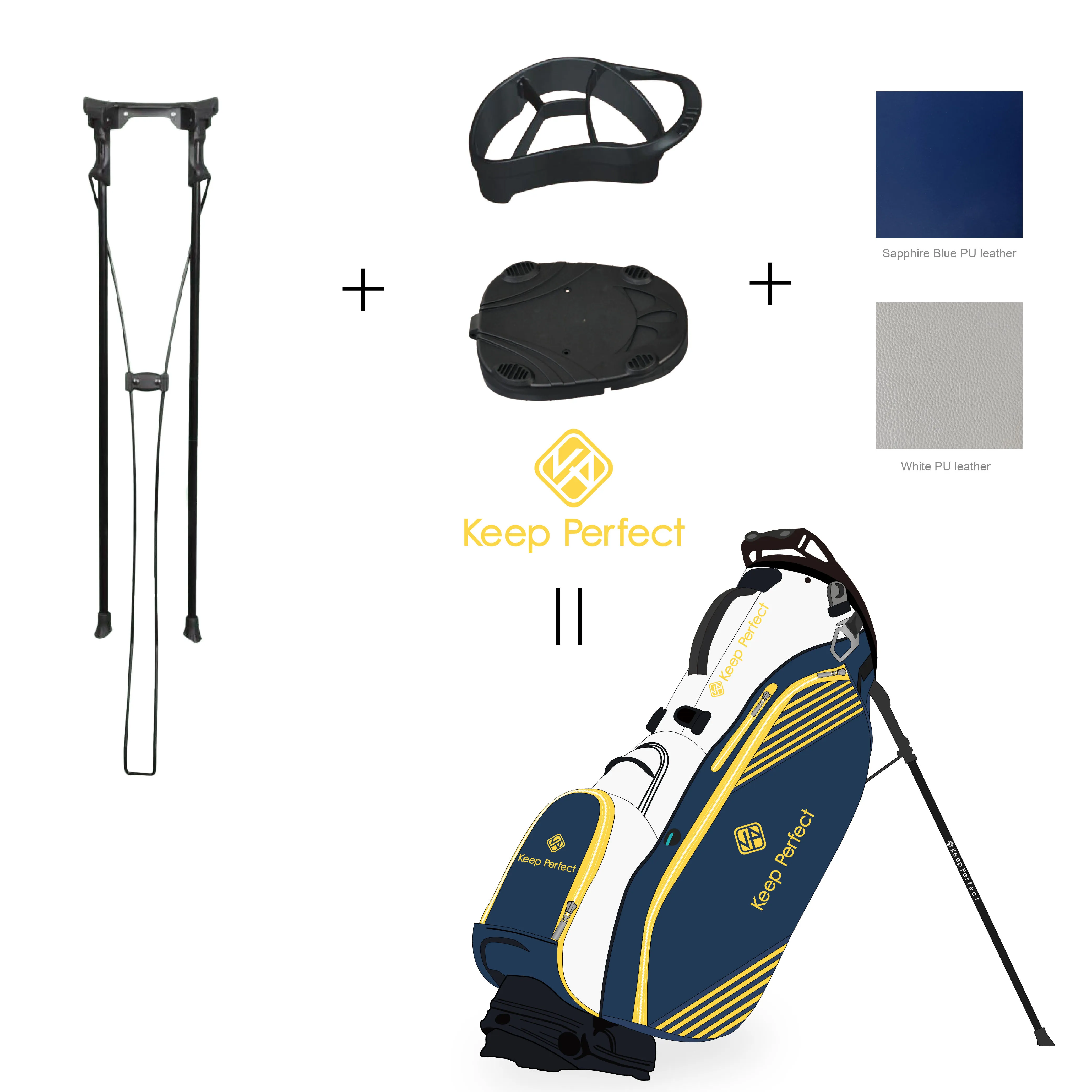
Material is the main lever for moving weight without breaking the bag. For a light build, an open-weight 300D-400D nylon or a lightweight polyester cuts grams while a targeted heavier reinforcement keeps the hinge and straps strong. For a heavy-duty build, a full 600D or higher shell and a denser lining trade a bit more weight for abrasion resistance and structure. TPU coatings add weather protection to either but add some weight and stiffness, so a waterproof bag lands at the heavier end of its band.
The insight for buyers is to specify material by function, not by a single label. Saying "lightweight nylon" is not a spec; saying "300D nylon shell with 600D reinforcement at the hinge, base, and strap anchors, 4-way top, three pockets" is. That level of detail lets the factory weigh the build accurately and quote honestly, and it prevents the common error of copying one material call-out across a lightweight line and a heavy-duty line that need different reinforcement. Put the denier, finish, and reinforcement zones in the spec and the weight takes care of itself.
Testing for Stability, Durability, and Load
- Stand deployment and base-stability cycle test (target cycles plus failure criteria).
- Strap-anchor static-load test so the carry straps survive full-round load.
- Weight check on the empty bag against the locked target plus or minus 0.2 lb.
- Pocket and zipper cycle test on the high-use openings.
- Packed-carton drop test sized for the lightweight or heavy-duty carton.
The failure modes differ by band. A too-light bag typically fails by tipping on the course, flexing under a heavy load, or wearing out its strap anchor; a heavy-duty bag more often fails at the pocket seams or the base in transit. Build the test plan around the band's real use. A lightweight bag still needs a static-load strap test even though it is light — it gets swung and set down hard every round — and a heavy-duty bag needs a base-transit check because its heavier shell can deform in a packed carton.
Choosing the Right Weight Band for Your Line
Settle the weight question with the load and the buyer in mind: who carries the bag, and how much is in it? A walker with a full set on eighteen holes wants the standard 4-5 lb band with sensible pockets and a stable stand. A minimalist or a junior playing half a set on nine holes can use an ultra-light build toward 3.5 lb. A cart-hungry, organization-first buyer wants the heavy-duty 14-way band for the dividers and the durable build. Name the band, set the target and tolerance, and brief the factory with the material and reinforcement that match.
For related guidance see the stand bag vs carry bag comparison for the ultra-light end, the stand vs cart comparison for the heavy end, and the bag architectures on offer. Review our factory QC process, consult the buying guide, or start a lightweight or heavy-duty program through our OEM/ODM service with a weight target and a load brief.
Cost and Freight: Lighter Versus Heavier in the Ledger
The weight band also shows up in the costing and shipping ledger in ways that are easy to overlook. A lightweight bag often uses a thinner shell and fewer pockets, so its unit cost can sit slightly below a comparable heavier build, but the saving is offset by the expense of a quality slim stand mechanism — aluminum legs and a well-made hinge are not cheap. A heavy-duty bag spends its cost on the 14-way divider system and the larger pocket stack, not on the weight itself. The honest planning view is that weight does not directly drive price; the features behind the weight do.
Freight is where the band difference is clearest. A lightweight bag packs tighter and lighter, so you fit more units per container and the per-unit landed cost drops — which is why value-priced and first-import programs often start with a light bag. A heavy-duty bag's larger carton takes more space and weight in a container, so freight is a bigger share of its landed cost, which matters if your margin is tight on a big cart-bag order. Quote both bands with their packed dimensions and weights up front so your total landed-cost math is right before you commit to a container mix.
Sourcing Signals: Capacity, Audit, and Support
Weight is not the only thing to verify; the capacity and the sourcing story behind the build matter too. Our affiliated plant is SGS-verified (March 2026, 4,950 sqm, 7 lines, 149 machines, 137 staff), with a monthly production capacity near 200,000 pieces and current monthly output around 150,000, and a trade-experienced export record across 200+ brands and 100+ countries. That capacity and audit trail matter when a lightweight line and a heavy-duty line run in the same season, because you want a partner who can hold a consistent weight and QC standard across multiple SKUs at once.
For a buyer planning a fleet, ask the factory how it keeps a light bag honest and a heavy bag durable in the same program, and how it holds the weight spec through a colorway or a component change. Then set your own checkpoints: a sealed weight and material record per SKU, a first-article weight check on run one, and an inline finish inspection during bulk. With the weight band, the target, and the QC locked, you get a repeatable line whether you ship an ultra-light walker or a 14-way heavy-duty organizer, and you can tell your retailers exactly what each bag weighs and why it is built that way.
One more note for catalogs: publish the empty weight and the intended load prominently, because a "lightweight" claim without a number invites a comparison your buyer will make against a heavier brand in the same aisle. A printed 4.2 lb with a stated tolerance and a confirmed full-set load beats a vague lighter-than-last-year promise, and it protects the retailer from a return when a 6 lb category bag is ordered under the wrong impression.
Finally, remember that weight is measured on the empty bag, but the felt weight is on the loaded bag. A 4.5 lb shell carrying fourteen clubs, water, and a couple of layers is a different burden than the same shell on an empty nine. When you brief us your target market and expected MOQ, quote the packed load your retailer will photograph and the empty weight your catalog will print, so the two numbers agree and the customer gets exactly the bag they expect off the shelf.
FAQ
What is a good weight for a golf stand bag?
For a walker, a lightweight stand bag around 4-5 lb is comfortable; under 4 lb is a premium-feel walking bag. Heavy-duty or organizer stand bags run 5-6.5 lb. The right target depends on how much the player carries and how long the round is.
Is a lighter golf stand bag always better?
No. Lighter is better for walking comfort, but a bag fights weight loss by trimming dividers, pockets, and reinforcement. A bag that is too light for its load can flex, tip, or fail at stress points. Match weight to the clubs and gear it must carry, not just to a low number.
How much does a heavy-duty stand bag weigh?
A heavy-duty or 14-way organizer stand bag typically weighs 5-6.5 lb empty, versus a lightweight walking bag at 4-5 lb. The extra weight buys full-length dividers, more pockets, and heavier stress-point reinforcement.
What is the lightest golf stand bag you can build?
With an open-weight shell, a 4-way top, minimal pockets, and a thin stand mechanism, a walking stand bag can be built under 4 lb, approaching 3.5 lb. Going much lighter sacrifices the stand stability and pocket utility most players expect.
How is the weight of a stand bag measured?
Weight is measured on the empty bag, dry, with no clubs or accessories, on a calibrated scale. Production weight should be checked per sample and given a tolerance, commonly plus or minus 0.2 lb after a colorway or dyelot change.
Does weight affect the price of a golf stand bag?
Usually not as a standalone line item. A lightweight bag may use a thinner shell and fewer pockets, which can lower cost, while a full-feature 14-way heavy-duty bag costs more because of the divider system and pocket stack, not the weight itself.
What MOQ applies to lightweight and heavy-duty stand bags?
At QUANZHOU JUNYUAN BAGS the regular MOQ is 200 pieces per colorway for both, with a 100-piece test order available. Lightweight bags pack tighter and lighter, so freight is lower than a heavy-duty build.
Request a B2B quote for golf stand bags
Send your target market, expected MOQ, and reference photos. We respond within 24 hours with a sampling plan.