For a featherweight minimal carry, explore our Sunday bags — For the most compact small carry, see our pencil bags — For B2B buyers the practical split is usage: a golf stand bag with deployable legs and full-set capacity runs about 4.2-5.5 lb, while a no-leg carry (Sunday/pencil) bag drops to roughly 2.5-3.5 lb and is built for par-3 courses, short rounds, and half sets. This guide compares the two across weight, stand system, pocket capacity, comfort, and unit cost, so you can decide which fits a player's golf style and which SKUs to stock. We build both at QUANZHOU JUNYUAN BAGS, an SGS-verified Quanzhou plant (4,950 sqm, 7 lines, 149 machines, 137 staff), and we explain the engineering that makes each bag honest at its price point.
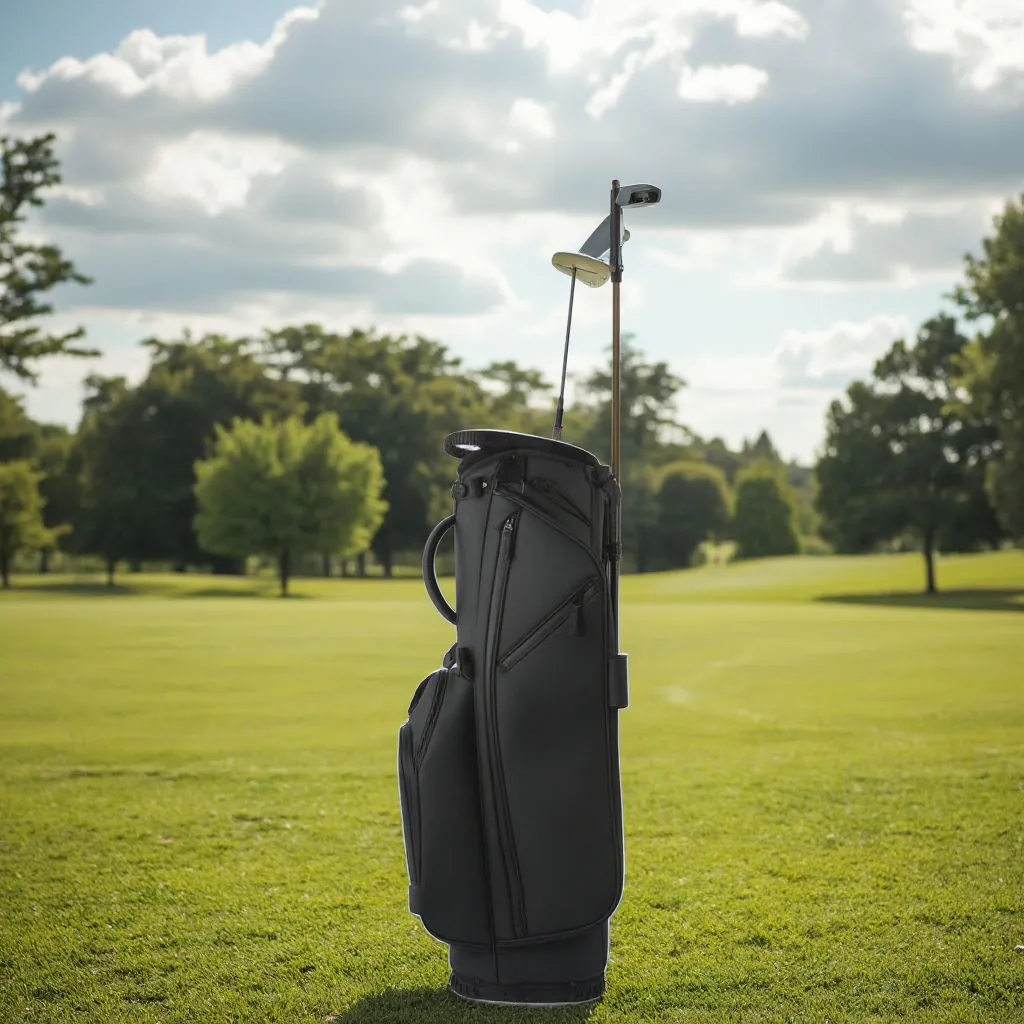
From a factory build standpoint, our dedicated ultralight stand bags page walks through the materials, hardware, and quality checks in detail.
Key Takeaways for Buyers
- Stand bags weigh 4.2-5.5 lb and hold a full set; carry bags weigh 2.5-3.5 lb for half sets and short rounds.
- No legs is the defining line: a carry bag must lean on a bag stand, cart, or wall; a stand bag stands on its own.
- Match the SKU to the player: walkers and full rounds prefer stand bags; par-3, resort, junior, and minimalist buyers want carry bags.
- Carry bags cost less per unit because they use less fabric and hardware, and they pack smaller for shipping.
- MOQ is 200 pieces per colorway for both (100-piece test available); brand a small front panel on the carry bag for promo lines.
What "Carry Bag" and "Stand Bag" Each Mean
Retail labels blur, but the factory definition is crisp. A stand bag is a walking bag with a deployable leg system: the legs pop out so the bag stands upright on the course, and the design carries a full set of clubs plus comfortable dual straps and several pockets. A carry bag — often called a Sunday bag or pencil bag — is the stripped-down opposite: no stand legs, a light single shoulder strap, minimal pockets, and just enough room for a half set or the clubs you use on a short course.
The reason the two must be treated as separate SKUs is that every structural decision is different. A stand bag's hinge block, base plate, and strap anchors are built to survive daily carrying and repeated leg deployment. A carry bag has none of that hardware, which is precisely why it can be a full pound and a half lighter and meaningfully cheaper. Choose the bag type that matches how the buyer actually plays, and the catalog will sell itself.
Weight: The Core of the Carry-Bag Appeal
Weight is the whole story for a carry bag. A standard golf stand bag lands around 4.2-5.5 lb because the legs, hinge block, base, dual straps, and pocket structure all add up. A lightweight carry bag comes in around 2.5-3.5 lb, and ultra-minimal pencil bags can fall under 2.5 lb. For a player who walks nine holes with half a set, dropping a pound or two off the shoulder feels immediate, which is the entire promise of the carry bag.
But lighter is not automatically better. The carry bag gives up the legs, the full-pocket layout, and the all-club capacity to get that low number. Our advice to buyers is to define the weight target by the intended bag load before choosing a type. If the SKU must carry fourteen clubs, rain gear, and a water bottle, a stand bag is the honest build; if it only needs to shuttle a few clubs for a twilight nine, a carry bag is the right spec and you should set the tolerance tightly, typically ±0.2 lb.
Head-to-Head: Stand Bag vs. Carry Bag Comparison Table
| Parameter | Golf Stand Bag | Carry / Sunday Bag | Buyer / Factory Note |
|---|---|---|---|
| Stand legs | Yes, deployable | No | The defining difference in the lineup. |
| Typical weight | 4.2-5.5 lb | 2.5-3.5 lb | ±0.2 lb tolerance after dyelot change. |
| Club capacity | Full set (14) | Half set typical | Carry bag fits limited shafts and pockets. |
| Divider | 4/5/6-way or 14-way | 1/2/4-way simple | Carry bag keeps the topsimple to save weight. |
| Pockets | Several (valuables, rangefinder, apparel) | 1-3 minimal | Pocket count is a driver of cost and weight. |
| Strap system | Dual padded self-balancing | Single light strap | Single strap is part of the carry-bag weight saving. |
| Standing on course | Stands alone | Must lean on a stand/cart/wall | Key drawback on hilly courses. |
| Unit cost | Higher (legs + hardware) | Lower (less material) | Carry bag packs smaller for freight. |
| Best-fit buyer | Full-round walkers, travelers | Par-3, resort, junior, minimalist | Position by course type and bag load. |
| MOQ per colorway | 200 pcs (test 100) | 200 pcs (test 100) | Same MOQ, lower per-unit cost on carry bag. |
Stand System: The Bigger Investment, When You Need It
The stand system is the most expensive single addition on a stand bag, and it is the first thing a carry bag removes. A good stand bag uses a leg mechanism with a hinge block, a deployable pair of legs, and a base plate that balances the bag on undulating ground, plus tip caps that grip. Getting that geometry right takes engineering and tooling: the legs must deploy smoothly, lock open, and collapse without jamming, and the whole unit must survive thousands of cycles.
That complexity is why a stand bag costs more and why a carry bag is so much cheaper to build. For buyers, the question is whether the player needs to set the bag down repeatedly on the course. On a flat, cart-based course the legs matter less; on a walking course with plenty of stops, legs save the player from leaning the bag on carts and walls. Do not pay for legs your buyer never uses — that is the classic reason a carry bag fits some programs better.
Pockets and Capacity: Full Set vs. Essentials
Pocket architecture is the second big differentiator. A stand bag carries a valuables pocket, a rangefinder pocket, an apparel pocket, a water bottle sleeve, and often an insulated cooler pocket, all arranged so the walker can reach gear while carrying. A carry bag trims to one or two minimal pockets — usually a small valuables or ball pocket — because every pocket adds Sewing, zippers, and weight, all of which fight the carry bag's reason for existing.
The clearance of "fewer pockets = lighter and cheaper" is real, and that is exactly why the carry bag works for its niche. A player on a par-3 or practice range does not need a full apparel pocket or a rangefinder slot. But when a buyer tries to add four pockets to a carry bag, it stops being light and starts being an awkward stand bag without legs. Define the pocket list by the round length: short rounds get the minimal pocket, full rounds get the organized stand-bag layout.
Straps and Comfort: Two Shoulders vs. One
Comfort differs sharply. A stand bag uses a dual-strap system — two padded, self-balancing straps that spread the load across both shoulders — which makes an hour or two of walking comfortable. A carry bag traditionally uses a single strap that hangs the bag on one shoulder, which is lighter and simpler but concentrates the load on one side. For a short round that is fine; for a full bag on a long walk a dual strap is far kinder.
In production this shows up in strap anchor reinforcement and padding spec. The stand bag's dual straps get padded foam, adjusters, and bar-tacked anchors because they carry the full bag weight. The carry bag's single strap is lighter but should still get a static-load test so it survives the bag setting down hard. If you are building a more comfortable carry bag for a resort or junior line, an optional padded single strap is a nice balance — still one strap, but walkable on nine holes.
Player Types and Market Positioning
The bag should match the player, not the other way around. The full-set walker — the weekend golfer who walks eighteen, the traveler, the player who likes pockets and organization — is the stand-bag customer. The carry-bag customer is different: the par-3-course regular, the resort guest playing a twilight nine, the junior building a light habit, the minimalist and the driver, and the corporate gifting buyer who wants a low-cost, brandable item.
Most balanced retail programs carry a lightweight stand bag, a standard stand bag, and one carry/Sunday bag for the short-course and junior buyer. The carry bag also shines as a promotional and gift item because its small front panel is easy to brand with embroidery or a heat-transfer logo, and the low unit cost keeps promo budgets honest. Position it as the "nine-holes quick bag," and it will not cannibalize the full-round stand bag.
Cost, MOQ, and Logistics for a Carry-Bag Line
A carry bag is cheaper than a stand bag for concrete reasons: less fabric, no leg tooling, fewer pockets and zippers, and a lighter strap. Expect a carry-bag unit cost to sit below a same-quality stand bag, and freight improves too because the smaller, lighter carton packs more per container. At QUANZHOU JUNYUAN BAGS our regular MOQ is 200 pieces per colorway for both, with a 100-piece test order to validate structure and branding before bulk. Lead time for both is the same: sampling 10-20 days, bulk 45-60 days.
Because the carry bag is small, it is a good first import order for a new buyer testing the market — a low-risk way to validate a brand and a vendor before committing to a container of full stand bags. Keep the same brand file and trim family across the carry bag and the stand bag line so the collection reads as one, and use the buy-in test order to confirm the weight, the strap comfort, and how the small panel takes your logo.
Materials That Make a Carry Bag Light
How a carry bag stays light is a materials story. The shell often uses an open-weight polyester or a thin nylon in the 300D-600D range cut back wherever possible, backed by a skeletal foam or none at all in low-stress areas. A stand bag, by contrast, spends more on reinforced panels around the hinge, the base, and the strap anchors because those zones carry the leg hardware and daily loading. That reinforcement is where a big part of the stand bag's extra cost and weight goes.
For buyers comparing bills of materials, specify the denier, finish, and reinforcement separately for each bag type rather than copying one material call-out across the catalog. A carry bag can save grams with a lighter lining and fewer welded seams; a stand bag should keep the heavier stress-point panels even if the rest of the shell is light. Steering material by function — not by a single "lightweight" label — is what keeps a carry bag honest at 3 lb and a stand bag durable at 5 lb.
Durability Differences at Each Weight
It would be misleading to say one is "more durable" in the abstract; durability follows the load each bag actually takes. A stand bag carries more clubs and hardware and flexes more as legs deploy, so its stress points — hinge, base, strap anchors — need heavier construction than a carry bag. A carry bag carries less and lacks the leg mechanism, so its seams and strap anchor take a different, lighter kind of stress. In practice a carry bag can wear out at the single-strap anchor and the shoulder webbing long before its shell fails.
Production-wise this means the QC emphasis shifts. Test the stand bag's hinge and base cycles and the carry bag's strap anchor and webbing seams. Buying cheap hardware on a carry bag is tempting because it is small, but a strap anchor fail on a light bag is just as annoying to the player as a hinge fail on a heavy one. Spend the reinforcement where the load is, and both bags last honestly at their own weight class.
Colorways, Branding, and Promotional Lines
The carry bag is a natural promotion and gifting SKU because of its low cost and its compact, brandable front panel. Embroidery, heat transfer, screen print, and woven labels all work, and the small body lets you run a tight hero logo cleanly. A stand bag gives you a larger canvas — front panel, lid, and side panels — so it suits deeper brand programs, while the carry bag suits quick promotional runs and resort giveaways where budget matters more than surface.
Set Pantone references and a tonal tolerance on each colorway so a two-line collection reads as one, and keep the brand file consistent across the carry bag and stand bag. A small run-down of each — even 20-30 units — lets you photograph the real lockup and confirm the small front panel takes the logo well before you commit to bulk. Use the 100-piece test order to validate both the structure and the branding at the same time.
Test Plan and Failure Modes for Carry vs Stand
- Stand deployment and base stability test (stand bag only).
- Strap anchor static-load test on the carry bag's single strap.
- Divider and shaft-fit check on the smaller carry capacity.
- Zipper cycle test on the minimal pockets that remain.
- Carton drop test sized for the lightweight carry-box packing.
Failure patterns differ by type. On a stand bag the usual return drivers are leg hinge drift and strap anchor wear; on a carry bag they are a seam pulling under the single-strap load and a zipper jam on the compact pocket. Because the carry bag carries less, its inspection is shorter, but do not skip the strap anchor test — a carry bag still gets swung and set down hard during a round.
Choosing Based on Your Golf Style and Course
Settle the choice with two questions about the buyer: how many clubs do they carry, and how long is the round? Fourteen clubs on eighteen walkable holes recommends a stand bag with legs and organization. A half set on nine holes, a par-3 course, or a practice session favors the light carry bag. If the player uses a cart most of the time, neither walking bag is essential, but the stand bag still protects clubs better on a cart than a featherweight carry bag does.
For related guidance see the stand bag vs cart bag comparison if carts dominate your market, the weight guide to set the right target, and the stand vs hybrid comparison for a middle option. Browse our bag architectures, review the factory QC process, and use the buying guide or our OEM/ODM service to start a program for either type.
A Buyer's Quick Math: Weight, Price, and Freight
The commercial gap between the two types is easier to grasp in numbers than in adjectives. Take a 5.0 lb stand bag and a 3.0 lb carry bag built to the same grade of 600D nylon. The carry bag removes the leg mechanism, trims the hinge block and base plate, and drops from several pockets to one or two — that hardware and sewing is where most of the stand bag's extra cost lives. As a rough planning figure, a carry bag typically lands 15-25% below a comparable stand bag on unit cost, and because its packed carton is smaller and lighter, you fit more units per container, which shaves per-unit freight in the same direction.
That arithmetic matters most for a first import program. If you are a new buyer testing a market, a 100-piece test order on a carry bag is the lowest-risk way to validate a factory, a colorway, and a logo lockup before you commit to a full stand-bag order. Once the trial confirms the weight at your target plus or minus 0.2 lb and the small front panel takes your embroidery cleanly, you have two honest SKUs: a walker's stand bag for the full-round customer and a lightweight carry bag for the par-3, resort, and junior buyer. At QUANZHOU JUNYUAN BAGS the regular MOQ is 200 pieces per colorway for both types, sampling runs 10-20 days, and bulk production 45-60 days, so you can sequence a two-bag launch from a single brief.
FAQ
FAQ
What is the difference between a stand bag and a carry bag?
A stand bag has deployable legs so it stands on the course by itself and carries a full set with several pockets, usually 4.2-5.5 lb. A carry bag (Sunday or pencil bag) has no legs, fewer pockets, a light single strap, and weighs as little as 2.5-3.5 lb; it is meant for short rounds, par-3 courses, or practice with a half set.
Is a carry bag better than a stand bag?
For a full set and a full course, no — a stand bag is better because the legs keep the bag upright and the pockets carry all your gear. A carry bag wins for speed and minimal weight on short rounds or par-3 courses, but it cannot hold a full set comfortably and has no stand.
How much does a carry bag weigh?
A lightweight carry or Sunday bag typically weighs about 2.5-3.5 lb empty, compared to a walking stand bag at 4.2-5.5 lb. Some ultra-light pencil bags drop below 2.5 lb, which is popular for minimalists and practice sessions.
Do carry bags have stands?
No. A carry or Sunday bag has no stand legs by design. Players lean it against a bag stand, a cart, or a wall, which is fine for short rounds but a drawback on hilly courses where a stand bag would stand on its own.
What is the minimum order quantity for custom stand and carry bags?
At QUANZHOU JUNYUAN BAGS the regular MOQ is 200 pieces per colorway for both, with a 100-piece test order available. A carry bag uses less material and packs smaller, so its per-unit cost and freight are lower than a full stand bag.
Who should buy a carry bag?
Buyers serving par-3 courses, resort twilight programs, juniors starting out, and minimalists or travelers who play a half set. It is also a popular corporate-gift and promotional item because of its low cost and easy branding on the small front panel.
Request a B2B quote for golf stand bags
Send your target market, expected MOQ, and reference photos. We respond within 24 hours with a sampling plan.