For a featherweight minimal carry, explore our Sunday bags — For the most compact small carry, see our pencil bags — The golf stand bag has traveled from a heavy leather staff bag of roughly 3-4 kg carried by caddies, through the folding-leg innovations of the mid-20th century, to today's barely-sub-1.5 kg technical carry bags that pair a stable aluminum stand with full-length 14-way organization and seam-taped waterproof packages. Understanding that evolution is not a history lesson for a B2B buyer — it is a map of which features have earned their place through sixty years of use, and of how a factory like QUANZHOU JUNYUAN BAGS reproduces the proven end-state reliably at scale.
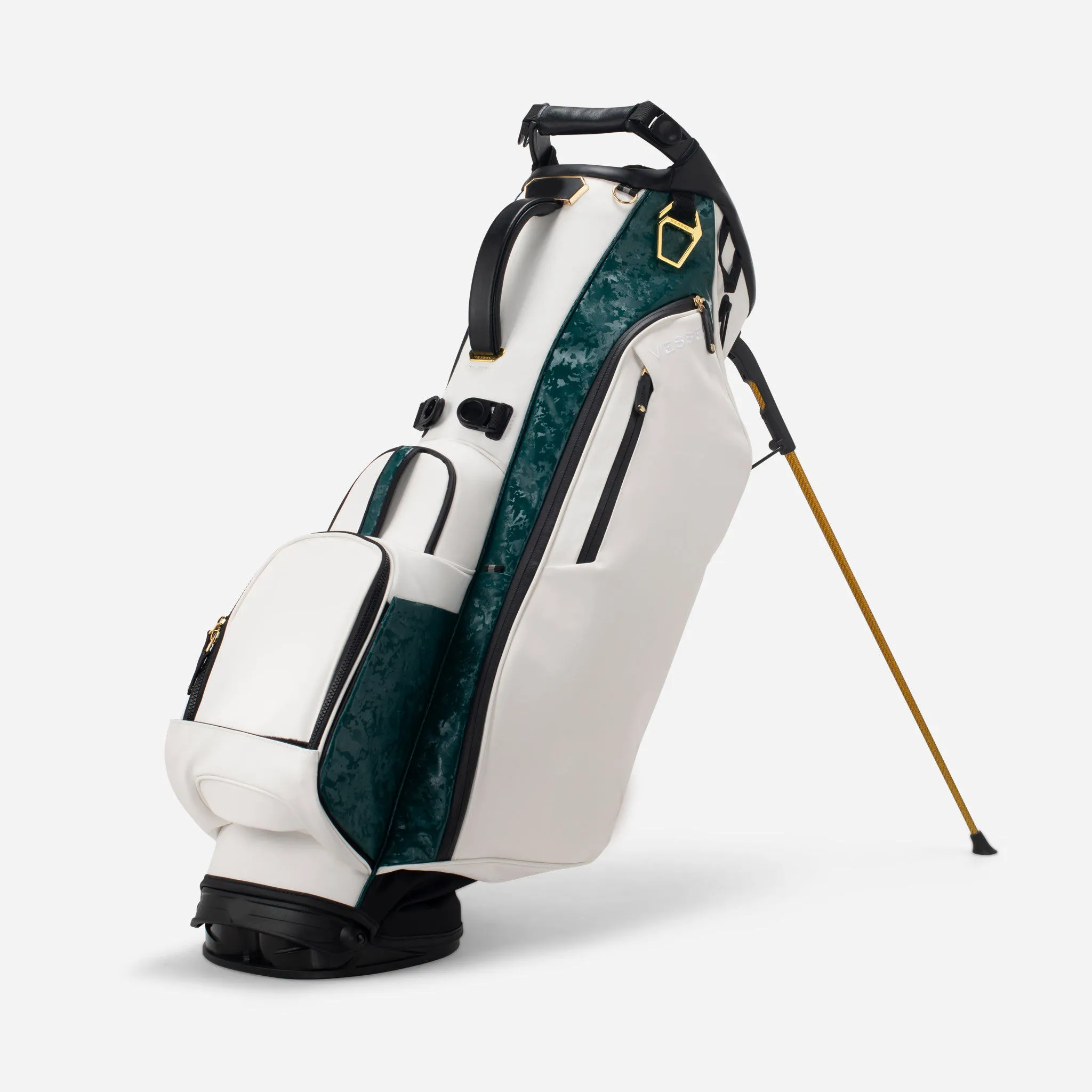
The start: heavy leather and caddie-carrying
Golf bags began as practical carriers, not performance gear. For much of the game's early history, the bag was a leather or canvas tube, reinforced for club protection but heavy by modern standards, and players often relied on a caddie to bear the weight across eighteen holes. Weights in the leather era commonly sat around 3-4 kg empty, and the bag itself had a simple collar with three or four openings, no reliable stand, and no concept of dedicated pocket engineering the way we understand it today.
Three constraints shaped the evolution that followed: weight, carrying comfort, and the constant problem of where a bag goes when the player swings. The bag that forced a player to lay it flat in damp grass, or to balance it awkwardly while standing over a shot, was the problem every designer tried to solve. This is the origin of the stand concept — not a gimmick, but the answer to a genuinely uncomfortable part of the game that had bothered players for generations.
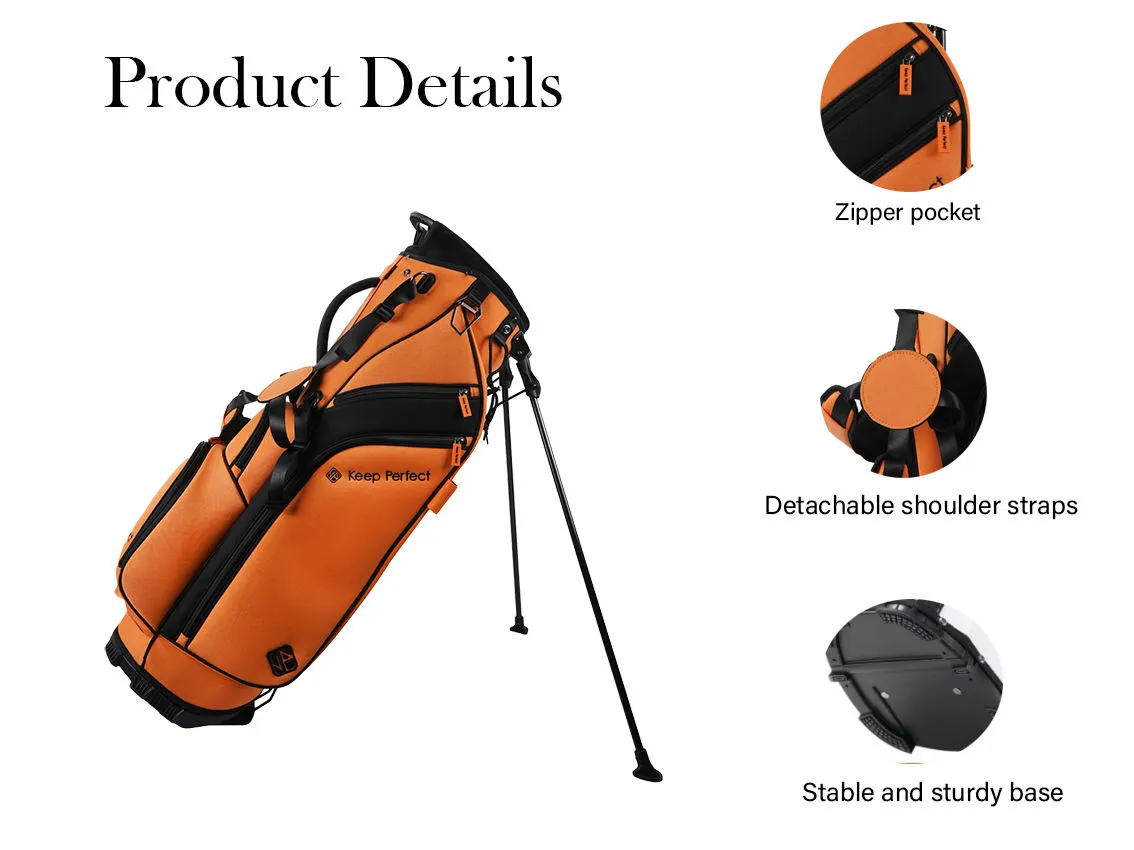
The folding leg arrives
From the mid-20th century, designers began fitting the bag with folding legs so it could rest upright on the course, and the "stand bag" emerged as a distinct product. Early legs were simple metal or even wooden folding stays, sometimes a single rear leg with a wide front foot, sometimes a two-leg tripod arrangement. The mechanism was basic — a manual deploy or a gravity-assisted lock — but it solved the day's biggest annoyance by keeping the bag off the wet grass and upright for easy access.
The trade-offs were immediate: added weight, hinge parts that could wear or jam, and a mechanism that sometimes deployed when it should not. Those trade-offs are exactly the ones modern engineering refined, which is why the hinge block, the spring-loaded deployment, and the base geometry remain the most important stand components a buyer specifies today. Every improvement since has been a better answer to the same questions the first folding leg raised: does it stay put, does it deploy reliably, and does it cost acceptable weight?
The lightweight materials revolution
The clearest single line of evolution in stand bags is weight. As nylon and later polyester replaced leather and canvas, and as aluminum and then composite alloys replaced steel legwork, the bag shed roughly 40-60% of its historical mass. Where a leather-era bag pressed toward 3-4 kg, a modern walking bag targets about 2.0-2.6 kg for a core carry, with an ultra-light tier comfortably below that number through fabric weight, foam framing, and hardware reduction.
Critically, this weight loss was not achieved by removing the stand — it was achieved by making the stand itself lighter. High-strength aluminum and composite legs, a slimmed hinge block, and a base designed for both stability and secondary weight all contribute. The lesson for a factory is that lighter weight is a systems problem, not a single material decision, and that the production sample must hit the targeted weight or the marketing claim collapses. It is the reason our QC workflow weighs every confirmation sample against a stated tolerance.
Divider and organization upgrades
Organization evolved in parallel with weight. For decades the bag top was a simple collar with a few fanned openings, and clubs were loaded in a rough grouping that let shafts touch and tangle. The introduction of full-length dividers — fabric or plastic tubes running most of the way down the body — stopped clubs from crossing mid-bag and protected grips and shafts from the clatter of walking. The 14-way top with a dedicated putter well, standardized through the 2010s and 2020s, became the premium organization benchmark because it gives every club type a defined slot.
For a sourcing team, the organization question is a usefulness trade: a 4-way or 6-way top keeps weight low and cost down, while a 14-way full-length top adds comfort of use and a meaningful weight and cost premium. The evolution resolved it by letting the buyer choose, so the modern catalog holds both a simple carry top and a full 14-way organizer. Lock the divider configuration, the tube material, and the top alignment into the spec, and the bag delivers the organization its opening promises.
Waterproofing and all-weather construction
Another major thread of evolution is weather protection. Early bags offered no real defense against rain, and wet gear was simply accepted. Modern waterproof construction closes that gap with water-resistant or waterproof fabrics, seam sealing or seam taping, water-repellent zippers, and protected opening construction. The distinction matters: a coated fabric alone resists light spatter, but a truly waterproof bag uses a sealed seam package and water-rated zippers so a downpour does not soak the clubs or the valuables pockets.
The technical parameters buyers now specify — the hydrostatic head of the fabric, the seam-sealing scope, and the zipper waterproof standard — are direct descendants of this evolution, and they are measurable in a lab. This is why a waterproof claim must be tested rather than assumed: the fabric can be confident, but the bag is only waterproof at its seams and openings. As weather variability pushes more rounds into wet conditions, this thread has gone from premium optional to a mainstream plan in rainy markets, and it is one of our most requested OEM/ODM options.
Comfort and strap engineering
Carrying comfort improved in step with the equipment itself. Early bags relied on a single strap and basic padding; the modern stand bag standard is a dual-strap, self-balancing system with substantial padded shoulder sections, adjustable length, and sometimes a removable design for cart use. The straps had to evolve because the bag became the thing players walked with, and a bag that is painful to carry defeats the point of its lightness.
The relevant spec for a buyer is the padding thickness, the adjust range, and the anchor reinforcement — the points where the strap meets the bag are among the highest-load areas and are governed by a static load test. A comfortable bag that fails at the strap anchor, or a bag that is light but awkward to carry, both lose the value the evolution added. Comfort and durability are bought together in the strap spec, not traded off.
An often-overlooked detail in this thread is strap adjustability for a mixed roster of players. Because modern bags serve men, women, and juniors who vary in build, the adjust range of the dual strap is itself a spec decision, and the anchor placement is set for balance across those body types. Buyers planning a family or multi-golfer line should confirm the adjust range and the balance feel on the sample rather than assume a one-size strap carries everyone comfortably — this is exactly the kind of felt detail that surfaces in after-sales feedback.
From metal to composites in the stand hardware
The hardware thread of the evolution mirrors the materials thread. Early folding-leg designs leaned on steel for strength, which worked but added real mass and could fatigue over a long season. As aluminum extruded legs became common, and as composite and higher-grade alloys appeared at the premium end, the legwork shed weight while holding or improving stiffness. The hinge block, the most stressed single part of the mechanism, moved from simple metal stampings to reinforced polymers and engineered metals that keep tolerance through thousands of deployment cycles.
For a factory that manufactures these bags, the hardware choice is a cost-and-durability decision with a measurable test behind it. The deployment-cycle target and the stability criterion exist precisely because this hardware is the part most likely to degrade, and the QC test is what prevents the wobble that shipping a marginal hinge lets slip through. When you specify "aluminum legs" or "reinforced hinge block," you are not just picking a material — you are picking a reliability band that the cycle test then proves.
The ultra-light and minimalism movement
A more recent branch of the evolution is the ultra-light and ultra-minimal carry bag. As walking golf gained popularity and as players sought to move faster and more comfortably, designers stripped the bag to its essentials: a lightweight body, fewer and simpler pockets, a modest 4-way or 5-way top, and a featherweight stand. Minimizing that far reveals plainly which features are essential and which are added weight, and it created a clear buyer who prefers less over more.
The tension this created is instructive for a sourcing program. The ultra-light bag — see our ultralight golf stand bags — wins the buyer who walks and wants the lightest honest option, while the 14-way organizer and the waterproof package win buyers who trade weight for function. One factory serves both by holding a range of weight tiers and by being honest about the weight in each listing — because the ultra-light buyer, more than any other, weighs the bag on arrival and reviews the match between spec and reality.
The sustainable materials turn
The latest thread in the evolution is environmental. As sustainability moved from niche to mainstream, bag makers began offering recycled polyester (rPET), recycled nylon, bluesign-aligned sourcing, and bio-based or PVC-free components alongside lower-impact dyeing and packaging. Where the lightweight era gauged success in grams, the sustainable era gauges it in verified claims: recycled-content percentages, certifications, and supply-chain traceability rather than marketing language alone.
The technical nuance for a B2B buyer is that sustainable materials must still hit the same performance bar — water resistance, durability, stand reliability — or the evolutionary gains are lost. rPET fabrics are now engineered to be indistinguishable in feel and strength from virgin polyester for the majority of carry-bag uses, which is why recycled construction is a mainstream OEM option rather than a niche. This thread is covered in depth in our recycled-materials guide.
Smart features on the boundary
The evolution is also testing where technology ends and the bag begins. A pocket devoted to a rangefinder, integrated or cooperative space for a GPS speaker, magnetic pockets for quick access to markers or putters, and charging-lane or cable-managed pockets for electronics are the design answers to modern carrying habits. These are not a separate "smart bag" in most cases; they are thoughtful placements that make an otherwise classic bag work with the electronics a modern golfer already carries.
The importance for a factory is that these features are structural — a rangefinder pocket needs padding and a clip point, a magnetic pocket needs a specific liner, a charging-lane pocket needs a grommet or pass-through — so they are designed into the tech pack rather than bolted on. Planned this way they add modest cost and no real reliability risk; improvised at the end, they add failure modes. It is one more instance of the core lesson: the evolution's wins are captured by good specification, not by accident.
Measuring the weight journey in one picture
To see the whole arc in a single view, the table tracks approximate empty-weight benchmarks by era and the feature each stage contributed to the modern bag. It is a useful sanity check when a buyer worries a spec is unrealistic: modern numbers are the result of a long, deliberate shedding of mass, and a well-built bag genuinely can combine a stable stand with a weight that the leather-era golfer would have found astonishing.
| Era | Typical Material | Approx. Weight | Legacy to the Modern Bag |
|---|---|---|---|
| Early / leather | Leather, canvas | 3-4 kg | The carry concept itself |
| 1960s-70s | Canvas/synthetic + metal legs | 2.6-3.2 kg | Folding-leg upright rest |
| 1980s-2000s | Nylon, aluminum legs | 2.2-2.8 kg | Lightweight construction |
| 2010s-2020s | Nylon/PET, composite legs, full dividers | 2.0-2.6 kg | Organization + comfort |
| Ultra-light tier | Light nylon, minimal hardware | ~1.5-2.0 kg | Featherweight walking option |
Read the table and note that every era's contribution survived into the modern bundle — nothing was thrown away, each was made lighter and more reliable. That is the real story of the stand bag: an incremental, sixty-year engineering discipline rather than a single revolution. For a buyer, that discipline is the reassurance: the specification you write today is standing on tested ground, and a factory that honors the QC behind each row of the table is the one that will deliver the bundle without regressing any of it.
How the modern bag is a bundle of the evolution's wins
The stand bag sold today is not one invention but the accumulation of each era's best answer, bundled into a single product. It takes the upright rest of the folding leg, the lightness of synthetic materials and composite legs, the organization of full-length dividers, the weather defense of sealed construction, and the comfort of dual straps, and combines them under one QC discipline. That is why buyers who evaluate a modern bag judge it as a system rather than by one feature.
| Evolution Stage | Key Change | Weight Impact | Modern Spec It Became |
|---|---|---|---|
| Leather era | Heavy natural material | 3-4 kg | Replaced by nylon/polyester |
| Folding leg | Upright rest on course | +weight/parts | Reinforced hinge + stability base |
| Lightweight materials | Synthetic + aluminum/composite | −40-60% | Weight tolerance on PPS |
| Full-length dividers | Less shaft tangle | +weight/cost | 4-14 way, divider spec |
| Waterproof package | Dry gear in rain | +weight | Seam tape + waterproof zippers |
| Dual-strap comfort | Walkable carry | ± | Padding + strap anchor load test |
The table is a useful briefing tool for a B2B program: each row is a proven feature that has survived decades, each has a known weight or cost consequence, and each is now a measurable spec. The factory's job is to reproduce the bundle consistently, and the buyer's job is to order the features they want and verify them on the sample.
This bundling is also why cheap imitations fail in reviews while well-executed bundles succeed: a clone reproduces the looks but drops the engineered detail — the tube that prevents tangle, the seal that stops rain, the hinge that holds tolerance — and the missing detail surfaces quickly in the field. The modern bag is not a shape; it is a collection of interdependent engineering decisions, and reproducing the collection faithfully is the entire manufacturing task. A buyer who understands this judges a factory by whether it can hold the bundle under QC, not by whether it can copy a silhouette.
What the history tells a modern sourcing program
The practical takeaway for a B2B buyer is that the hourly complaint history of the category — stand wobble, weight that does not match the label, zipper failure, strap-anchor pull — are the same failure classes that have existed since the stand was invented, and they are solved the same way today: with a defined spec and a test. Do not chase the newest buzzword; chase the repeatable execution of the features the sixty-year evolution proved.
It is worth stating plainly that none of this evolution happened because a single material or a single factory changed the game overnight. It happened through iterative, measurable improvement that rewarded the manufacturer who tested the stand, weighed the batch, and sealed the seam. That is a fair description of the modern OEM relationship as well: the factory that offers a defined test plan and a sealed master is the natural partner for a brand that wants the accumulated engineering of the category delivered without the accumulated defects.
The checklist below mirrors the evolution's proven points and turns them into pass/fail checks. Use it before sampling and before bulk, then add your target market, ref photos, MOQ, and timeline to service@junyuanbags.com to start the buying-guide-style conversation with a concrete plan.
Sampling & QC checklist from the evolution
- Stand deployment cycle test (target cycles + failure criteria)
- Base stability check (angle, slip resistance, leg-spread consistency)
- Weight verification against advertised spec on the PPS
- Zipper smoothness + cycle test (pull force and jam rate)
- Strap-anchor load test (static load + stitch-failure criterion)
- Divider alignment and full-length tube QC
- Seam and, if applicable, waterproof-seam integrity test
Each check maps directly to a stage of the evolution and to a real after-sales complaint. A program that runs them against the production fabric defeats the category's oldest failure modes before they reach the golfer, and that is the value of understanding the years — you are not rediscovering the wheel; you are manufacturing it correctly.
FAQ
What was the first golf stand bag like?
The first stand bags appeared in the mid-20th century as lightweight carry alternatives to heavy leather staff bags, using simple folding metal or wood legs, canvas or early synthetic bodies, and a basic top with few dividers.
When did modern stand bags add legs and lightweight materials?
Folding-leg designs gained traction from the 1960s-1970s, while nylon and aluminum construction, and later high-strength composites, steadily cut weight through the 1980s-2000s until the walking-friendly stand bag became a distinct category.
Why are stand bags much lighter than they used to be?
Weight fell from roughly 3-4 kg in leather eras to 1.5-2.5 kg today because of lightweight fabrics, foam-frame designs, aluminum and composite legs, and reduced hardware — holding structural strength while shedding grams.
How did dividers and organization evolve?
Bags moved from a simple 3-4 way collar to full-length dividers that reduce shaft tangle, and the 14-way full-length top with a dedicated putter well became the premium organization standard in the 2010s-2020s.
What does the evolution mean for a B2B factory program today?
It means today's buyers expect a technological bundle — a stable stand, lower weight, full-length organization, and durable zippers — which a factory delivers by locking measurable specs and running disciplined QC rather than chasing a single feature.
What is the fastest way to get an accurate quote for a stand bag?
Send bag type, material direction, divider (4/5/6/14-way), pocket list, logo method, target MOQ, timeline, and reference photos or a tech pack.
Recommended Internal Links
Request a B2B quote for golf stand bags
Send your target market, expected MOQ, and reference photos. We respond within 24 hours with a sampling plan.