For the most compact small carry, see our pencil bags — Practice golfers can also browse our range and simulator golf bags — For traveling golfers, a compact stand bag packs smaller and carries easier: a trimmed footprint that fits a travel cover, a low-profile stand that folds flat and never snags, an easy top handle for trunk and cart lifts, a lighter 3.8–5.5 lb engineered weight, and packing-friendly pockets that keep the load neat through airport and rental-cart steps. This B2B guide turns "compact and portable" into measurable specs our affiliated Quanzhou factory (SGS-verified, 4,950 sqm, 7 lines, 149 machines, 137 staff) builds, so a buyer can source a travel line that moves gracefully and holds up to the road.
Key Takeaways
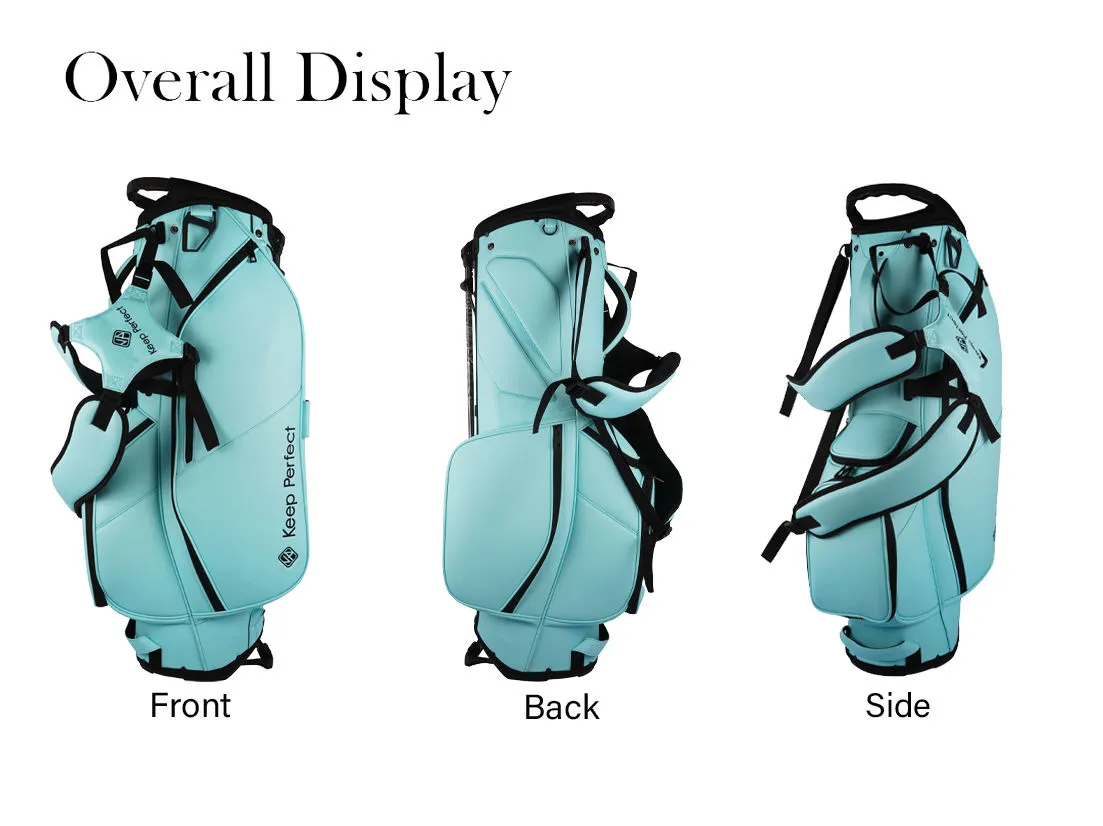
- Compact means footprint first: a smaller packed height and width that fit a travel cover and a trunk without forcing the geometry.
- A low-profile stand that folds flat and does not snag is the difference between an easy bag and an annoying one at baggage claim.
- Easy lifting — a padded top handle and a balanced carry point — is a travel feature the frequent golfer feels on every leg of the journey.
- Durability stays on the stressed parts even as weight drops, so a light travel bag still passes the stand, hinge, strap, and drop tests.
Compactness as a geometry decision
A travel bag's first job is to take up less room. Compactness is not just a lighter bag; it is a smaller packed height, a narrower body that still holds the clubs, and a profile that nests cleanly in a travel cover and a trunk. The engineering tension is that the loaded clubhead-to-flange distance is fixed by the bag holding a full set, so a compact bag trims the non-essential width and the stand overhang rather than shrinking the club-holding core.
The result is a bag that fits travel cases whose internal dimensions are tight, lets a player load the trunk efficiently, and drops onto a baggage carousel without being the awkward biggest thing in the queue. Because the travel cover mating is a high-stakes fit, we confirm the collapsed height and the widest point against the cover's internal spec at the sample stage, so the buyer does not discover a length mismatch at the airport.
For the buyer this geometry is worth writing into the tech pack as explicit dimensions — packed height, widest point, and stand-fold footprint. A compact line sold with those numbers lets the retail customer check the fit before buying, cuts fit-related returns, and gives the sales team a concrete "fits standard travel covers" claim that is honest and repeatable.
The low-profile stand that packs flat
The stand is usually what makes a "travel" bag awkward, because tripod legs snag on carousel belts, trunk edges, and travel-case liners. A compact travel bag solves this with a low-profile stand that folds flat and nests tight against the bag when not deployed — reducing the width that a travel cover has to accommodate and removing the snag points that made a bag annoying to handle.
Low-profile does not mean weak. The hinge block stays reinforced and the base geometry holds its stability, because a travel bag gets dropped, shoved, and stacked more than a course-only bag, and it must still open level on the practice range or the golf cart path once it lands. We confirm the deployment cycle and the folded-nest behavior together, so the stand is both easy in transit and dependable in play.
For the buyer the low-profile stand is a differentiator to lead with. "The stand packs flat, so it will not snag your case or your trunk" is a concrete benefit a traveling golfer understands on the spot, and it is backed by a sample you can hand someone and feel. A bag that packs cleanly is a bag that keeps its owner happy from the driveway to the first tee.
Easy lifting: handles and carry points
Travel means constant lifting — into the trunk, onto a trolley, out of a rental car, and over to the range — so easy grab points are a genuine travel feature. A larger, padded top handle that sits high and clears the bag's load gives a gloved or bare hand a solid grip, and a second lift point balance lets a player carry the loaded bag more evenly instead of wrestling a one-sided load.
We place the handles so they do not interfere with the stand, the pocket access, or the travel cover fit, and we confirm the handle anchor and padding at the sample. A handle that is comfortable when the bag is lightly loaded but bites under the full 14-club travel load is a failure to catch early, so the sample test is loaded, not empty.
For the buyer, easy lifting is a feature-and-pain-relief story in one. Travelers pay attention to how a bag feels to lift because they do it a dozen times a trip, so a well-handled compact bag earns satisfaction that a spec sheet cannot capture. It is also a small thing that distinguishes a well-designed travel line from a generic compact shell.
Packing-friendly pockets and travel organization
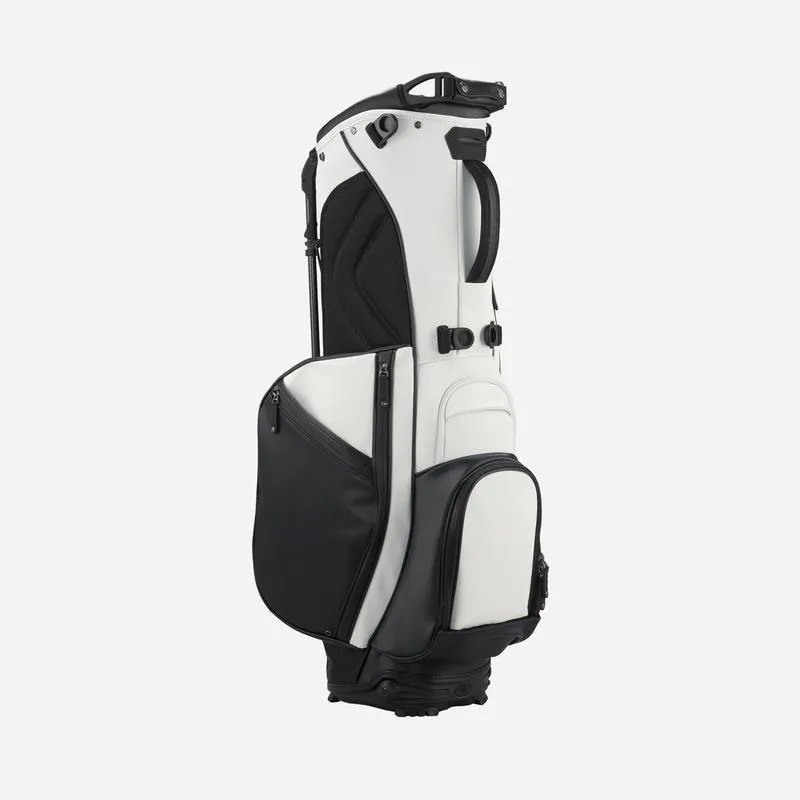
Travel is organization on the move, so pocket architecture does real work. A compact travel bag packs a travel essentials pocket for documents and passports, a valuables pocket that is secure and low-profile, and an apparel pocket sized for a packed layer — all arranged so nothing bulges the footprint the travel cover has to hold. Low-profile closures and flat-lay pockets keep the bag slim even when loaded for a trip.
The pocket plan also keeps the travel load tidy rather than a jumble. A quick-access ball and tee pocket for the destination course, a cooler pocket that packs down when empty, and storage that accepts a travel folded windbreaker mean the player carries less loose gear. We confirm every pocket zips clean and stays flat at the sample so the slim profile is preserved when the customer actually packs it.
For the buyer the packing story is a large part of the compact value. A bag that organizes the travel load, packs the stand flat, and holds a standard travel cover is a bag the road golfer reaches for every trip. Writing the pocket list and the flat-lay behaviour into the tech pack is what keeps the "compact and portable" promise true after the bag is loaded, not just out of the box.
Weight and the travel balance
A travel bag should be light and carry well, but light never means fragile when the road is the test. A compact travel model typically lands at 3.8-5.5 lb, trimmed on the body and non-wear panels with a reduced lining and lighter hardware, while the stand hinge, base, strap anchors, and bottom wear panel hold the full durability bar. Weight is written with a documented tolerance, verified at mid-production, and confirmed to still pass the hinge, strap, and drop tests on the same build.
The travel balance is about distributing the saving where it does not matter and keeping it where it does. A lighter shell and leaner construction cut the carried weight the traveler feels at every lift, while the stressed parts stay built for airport and trunk handling. That is the honest definition of a light-but-durable travel bag — and it is what keeps a compact line from being a season-long disappointment.
For the buyer this balance protects both margins and reputation. A travel bag that is easy to lift yet survives the road earns repeat and referral, while an over-trimmed bag fails right in the season and returns. Writing weight, durability, and the packed dimensions into one tech pack is the safest way to brief a compact travel line.
Compact travel stand bag spec table
Use this as the internal baseline for a travel line, then lock final numbers after sampling and a pack-and-fit check.
| Travel Block | Target Spec | Sourcing Notes |
|---|---|---|
| Packed height | Trims to fit standard travel cover | Confirm collapsed height and widest point vs cover. |
| Stand | Low-profile, folds flat, reinforced hinge | Packs without snag; holds base stability. |
| Handles | Padded top handle + balanced second lift | Loaded-sample comfort check, not empty. |
| Pockets | Travel essentials, valuables, apparel, flat-lay | Organize the trip; nothing bulges the cover. |
| Weight | 3.8-5.5 lb (tolerance +-0.2) | Light; durability held on stand, straps, bottom. |
| Durability | Hinge/strap/drop tests pass | Airport and trunk handling survive the season. |
| MOQ / lead time | 200 pcs (100 pcs test); sample 10-20d, bulk 45-60d | Validate cover fit and handling before scaling. |
Travel durability, testing, and a road-ready brief
A travel line carries the standard QC load plus travel-specific checks: stand deployment cycle and base stability, strap anchor load testing, zipper cycle and smoothness, a drop test on the packed product that mimics carousel and trunk drops, and a travel-cover fit review to confirm the collapsed dimensions. Naming each method and pass/fail bar lets QA enforce the road-readiness claim instead of hoping for it.
Briefing the factory for a travel build means writing the trip into the spec. Send a one-page sheet naming the packed dimensions and cover fit target, the low-profile stand requirement, the handle and lift-point plan, the travel pocket list, the weight with tolerance, and the MOQ and lead time aligned to the spring travel season. At QUANZHOU JUNYUAN BAGS we support OEM and ODM from our affiliated Quanzhou plant and confirm the pack-and-fit and handling choices together at sampling for a clean hand-off into bulk.
Reach us at service@junyuanbags.com or +86 17750020688. Validate the loaded-handle feel, confirm the packed height and widest point against your chosen travel cover, and keep the stand deployment cycle and drop test in the inline inspection. A compact, low-profile, easy-lifting travel stand bag is how a brand wins the road golfer who packs a bag several times a season.
Fitting into the travel ecosystem
A compact travel bag rarely travels alone; it sits inside a travel cover or case, on a bag trolley, and in a rental or personal car, so it must fit its ecosystem rather than fight it. We design the packed footprint, the stand-fold, and the handle placement so the bag sits naturally in a standard soft or hard travel case, rides a trolley without overhang, and shares a trunk with the rest of the travel load without becoming the problem item.
Compatibility is a measurable spec. The collapsed height, the widest point over the stand, and the overall packed length are all dimensions a buyer can compare against the cover or case they sell or recommend. Confirming these against a short list of common travel covers at the sample stage prevents the fit surprises that cost a customer their bag at check-in or a bend in the case that damages the clubs during a heavy travel day.
For the buyer, ecosystem thinking also protects the sale. A bag that pairs cleanly with the travel covers and trolleys in your range is a bag that sells up, because the customer trusts the whole kit hangs together. Documenting the fit dimensions keeps that pairing honest and gives the retail team a concrete compatibility line they can put on the product page and the sales counter.
Materials tuned for the road
Road travel is a harder life for materials than a course-only bag, so a compact travel bag uses fabric and construction chosen for portable life. A Nylon-bodied shell with reinforcement at stress points keeps the bag light and hardy, mesh or breathable panels appear where weight can be spared, and the bottom wear panel, contact corners, and strap anchors use the densest material in the build because those take the carousel and trunk abuse.
We also keep the travel bag low-maintenance on the road. A water-repellent finish sheds rain between the car and the clubhouse, and a smooth, treated outer face wipes down after a flight or a damp round, so the bag returns from a trip looking presentable rather than trail-worn. Confirming the finish and the reinforcement placement at the sample is how the compact line maintains its quality story through constant movement.
For the buyer, materials tuned for the road support the premium. A travel bag built from the right shell and reinforced where the road bites is a bag a customer trusts to protect a good set of clubs across airports and rental carts, and it justifies a price that the light-but-fragile alternative cannot. The durability and the portability are both outcomes of the same honest materials plan, which is why shell, reinforcement, and finish belong in the same line of the tech pack rather than spread across separate afterthoughts.
Selling the travel season
Travel golf has a timing story worth planning. The peak buying windows are the pre-season build-up and the winter getaway months — golfers buy a compact travel bag before their first big trip — so the sample and bulk schedule is worked backwards from those windows. A buyer who starts asking about compact travel features too late pays expedite to miss the season they most want to catch.
The merchandising angle writes itself when the specs are real. "Fits standard travel covers, packs flat, easy to lift" is a claim the buyer can carry from the product sheet to the customer because it is backed by measured dimensions, a reinforced low-profile stand, and a verified weight. That same honesty supports a travel premium, since the customer perceives the packed size and easy lift they are paying for.
Reach us at service@junyuanbags.com or +86 17750020688 to plan the travel season properly: confirm the MOQ of 200 pcs (100 pcs test order), sampling in 10-20 days, and bulk in 45-60 days, aligned to the pre-season window. A compact, low-profile, easy-lifting travel line is the way to make the road-golfing crowd a steady, repeatable part of the brand's season.
Travel QC checklist and reorder discipline
The travel program holds the same QC discipline as every line, extended with road-specific checks. Keep a physical color master per colorway, run the stand deployment cycle and base stability, confirm the dropped-product test that mimics carousel and trunk abuse, verify the packed dimensions against the cover, and keep the loaded-handle comfort check at sampling. Each of these is a repeatable checkpoint that keeps the travel line identical on reorder.
Reorder discipline matters most for a travel program because the second season sells the brand as a whole travel kit. Lock the packed dimensions, the stand-footprint, the handle specs, and the color masters now; confirm them at each production run so the travel promise never slowly drifts into a cheaper or looser build. A stable, documented travel line is one a retailer trusts enough to restock before every getaway season.
Reach us at service@junyuanbags.com or +86 17750020688 with your brief. We will send a sampling plan, confirm the cover-fit and loaded-handle checks, and hold the travel build to the same measurable standards as every line we ship. A compact, low-profile, easy-lifting travel stand bag is how a brand wins the road golfer who packs a bag several times a season.
Range-to-course portability
A compact travel bag is used before and after the flight too — carried from the car to the range, walk the practice green, then to the first tee — so portability does not stop at the airport. The same low weight and balanced carry points that ease the trunk lift keep the bag comfortable on the course, and the compact footprint that fits a travel case also rides a cart quietly without overhang or tipping.
We therefore build the compact line to be a genuine course bag, not a luggage-shaped object that only works in transit. The dual-strap harness is self-balancing, the stand deploys level on grass and cart paths, and the pocket layout works for a full round, so the buyer can sell one bag that does both road and course duty. That dual life is a large part of the value for a traveling golfer who genuinely hates owning two bags.
For the buyer, range-to-course portability removes a sales objection before it is raised. A compact bag that is a real course companion earns a place in the everyday rotation as well as the travel kit, widening the occasion the customer buys for and the life of the product in regular use. Confirming course behavior — stand stability, strap balance, pocket access — alongside the travel specs is how the one-bag promise holds up.
Sizing and parcel considerations for the road
Travel also raises shape and packing questions that trip up a generic design. A compact bag should keep a shape that packs predictably, not one that fights the bag's own fabric or the neighbor's luggage; loop and strapping points should sit where a travel cover or trolley strap engages cleanly; and nothing sharp or bulky should protrude to strain the cover. These are small geometry points that decide whether the road life is smooth or a constant fight.
We confirm the bag's relaxed shape and the location of any external loops or attachments at the sample so they align with the travel covers and trolleys your customers actually use. A bag that nests cleanly, straps naturally, and rides a trolley evenly is a bag that arrives at the course intact and ready — which is precisely the reliability a traveling golfer is paying good money for.
For the buyer, catching these geometry issues at sampling protects the whole program. Rectifying a protruding loop or a poor trolley fit after bulk is expensive and slow, while building them right the first time produces a compact line whose road behavior is a dependable feature rather than a case-by-case gamble.
Related reading
- Lightweight bags for travelers
- How to select a bag for air travel
- OEM/ODM Service overview
- Factory & QC standards
- Golf Stand Bag Buying Guide
FAQ
What makes a golf bag travel-friendly?
A compact footprint that fits a travel cover, a low-profile stand that packs flat and does not snag, an easy top handle, a lighter engineered weight, and packing-friendly pockets. These let a bag move through airports, trunks, and rental carts without adding bulk.
How much should a travel golf bag weigh?
A compact travel bag typically lands at 3.8-5.5 lb, engineered lighter on non-wear panels with the durability bar held on the stand hinge, strap anchors, and bottom wear panel. Weight is verified with a documented tolerance.
Will a compact bag fit in a travel cover?
Yes when sized right. Confirm the collapsed or packed height and the widest point against the travel cover's internal dimensions, and keep the stand able to fold or nest so it does not add width that a travel case cannot hold.
Is a compact stand bag still durable for travel handling?
Yes. The weight saving comes from materials, not from the stressed parts; the stand hinge, base, straps, and bottom wear panel hold the same durability and testing standards, so airport and trunk handling do not break the bag.
What is the difference between compact and lightweight travel bags?
A compact bag prioritizes a smaller footprint that packs flatter and fits travel cases, while a lightweight bag prioritizes the lowest weight first. Many buyers want both, and the best travel model balances a slim profile with a low verified weight.
Two closing notes for a buyer launching a travel line. First, dimension the trip: confirm the packed height and stand-fold footprint against your travel cover so "fits travel cases" is a measured fact. Second, engineer the road: a low-profile stand that packs flat, an easy top handle that lifts well loaded, and a durable build that survives the carousel are the features the frequent traveler pays for. Reach us at service@junyuanbags.com or +86 17750020688 to begin.
Recommended internal links
Request a B2B quote for golf stand bags
Send your target market, expected MOQ, and reference photos. We respond within 24 hours with a sampling plan.